A Slice of Life
Bill Lites
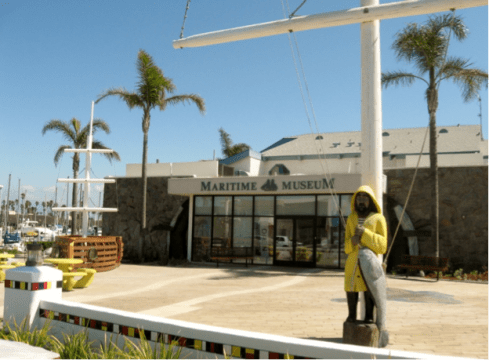
Heading for the Point Loma Peninsula, I checked out the Cabrillo National Monument, which commemorates the landing of Juan Rodriguez Cabrillo in the San Diego Bay on September 28, 1542. After that beautiful drive, I visited the famous San Diego Maritime Museum, Seaport Village, the Seafood Grotto, the Tribute to Bob Hope wartime tours, and the WWII V.J. Day Monument. The tribute to Bob Hope was unique, in that it consisted of a group of bronze figures representing all the U.S. Military Services, gathered around Bob, while he told many of his funniest jokes (via recordings) to anyone who was listening.

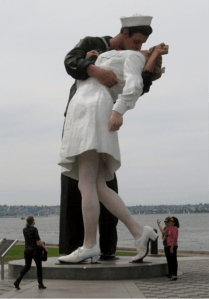
And then, there was the gigantic WW V.J. Day Monument, depicting the famous 1945 Time Square celebration picture of a sailor kissing a dental technician. Many, along with me, had always thought she was a nurse, because of her white uniform, but the base plaque said she was not a nurse, but a dental technician. I finished the day with a wonderful visit with our high school friends Jim and Charlene, while we ate dinner at the Brigantide Seafood Restaurant.
The next morning I headed east to visit the Pacific Southwest Railroad Museums in La Mesa and Campo, Ca. Unfortunately, they were both closed, so I just kept heading east toward Yuma, AZ where I planned to visit the Yuma Territorial Prison. Now there was a place you would never have wanted to be incarcerated, as a criminal, in the late 1800s. Amazingly, even though most inmates were sentenced to do time at the Territorial Prison for violent crimes, some were sent there for things such as polygamy, forgery and violations of the Neutrality Act. While in Yuma, I also visited the U.S. Quartermaster Depot which was used by the U.S. Army to store and distribute supplies for military posts in the territories of Arizona, Nevada, Utah, New Mexico, and Texas from 1864 to 1883.

Next, it was on East for another 240 miles of desert, thru Gila Bend and a lot more desert, to Tucson, AZ where I was looking forward to visiting the Pima Air & Space Museum and AMARG (Better known as the Bone yard). The next day was Friday, and I was up bright and early so I could be first in line for tickets to both the Museum and the Bone Yard, since they only gave Bone Yard tours M-F. What a great time I had there! The Museum itself encompasses four large hangers of beautifully restored aircraft, and 30+ acres of static display aircraft outdoors. The Bone Yard consists of over 300 acres, where literally thousands of discontinued U.S. Military aircraft are stored, reclaimed or restored to flying condition when needed. Luckily, the Museum provides bus tours of both the Museum grounds and the Bone Yard, so people like me can see most all there is to see in about 4-6 hours. It really boggled my mind to see acres and acres of airplanes stored like that, all in one place!

—–To Be Continued—–







 So, I headed west for Inglewood, CA (where I went to college) but ran into heavy traffic before I could get close to my first destination. It was Sunday, and a bicycle marathon (with tens of thousands of bicycles) was being held that day and was traveling down Wilshire Blvd. causing traffic to be backed up for miles on either side of Wilshire. After creeping along for almost an hour, before I found a place where I could get out of that mess, I was tired, frustrated, and decided to call it a “Wasted Day”- giving up on seeing any museums that day and headed back toward the motel.
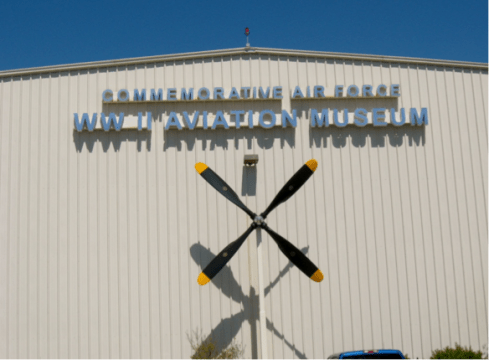
 Airport to visit the Lyon Air Museum. This was a great experience, as all the museum’s aircraft are in flying condition and all their rare vehicles run. I got a special treat when they towed their B-17G, “Fuddy Duddy” out of the hanger and fired up all four engines. There’s nothing I enjoy more than the smell of a large aviation engine starting up. It’s something about the oil and gas mixture that does it for me. And, here I got to experience the smell of “Four” engines starting! What a thrill.



 Navy Seabee Museum. This museum preserves and displays historic material relating to the history of the Naval Construction Force, better known as the Seabees, and the U.S. Navy Civil Engineer Corps. During World War II, approximately 250,000 Seabees passed through the Naval Construction Battalion Center (NCBC) at Port Hueneme, on their way to or from Europe and Pacific Theaters. Among many other tasks they were asked to perform, over the course of the war, the U. S. Naval Combat Demolition Units (NCDU) working closely with the Army Combat Demolition Units (ACDU) were instrumental in removing much of the hazardous materials and obstacles from the beaches in advance of the June 6, 1944 Normandy Invasion.
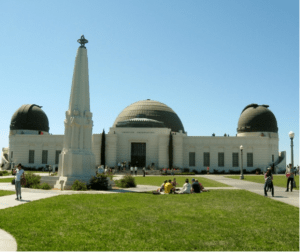 that day. Cars were backed up halfway down the mountain waiting for a chance to find a parking space. I went into the lobby and took a look at the fascinating Foucault Pendulum, which was introduced in 1851 by French physicist León Foucault, as the first simple proof of the rotation of the Earth in an easy-to-see experiment. I walked around the outer domes and got a view of the smoggy L.A. basin and the Hollywood Hills.







 Old Things R New