My beloved child in whom I am well pleased, when I look at you, I see my son, Jesus, who died that you might be made right with me.
You have been well schooled in the myth that unless you are sinless I will not hear your prayers. It is a sad thing when teachers take the words of the Pharisees in the Bible and twist them so that my own beloved children think they can’t communicate with me.
Every day dawns fresh for you my dear. Do not major on shortcomings, but major on the robe of righteousness that I have laid over you. When I look at you I see not what you used to be, but I see Jesus, my beloved Son in whom I am well pleased. Pray to your heart’s content. I hear, and I answer.
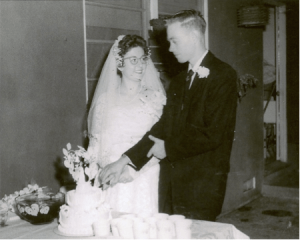
Bill and I were married at the Congregational Church in La Mesa, a small town on the California coast. Friends of Bill’s Mother’s had come through Albuquerque where I lived with my parents, and had invited me to ride back to California where they now lived, so I could visit Bill. He was stationed on the U.S.S Hector at the naval base in San Diego. It seems now that when we decided to get married, so I could stay there with him, all we had to do was say, “We’re getting married,” and everything was done for us that could be done at such short notice.” In case you’re wondering, it wasn’t a “shot-gun” wedding. Even though we’d been engaged for a year, our mothers were shocked when we called them. Since Bill was only nineteen and a parent had to sign for a boy under twenty-one, Bill’s mother sent her permission. I, as a girl of eighteen, did not need signed permission from my parents, but I did need a blood test.
Our dads were unable to be there because they were both on business trips – William Lites, Senior, for the Southern Baptist Convention and Ivan Bowers for the Atomic Energy Commission. They worked hard to support their families and were both gone many hours and days throughout our teenage years.
Our mothers worked for the government at desk jobs in Albuquerque. They worked hard too, but they had more regular hours and were able to come to the wedding. My Mother, Dora Bowers, drove out with my Aunt Jenny, and my cousin, Kathy. Bill’s mother, Agnes, and Bill’s younger sister, Judy, flew out on a TWA Constellation from Albuquerque.
I had planned to wear my pink linen dress from the previous Easter for the wedding. It had only a tiny stain on the skirt, but Joan, the lady I was staying with, insisted on borrowing a wedding dress from her friend. We were married by the Reverend Curtis Claire. He chucked obey from the wedding service because he thought it was too old fashioned.
We had the weekend before Labor Day to get ready for the wedding. Our mothers and hosts booked the church, bought the cake, made the punch, took us grocery shopping, and helped us find a place to live, none of which either of us had ever done before.
We drove Aunt Jenny’s car away from the church. When we left Joan’s house after the reception, however, we had to get into Bill’s chopped and channeled 1932 five-window Ford Coupe and drive the ten miles on the San Diego Freeway to our new home. It was a bedsit in an old house, next to Balboa Park in a suburb of San Diego. We had the tiniest yard you ever saw, with a pomegranate tree in it. We left the white vinyl couch made into a bed because we were at work all day and it wasn’t worth bothering to fold it up every morning and put it down every night.
On Bill’s first day off, we went to the San Diego Zoo. I don’t’ think I’d ever been to a zoo before. It was wonderful and I loved it. I got a job at a diner and rode the bus to work. We had a lot of fun, we both loved the movies and went to one every weekend in downtown San Diego. On quiet nights at home, with no T V, Bill worked on model airplanes and I read library books. On a misty night in January, we packed everything we owned into the second-hand Mercury Bill had traded the hot rod for. We drove over California mountains and across Arizona desert to Albuquerque where I stayed for eight months attending Beauty School while Bill went cruising to Japan swabbing decks all the way.
Sometimes I write down what I think the Holy Spirit is saying to me. It’s as if I were sending God a letter. At other times I sit and wait to hear what He says back. Yesterday I wrote out 1 Thessalonians 5:16-18: “Rejoice always, pray continually, give thanks in all circumstances; for this is God’s will for you in Christ Jesus.” That was, of course, exactly what I needed to hear.
After I had thought about it for twenty-four hours I felt like writing some more. I don’t pretend to have any answers, and I’m sure I make mistakes, but here’s what I wrote: (I write in second person because it makes the message more personal. Perhaps you do this too.)
Beloved, I felt God say, sometimes you recall hard things in your life that you wish had happened differently. You feel sorrow that you had to go through those experiences. You try to reconstruct ways in which outcomes would have been better if circumstances had been different. None of that does any good. Do you know why? It’s because I, The Father, set up those circumstances or, at least allowed them for my purposes.
My dear child, wouldn’t it make you angry to think I had set you up for hurt — that I deliberately ruined at least a part of your life?
More likely you think I wasn’t even there and that you caused everything yourself. It is so easy for you to come up with the wrong perceptions. It’s as if there were a part of your brain that insisted on lying to you. It’s a trickster, a devil, a demon, the flesh, the self, the carnal nature. It makes up stories about your life and then you cling to them. It says seek always, but do not find. It desperately needs intimacy with you in order to feed itself. It is false. Only I am true.
You have always had choices. Sometimes the choices you made were less than productive, but I didn’t leave you alone on dark paths of fear, bitterness, and greed. I went with you. I buffered the cold winds when I knew something would be too much for you. I worked always to bring you to my side
Could the same scary things have happened if you had made right and good choices? Yes and no. Every choice sent you down a different path so that every one of them had a potential for a different outcome.
Remember, dear one, your life in Me is a finely choreographed dance. You need to rehearse with me so that our steps will match. I have plans for good for you and not for evil. Remember, you need me and I need you. I have always loved you and I always will. Nothing you could ever do would change that.
When the movie star, Bette Davis, became elderly, she had a pillow with these words embroidered on it. “Old age is not for sissies.” I admired that platitude and to this day, I try to live by it. Last week we met a woman in a rehab facility who is an example of courage in the face of aging.
In 1919 when World War 1 was ending, Helga was six years old, and it was almost Christmas. The teacher was busy planning a Christmas program so before school one day, Helga took an empty paper sack and smoothed it out so she could create a poem. It is a medium length poem about the birth of Christ. Helga recited every word by heart. She’s also a modern day, on- the-spot poet. Here’s the one she spoke for me.
“There’s a lady in a jacket of pink.
When she used to wash dishes, she stood by the sink.
Her blouse is full of flowers.
I hope the Lord gives you many happy hours.”
After the poem Helga invited us to sing along as she played on a battered harmonica
about twelve inches long with key of G holes on one side and key of C holes on the other. She sat in the seat of her walker and told stories of her childhood. She asked us to say the words from John 3:16 with her, which we did, and to sing, “You are My Sunshine,” while she accompanied us. Here’s a bit of her story:
“In 1913, I was born of German parents in a Hoboken cold-water, walk up flat. By the time Americans entered WW 1 in 1917 I was four years old, and I thought Germans were nice. Mama taught us that Jesus wanted us to love people, and that we should never put ourselves above anyone else. I was amazed when I learned during the war that we could be thrown in jail for speaking The Father Tongue. All along American Germans were persecuted as spies. When word came that the war was over, the streets filled with people. We hugged and sang. Folks in wagons and cars drove past waving or honking their horns. One wagon was pulled by a white horse and had a saloon woman sitting on the seat next to the driver. I knew she was from around the corner where we were never allowed to go. In the back of the wagon someone had stuck a dummy, head first, into a toilet bowl and everyone was saying it was the Kaiser.”
Hoboken, New Jersey
Helga will be 103 in February of 2016. I wanted to ask what she believed had kept her going this long, but I thought I knew the answer. I had once asked another 103 year old woman and her husband, who was 105 what kept them strong. They said it was being a follower of Jesus. I believe it. The joy of the Lord is Helga’s strength, too. That makes Helga no sissie at all.
Wal pardner, now that you have asked, I have a couple of things to say about church music. Loved your blog, by the way, Onisha. Opening a dialogue may help.
The church we are now attending has a contemporary service and a traditional one. The traditional one is at 9:30, which is okay with us. It gives us time to get ready in a leisurely way and gets us out by 11:00. That’s when the contemporary service starts. We get the beautiful sanctuary, they get the big fellowship hall. I’m sorry to report that stained glass windows and real pews are pleasurable to me.
They don’t seem to label the two services, so we first attended the 11:00 o’clock contemporary service. I, who have not yet lost my hearing, had to wear earplugs, not only for the music but for the service as well. Oh, by the way, in case anyone needs to know, I’ve used about all the earplugs on the market and I’ve found the white wax ones work best. I can still hear but it’s not painful. Soon all the children will start to turn deaf and then no one will need earplugs any more. There are only so many decibels the human body can stand without deafness setting in.
But I digress. Our grandchildren’s parents used to invite us to Christmas specials at churches around their town, but they had to stop because even when we didn’t complain they could tell the service was just plain too loud for us. That was one pleasure forfeited, but the grandchildren are all grown up now and out on their own, so I suppose it’s not a huge loss.
I read that one of the churches in town is going to have a “Swing Low,” evening. I’ll bet that would be fun, but I’ve been fooled too often to think the volume will be something I can handle, so I have decided not to ask Bill to take me. That’s okay, as a young performer said in a contemporary service: if you want to hear hymns, listen to them on your iPod. Believe me, I do, I listen to them frequently and I sing along too. iPod, iPhone, and You Tube are my go-to devices. Really, if we didn’t want to, we wouldn’t have to attend church at all. We could just use the T. V. and the Internet and send our tithe to them. A friend told me that their minister of youth made a teaching out of “why we don’t use hymns in the church anymore.” I wouldn’t have minded hearing his thinking on the subject, but I probably would have had to wear my earplugs in order to do it.
Believe it or not, loud sounds distress me in a way I can’t control. One time, I had to walk out of a church because the music gave me such a panicky feeling I felt driven out. It would be all right not to have instruments, as Onisha suggests, but perhaps it’s not so much the instruments that raise the decibels as it is the powerful microphones and speakers.
Any good rant has the phrase, when I was a child: When I was a child and we had plays in school, we were taught to speak loudly enough so we could be heard all the way at the back of the room. I know from personal experience that it’s easier to use mikes, but at least everything didn’t have to shut down if the candles blew out.
The church we’re attending now seems to have some decent long-range plans for making more people on both sides happy. We’ve been going there for a couple of months now and haven’t heard the same music group twice. This church has a long history of highly valuing its music and musicians. Sometimes the young people come in and sing hymns for us, too. They seem to like them fine, even though they’re not particularly easy to sing if you aren’t used to them. Many younger people, learn real music in chorus and band. I’d love to hear the fruit of their labors reflected more in church services – and we are hearing that now, so I’m not complaining about what we currently get.
The church we’re attending has a small, but good band. They have an admittedly senior choir. They had a “younger person” play a gorgeous saxophone piece last week. The pianist is top-notch and well educated in music. She lives for it. During the week she may be seen popping into the library in a lovely dress on her way to a nursing home to play.
One good thing has happened with the hymns here, they’ve been jazzed a bit. Maybe the no-hymns group will like them better that way. I do. You could actually waltz to them now.
The church we were in before was so casual they even valued having me as part of the praise team because I could sing loudly and usually carry a tune. We had a keyboard, acoustic rhythm instruments (yes, tambourines – gasp!) and six or seven singers. We had one hymn a week. Other than that we sang the older choruses that had melodies and the songs that the minister of music wrote herself. We had no hypnotizing droning. Everyone could hear the music very well, but it wasn’t so loud that anyone would be deafened by it.
I dearly love the younger church set. I love their enthusiasm for church and what they are doing for the children in giving them pertinent and exciting activities. Such grace, such variety, such hard work. Sorry if you feel that we older people are a burden because we won’t or can’t change. We’ll be gone before you know it. You’ll miss us, though. Is it possible that even God cannot deal with this problem? Now why would that be? I thought he could do anything.
Here’s an old one made new. I like it, how about you?
I was having fun with my cousins from Georgia over the weekend and didn’t have a chance to collaborate with DiVoran on her regular Monday post. So I thought it would be fun to share with you what else she has been up to. As well as blogging and poetry, DiVoran is also an author of Christian fiction. She has been writing a serial western romacne novel and a new chapter is posted each week on Rebekah Lyn Books. PLUS she creates orginal art work for each chapter! If you like this excerpt be sure to read the other chapters~Onisha
Go West
By DiVoran Lites
Chapter One
Ellie
Elizabeth Morgan, riding backward, looked out the train window at a sign that said, Clifton. It was here she hoped to find a plan and purpose for her life. As she stood, she studied the Victorian-style train station with several men milling on the boardwalk. They wore ragged clothes, battered hats, and down-at-the-heel boots. For a moment, she tried to imagine them dressed in well-fitting woolen suits with homburgs or fedoras on their heads. Then shaking her head, she gave it up. All the imagining in the world would not make this burg into downtown Chicago, and that was fine with her. She needed a new life, maybe she’d find it here.
Smoothing kiss curls over each cheek, she straightened her narrow-brimmed cloche. As she reached toward the shelf for her tapestry carpet bag, an arm went over her head and carefully lifted it down. She looked up at a tall man with silver-blond hair and gray eyes that were the kind that turned blue on a sunny day. He now held the carpetbag in one hand and a deep brown Boss of the Prairie Stetson in the other. She didn’t know yet who he was, but she knew from working in her grandparents’ department store back home, that he had good taste in hats. His frayed khaki shirt, however, looked as if it were part of a uniform from the Great War.
I have almost always washed dishes, sometimes I had help, sometimes not. When I was a child, Mother called on me when the restaurant got too busy for her, Dad, and a waitress, if we had one, to handle. My brother washed dishes with me. Usually I washed and he dried. To amuse ourselves we bickered or stacked the dishes in the drainer as high as possible stopping just before they began to topple. We called it making castles. Our parents paid us 25¢ an hour. One day I was at my friend, Patricia Franklin’s house for supper. I loved the Franklins, a big catholic family with five boys and one girl. The girl, Patricia, was my best friend, and I had a crush on one of her brothers. He didn’t have a crush on me.
Usually, Patricia and I washed the dishes after supper when I was there. The Franklins obviously had other arrangements when I wasn’t. On this summer evening, when I went into the kitchen to start on the dishes, I figured somebody would follow. To my surprise, no one came. I washed all the dishes by myself and left them to dry piled majestically into a fine castle. I got a lot out of the experience. For one thing I was pleased that my skills were such that someone besides my own family needed me. For another, being so responsible make me feel like a grown-up. The third thing was that I felt I was expressing my regard for the family and they would all pleased with me. I don’t know whether that ever happened, because I’m not sure they knew they had a martyr in their midst. Of course, their being Catholic, I wouldn’t be even a minor martyr compared to the ones the had read about. But I felt good about myself, anyhow.
A restaurant customer once said I was the chief cook and bottle-washer. I couldn’t claim the first part-but the second part was true. I have been washing dishes for 70 years. Every country on this globe has people who can make the same claim (if they have dishes, and more to the point, if they have food).
Now there’s only Bill and me. Together we keep the kitchen moderately clean. I’m glad I have things like that to do. I heard a story once from a friend who visited a rehab center. She gave a talk and after refreshments, one of the elderly women took her plastic cup over to a sink where she slowly and lovingly washed and dried it. You see, she had no home to care for anymore. I’m glad I have jobs to do even now. I thank God for dishes and for everything that goes with them. Also I thank him for my electric dishwasher, even though one of us has to wash them by hand before we put them in or they won’t come out clean.
If you’ve ever had anything stolen, you have probably experienced the emotions and imaginations that plague victims everywhere. I always kept my engagement and wedding ring (which had been fused together by a jeweler fifty-seven years ago) on the top of my dresser on a solid glass ring holder along with a dinner ring left to me by Bill’s mother. The rings had a history together. Bill’s aunt gave him the diamonds for my rings when he wanted to get engaged. Later Bill’s mother wanted new rings and asked if I’d mind if she had hers made like mine, only in yellow gold. I didn’t mind. We didn’t even live in the same town any more. After Bill’s dad died, his mother again changed rings, only this time, she took the diamonds from her engagement and wedding rings and had them made into a beautiful dinner ring. When she went home to Heaven she left them to me. I’d been wearing both for many years, but only wore them when I went out so that they didn’t get in my way when I cooked, typed, or washed my hands.
One day, I was rushing to go somewhere on time and because the rings were always the last thing I put on, I reached for them. They weren’t there, but Bill’s wedding ring, which I sometimes wear was. I thought I recalled hearing something fall down behind the dresser, so I knew they were safe. I put Bill’s ring on and left. I figured I would find them later. Better yet, I would wait until somebody big, strong, and younger than us came over and could move the dresser. Bill has shoulder issues and my chiropractor doesn’t want me scooting heavy things.
That day I was having lunch with my daughter, but I decided not to tell her about the rings because I’d soon have them in hand and there was no need to worry her. It took several days before I even told Bill. The next morning while I was out for my walk he moved the dresser to look for them. They weren’t there. I moved the dresser myself to look for them, which was not too smart.
I then started looking in earnest. I looked all through the house, went through the dresser drawers. They needed to be organized, anyway. I looked through my few purses, checked every pocket of every garment I own, and thoroughly searched the car. No rings anywhere.
Sometimes when we go to a doctor and we’re not sure the doctor knows what he’s talking about, we decide to get a second opinion. It’s the same with making a personal decision. We can study and work at making the right one, but we may not be able to come to a solution without asking for advice from a friend. That’s all right, there is safety in consulting together. But there is another way.
A general of the Israelite army, Joshua once said,
“As for me and my household, we will serve the Lord.”
It turned out that Joshua did serve the Lord in every possible way. Title of picture that comes with this one is Jericho. It’s the walls of Jericho and the trumpet players.
One day, Joshua knew that his army was supposed to occupy the walled town of Jericho, but he wasn’t quite ready to make his move. Suddenly, he looked up and saw a big man standing in front of him with a gleaming sword in his hand. Joshua asked, “Are you on our side, or on the side of our enemies?”
“Neither, “ said the man. I am here as Prince of the Lord’s host. Take off your shoes for you are on holy ground.” Joshua took off his shoes and stood ready to listen to anything the Lord had to say.
In his commentary, Matthew Henry says this big man was the same one who came with three others to Sarah and Abraham to tell them they were going to have a baby in their ninetieth decade of life. It was actually Jesus who visited them and now he had come to see Joshua.
Jesus told Joshua that God had secured Jericho for the Israelites and he told him exactly how the army was to claim their victory. There was no need for Joshua to strategize or plan, no need for him to consult his officers. The Lord was in charge.
You may already know what happened at Jericho, but if you don’t, you can read all about God’s surprising action in the Holy Bible in Joshua Chapter 6.
Now, think about it. Could Joshua or any of his men have come up with the plan they saw worked out by the Lord? Never in a million years. And what if they had been able to imagine it? Do you think they would have had success carrying it out? Not at all. If you don’t know the story, please read it in your Bible in The Book of Joshua Chapter 6.
No one but God knew and no one but God had the power to carry out the plan. The answer he gave transcended anything a human could have thought up or accomplished. What an adventure for the humans involved!
Dear one, do you know that you and I can experience miracles every day. They may not be what we expect. Maybe they aren’t even what we think of as miracles, but if we are open to God working in our lives, we can experience surprise, synchronicity, and serendipity every day. All we have to do is forget plotting and planning, and forget asking advice from our friends. The more we practice hearing from God and following His leading, the more exciting our lives will be. Let’s do it, let’s ask for that third opinion.
(C) Copyright 2012-2024 Old Things R New All rights reserved. This website is an Amazon affiliate and the income from sales helps to defray the cost of running the site.






 If you’ve ever had anything stolen, you have probably experienced the emotions and imaginations that plague victims everywhere. I always kept my engagement and wedding ring (which had been fused together by a jeweler fifty-seven years ago) on the top of my dresser on a solid glass ring holder along with a dinner ring left to me by Bill’s mother. The rings had a history together. Bill’s aunt gave him the diamonds for my rings when he wanted to get engaged. Later Bill’s mother wanted new rings and asked if I’d mind if she had hers made like mine, only in yellow gold. I didn’t mind. We didn’t even live in the same town any more. After Bill’s dad died, his mother again changed rings, only this time, she took the diamonds from her engagement and wedding rings and had them made into a beautiful dinner ring. When she went home to Heaven she left them to me. I’d been wearing both for many years, but only wore them when I went out so that they didn’t get in my way when I cooked, typed, or washed my hands.