Tag Archives: Viking River Cruise

The Cruise of a Lifetime-Part 13

7 Sep

SUNDAY MEMORIES

Judy Wills

Since we had to change ships today, Fred and I were up at 5:30 a.m. to shower and dress and finished packing.  At 7:00 a.m. we had breakfast with Richard, Judy and Lucy.  At 7:45 we completed our packing and put our bags out in the hallway as instructed. 

At 8:15 a.m. we reported to our assigned bus to leave the ship and go to Bratislava, Slovakia.

According to the ship’s info on Bratislava:   The emergence of Slovak national consciousness dates to about the 1700s.  The written language appeared before the 18th century, and near the end of that century a national movement began to encourage a Slovak identity and the development of Slovak Romanticism with a focus on popular folk traditions.  At the end of World War 1,Slovak identity was fully formed, and in 1919 Slovakia joined with Czechia to form a union of two western Slavic nations: Czecho-Slovakia.  But its independence was greatly limited by its strong economic, military and political dependence on Germany.

It was then conquered by the Soviets, who wanted to create a pro-Soviet and Communist Czechoslovakia.  This lasted until the fall of Communism during the Velvet Revolution of 1989.  In 1993, the Slovaks and the Czechs agreed to separate peacefully in what is called the Velvet Divorce.  The Czech Republic became a democratic state.  Slovakia became an independent nation. 

We arrived at the Bratislava Castle by 10:00.

It was quite windy day but not too cold.  While we didn’t go inside the castle, the outside was interesting. Because I knew the history of SPQR, I found this interesting. 

According to Google and Ancient Rome for Kids:

The letters SPQR stood for Senatus Populus Que Romanusa – the Senate and the People of Rome.  After defeating Tarquin, the last Roman king, the people started a new type of government, a republic.  A republic is a type of government whereby people elect officials to represent them in government.

As a publicity campaign, and as propaganda, the new senate had the letters SPQR chiseled, branded or stamped on everything that they controlled.  Public buildings, new coins, and even park benches got the letters SPQR added to them.

The people of Rome were proud of their new government, and were reminded every time that they saw SPQR that they were a part of the Roman Republic, and no longer ruled by a king.

At 10:30 we left for Old Town with a walking tour.  We saw many fascinating sights.  Here are some:

This little guy is called Cumil (pronounced as Chumil).   As the story goes, Cumil was a mischievous person who while working, used to emerge from under the manhole to look beneath the ladies’ skirts! (Tripadvisor)

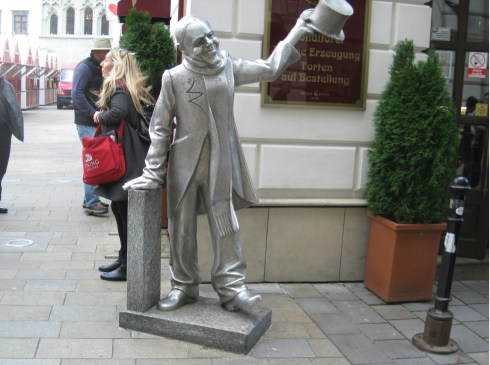
Statue of Bratislava Cavalier Schoner Naci

Napolean – one of the few places to sit
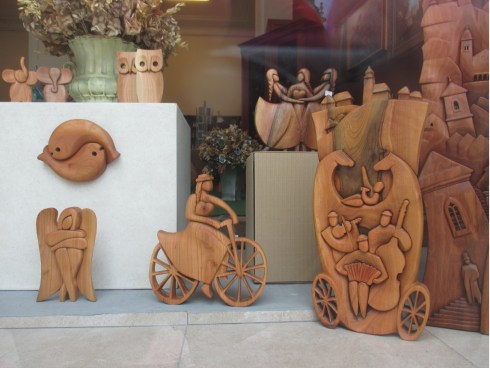
We were given two hours of free time, to look around Bratislava on our own,  which is really too long.  We found no place to sit – no public benches. We finally went into a bakery and had a hot chocolate and a chestnut pastry.  We met and shared a table with Iris and April, sisters from Calgary, Canada (Richard called them “the sisters”), who were also on our cruise.  We complained to Carl West (who is from Bratislava, as is Billie, our concierge), that there were no public benches where we could sit and rest our feet.  He just laughed.  We think it is the city’s plan so visitors have to go into a shop to eat or drink in order to sit and rest.

At 1:00 p.m. we had lunch in the Austrian Trend hotel – it was a very good meal and the entire upper level was set up as a restaurant for our entire ship’s compliment. 

At 2:30 p.m. we were back on the bus for our trip Budapest, Hungary.  All the buses stopped for a restroom break at 3:45. The bus trip to Budapest normally takes only three hours, but took us four hours instead.  We were finally on board the Lif at 6:15 p.m.

At 7:00 p.m. we had dinner with Richard, Judy and Lucy.  Richard told us their tour guide, while going through Transylvania, told a story about “wampires… and the bus erupted with laughter. 

We were in bed by 10:00 p.m.  It had been a long day.
Judy is living in Central Florida with her retired U.S. Air Force husband of 50+ years. Born in Dallas, Texas, she grew up in the Southwestern United States.She met her husband at their church, where he was attending the university in her town. After college and seminary, he entered the Air Force, and their adventures began.They lived in eight of our United States, and spent six years in Europe, where their oldest daughter was born. She was a stay-at-home mom for many years .

  Judy has always been involved with music, both playing the piano and singing. Always interested in exercise, she was an aerobic dancing instructor, as well as a piano teacher for many years, and continues to faithfully exercise at home.

After moving to Central Florida, she served as a church secretary for nearly nine years.Her main hobby at this point in time is scanning pictures and 35mm slides into the computer. She also enjoys scrapbooking.She and her husband have two married daughters and four grandchildren, including grandtwins as well as a great-grandson and a great-granddaughter. She and her husband enjoy the Disney parks as often as possible.

The Cruise of a Lifetime-Part 12

24 Aug

SUNDAY MEMORIES

Judy Wills

Reblog

After breakfast, we began a partial bus-and-walking tour of Vienna, Austria.  There’s just so much to see.  It seems strange to have an ultra-new building with the old buildings, but they seem to fit together rather well.  For the entire six years we lived in Germany, I hounded Fred about taking me/us to Vienna.  Never happened!  So this trip finally put us in that beautiful city.

I’m not a terribly good historian, but I have heard of the Hapsburg Dynasty.  Austria was the home for that dynasty.  The ship’s info sheet stated:  The rise and fall of the House of Hapsburg began along the Danube’s banks in 1276.  With Austria firmly in their grasp, the family gained new territories by marriage until their serial nuptials put most of Europe under their power.  As their wealth and territory grew, few royal families remained to help them acquire more kingdoms.  Their solution to this problem may have also been their undoing.  While the dynasty actually had its beginning in 1020, it wasn’t until 1273 when it moved to Austria.

The info sheet also said:  The Hapsburgs sought to retain their massive power through intermarriage between cousins or uncle and niece.  “The best spouse for a Hapsburg is another Hapsburg,” went the proverb.  The last of the Spanish line, Charles 2, was disabled from birth, perhaps from a genetic disorder typical in children born from siblings, and died.  It’s likely that the Austrian Hapsburg line ended for the same reasons.

While there are still living relatives of the Hapsburgs, for all intents and purposes, the dynasty died out in 1918, at the close of World War 1.

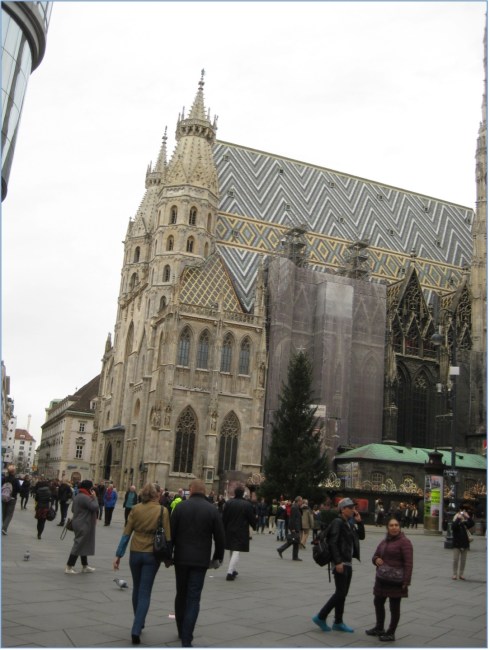
We walked through Saint Stephen’s Cathedral, which has a really dark interior.  I was unable to get any good pictures there.

But the outside is remarkable.  There is even a bronze model of the cathedral outside, that is to scale. 

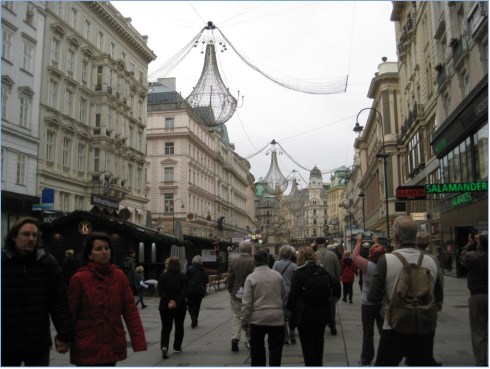
We then walked through some of their Christmas Market.  It was still rather early in the season for the Christmas Market to be up and running, but there were a few booths set up already, and we enjoyed seeing them.

At 12:45 we met under the clock on the square and headed back to the bus and into the ship for lunch, which we had with Richard, Judy and Lucy.

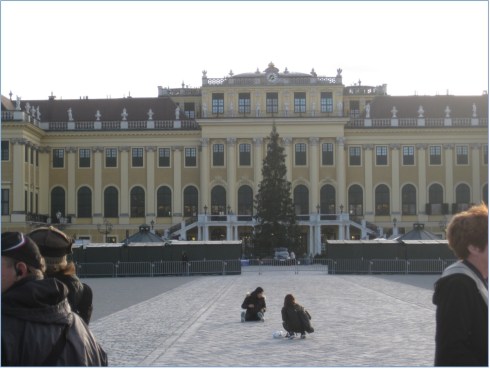
At 2:00 p.m. we took a tour of the Schönbrunn Palace.  It’s very opulent, but beautiful.  

On our way into the Palace, there was a man on the sidewalk, covered in gold.  He was standing on a box, and was singing some Mozart – advertising a concert.  I just thought it was cute.  I gave him a short curtsy, and he replied with a small bow.

We had an early dinner (6:00 p.m.) with Richard, Judy and Lucy.  At 7:00 p.m. some of the group left for a Mozart and Strauss Concert, that was free to all who wanted to attend, since we had to change ships again.  Fred and I decided to stay onboard and pack.  Then we read some, and then were in bed and asleep by 9:30 p.m.

~~~~~~~~~~To Be Continued~~~~~~~~~~

Judy is living in Central Florida with her retired U.S. Air Force husband of 50+ years. Born in Dallas, Texas, she grew up in the Southwestern United States.She met her husband at their church, where he was attending the university in her town. After college and seminary, he entered the Air Force, and their adventures began.They lived in eight of our United States, and spent six years in Europe, where their oldest daughter was born. She was a stay-at-home mom for many years .

  Judy has always been involved with music, both playing the piano and singing. Always interested in exercise, she was an aerobic dancing instructor, as well as a piano teacher for many years, and continues to faithfully exercise at home.

After moving to Central Florida, she served as a church secretary for nearly nine years.Her main hobby at this point in time is scanning pictures and 35mm slides into the computer. She also enjoys scrapbooking.She and her husband have two married daughters and four grandchildren, including grandtwins as well as a great-grandson and a great-granddaughter. She and her husband enjoy the Disney parks as often as possible.

The Cruise of a Lifetime-Part 11

17 Aug

SUNDAY MEMORIES

Judy Wills

Reblog

November 16th, Monday.  We were up at 6:00 a.m. to shower and dress.  We had breakfast at 7:15 a.m., with Richard, Judy and Lucy joining us (they don’t get up as early as we do).  By 8:00 a.m. we arrived at Emmersdorf, Austria.

At 9:30 a.m. we took a bus to the 900-year-old Melk Abbey.  It is situated on an outcrop rising above the Danube, crowned by twin towers.

Here is a model of the Abbey 
As you can see…we are fascinated by pipe organs 
They were not without music 

While the abbey was founded in 1089, and given to the Benedictine monks, the current abbey was renovated between 1702 and 1736.  It was originally a royal palace with ceremonial courts, guest apartments, grand halls and a library – which contains around 80,000 medieval manuscripts.

Courtesy Wikipedia 

The abbey has a blue room,

 a green room,

a marble room, and the mirrored room.

Many of the floors have beautiful wood-inlay.

This beautiful stairway is the beginning of the grounds.  However, since I still couldn’t maneuver stairs very well, we walked down (and later up) the ramp.

By 12:10 p.m. we were back on board the ship, and had lunch in the Lounge with Janice and John from Ontario.  We were also joined by the couple from Los Angles (originally Denmark) but we still did not get their names.

At 2:00 p.m. we sailed through the Wachau Valley.

The countryside is stunningly beautiful.  Both banks are dotted with ruined castles and medieval towns and are lined with terraced vineyards.   The Wachau is described as “an outstanding example of a riverine landscape.”  Noted for its cultural importance as well as its physical beauty, it is described:  “The architecture, the human settlements, and the agricultural use of the land in the Wachau vividly illustrate a basically medieval landscape which has evolved organically and harmoniously over time.”

At 4:00 p.m. we docked in Krems.

Fred and I decided to stay on board the ship because it would be getting dark soon and it was cool and windy.  Before dinner Fred and I watched the Monuments Men movie in our stateroom.  Really good movie, and gave us some insight into the Nazi greed and stupidity.

At 6:45 p.m. we went to the preview of tomorrow’s Vienna excursions.  Carl West told us we have to change ships again.  Following much groaning from the passengers – during which he remained silent – he said, “thank you.”

At 7:15 p.m. we had a traditional Austrian dinner.  We had our first schnitzle with potatoes, a small piece of chicken, wurst, and dessert.   Richard, Judy and Lucy ate with us. 

We sailed to Vienna overnight.

~~~~~~~~~~To Be Continued~~~~~~~~~~

Judy is living in Central Florida with her retired U.S. Air Force husband of 50+ years. Born in Dallas, Texas, she grew up in the Southwestern United States.She met her husband at their church, where he was attending the university in her town. After college and seminary, he entered the Air Force, and their adventures began.They lived in eight of our United States, and spent six years in Europe, where their oldest daughter was born. She was a stay-at-home mom for many years .

  Judy has always been involved with music, both playing the piano and singing. Always interested in exercise, she was an aerobic dancing instructor, as well as a piano teacher for many years, and continues to faithfully exercise at home.

After moving to Central Florida, she served as a church secretary for nearly nine years.Her main hobby at this point in time is scanning pictures and 35mm slides into the computer. She also enjoys scrapbooking.She and her husband have two married daughters and four grandchildren, including grandtwins as well as a great-grandson and a great-granddaughter. She and her husband enjoy the Disney parks as often as possible.

The Cruise of a Lifetime-Part 10

10 Aug

SUNDAY MEMORIES

Judy Wills

Reblog

This is the day we would be transferring from the Gefjon to the Skadi. 

Therefore, we were up at 5:30 a.m., dressed and finished packing.  We had breakfast at 6:45 a.m. with Richard, Judy and Lucy, and Danny who is retired military.  Richard liked to tease Danny, so we had a lively breakfast conversation.

We had to have our bags outside our door by 8:30 a.m.  We were also to have our room keys turned in by 8:30 a.m.  We boarded bus number 3 and left at 9:00 a.m. along with three other buses bound for Passau.  We rode the bus for one-and-a-half hours to Passau.

We moved from the Gefjon to the Skadi.  It was essentially the same ship, just a bit older.  We even had the same room number, 325.  We unpacked our tote bags (they would bring our suitcases later), then at 11:30 a.m. we went on a one-and-a-half-hour walking tour of Passau.

Passau (pass-ow) is known as the “City of Three Rivers.”  It lies at the confluence of the Inn, the Danube and the Ilz rivers.  It was originally a settlement of the Boil Celtic tribe, and later the site of the Roman fort, Castra Batava.  Passau was an important medieval center for the salt trade, the “white gold.”  It was transported from the Alpine salt mines to Passau, where it was processed by entrepreneurs called Salzfertiger.  The salt imports to Passau were forbidden in 1707, and that trade was lost.

During the Renaissance, Passau became famous for making high-quality knife and sword blades.  Local smiths stamped their blades with the Passau wolf, and superstitious warriors believed that the wolf granted them invulnerability.

When fires ravaged the city in the 17th century, it was rebuilt to reflect the baroque character that survives today.  Today, Passau is home to 50,000 people.

We were back on board the Skadi by 1:30 p.m. and had lunch in the lounge with Richard, Judy and Lucy.  By the time we had finished lunch, our suitcases were in our room, so we unpacked them.  We hoped this would be the only transfer we would have on this cruise.  One nice thing about a cruise – you usually get to stay in the same room for the duration, which makes it quite nice.  This was just a small disruption.

After we had unpacked, we went back into town.  We saw St. Michael’s cathedral first, 

and then Saint Stephen’s. 

It is one of the town’s foremost baroque landmarks and boasts the largest pipe organ outside the United States.  Beautiful.  It has 17,974 organ pipes, 233 stops and four carillons.  All five parts of the organ can be played from the main keyboard, one at a time, or all together. 

The Skadi sailed at 5:00 p.m.  At 7:00 p.m. we had dinner with John and Denise from California, and a couple from Los Angeles who were originally from Denmark (never got their names).  He was a German teacher in a high school in Los Angeles.

More interesting sights in Passau:

Remember, we were told that the incomplete “8” equals a “4” – therefore, the date shown is 1499. 
A plaque on the wall in the Glass Museum 

~~~~~~~~~~To Be Continued~~~~~~~~~~

Judy is living in Central Florida with her retired U.S. Air Force husband of 50+ years. Born in Dallas, Texas, she grew up in the Southwestern United States.She met her husband at their church, where he was attending the university in her town. After college and seminary, he entered the Air Force, and their adventures began.They lived in eight of our United States, and spent six years in Europe, where their oldest daughter was born. She was a stay-at-home mom for many years .

  Judy has always been involved with music, both playing the piano and singing. Always interested in exercise, she was an aerobic dancing instructor, as well as a piano teacher for many years, and continues to faithfully exercise at home.

After moving to Central Florida, she served as a church secretary for nearly nine years.Her main hobby at this point in time is scanning pictures and 35mm slides into the computer. She also enjoys scrapbooking.She and her husband have two married daughters and four grandchildren, including grandtwins as well as a great-grandson and a great-granddaughter. She and her husband enjoy the Disney parks as often as possible.

The Cruise of Lifetime-Part 8

20 Jul

SUNDAY MEMORIES

Judy Wills

Reblog

Friday, November 13, 2015

We were up early and were at breakfast by 7:15.  We were to have a very busy day this day.

We arrived at Nuremberg at 9:00 a.m. and we began the World War 2 tour.  We visited Zeppelin Field, the Congress Hall, Documentation House, and the Memorium Nuremberg Trials.

The Zeppelin Field was where many of the Nazi rallies was held.  It was not as large as we had expected.  The buildings had been reduced to just a few, and the center building had sported the Swastika that was blasted off after the war (famous picture of that event).

Every few yards along the perimeter, there was a building.  When the guide asked if we knew what they were, many in the group suggest one thing or another.  He said, “it’s really very simple.”  When I said, “restrooms,” he said, “that’s right.”  With the 250,000 people assembled, they had to have facilities for them.  (These two pictures were taken by me and cropped)

We visited the Documentation House, which is attached to the Congress Hall.

The Congress Hall was built at Hitler’s demand, and was to be used only for one time each year.  When Hitler was asked how all these buildings would be paid for, he replied that, after they won the war, they would get the money from those Germany conquered.  The Congress Hall was built in the shape that was to duplicate the Roman Coliseum.  The Documentation House held many photos and memorabilia from the Nazi era.

We sat in the courtroom where the Nuremberg Trials were held in the Palace of Justice.  Fascinating room, with large placards holding pictures and notes about the trials. 

Lots of information was given – through the placards as well as our knowledgeable guide.  He mentioned Robert H. Jackson, who President Truman appointed as U.S. Chief of Counsel for the prosecution of Nazi war criminals.  He made some outstanding statements (courtesy Wikipedia):  

Closing Argument for Conviction of Nazi War Criminals

Robert H. Jackson, U.S. chief of counsel for the prosecution of Nazi war criminals

An advocate can be confronted with few more formidable tasks than to select his closing arguments where there is great disparity between his appropriate time and his available material.  In eight months – a short time as state trials go – we have introduced evidence which embraces as vast and varied a panorama of events as has ever been compressed within the framework of a litigation.  It is impossible in summation to do more than outline with bold strokes the vitals of this trial’s made and melancholy record, which will live as the historical text of the Twentieth Century’s shame and depravity.

Nuremberg Prosecutor (1945-1946) Speeches

One of the most famous statements he made was:

            “The true applicant before the bar of this court is civilization.”

Strategies of the American Chief Prosecutor Robert H. Jackson

It all had a profound impact upon us.

~~~~~~~~~To Be Continued~~~~~~~~~~

Judy is living in Central Florida with her retired U.S. Air Force husband of 50+ years. Born in Dallas, Texas, she grew up in the Southwestern United States.She met her husband at their church, where he was attending the university in her town. After college and seminary, he entered the Air Force, and their adventures began.They lived in eight of our United States, and spent six years in Europe, where their oldest daughter was born. She was a stay-at-home mom for many years .

  Judy has always been involved with music, both playing the piano and singing. Always interested in exercise, she was an aerobic dancing instructor, as well as a piano teacher for many years, and continues to faithfully exercise at home.

After moving to Central Florida, she served as a church secretary for nearly nine years.Her main hobby at this point in time is scanning pictures and 35mm slides into the computer. She also enjoys scrapbooking.She and her husband have two married daughters and four grandchildren, including grandtwins as well as a great-grandson and a great-granddaughter. She and her husband enjoy the Disney parks as often as possible.

The Cruise of a Lifetime-Part 7

13 Jul

SUNDAY MEMORIES

Judy Wills

Thursday, November 12.

Reblog

Since we hadn’t reached Bamberg yet – scheduled to arrive about 1:00 p.m. – and it was another sailing morning, we slept in, getting to breakfast at 8:00 a.m.  Before we finished, Richard, Judy, and Lucy arrived.  They got their breakfast, and we visited until 9:30.a.m.  We went through several locks, which was fun to experience. 

Carl West, Program Director for the Gefjon, gave detailed information about the tours in Vienna, Budapest and other cities, which Fred attended, followed by lunch in the lounge.

At 1:30 we left the ship on a bus transfer to the city of Bamberg.

We went on a walking tour of Bamberg, seeing many beautiful and unusual types of architecture and statuary.

We saw beautiful churches and buildings, including St. Michael’s Abbey for the training of the clergy.

We even saw a “Green Goose” pub!

It always seemed funny to us to see English words in a German town.  We even found a Kätie Wohlfahrt Christmas store in town!  We walked through a garden, with a few flowers still in bloom.

According to the info sheet from the ship: “One of the few cities in Germany not destroyed by World War 2 bombing, Bamberg is the largest Old Town to retain its medieval structures…Along with its Gothic, baroque and Romanesque architecture, the city was laid out according to medieval planning rules as a cross with churches at the four cardinal points.”

Ever since we lived in Germany, I have been fascinated with the hotel/store/restaurant signs.  Back in the days when the “common” folk were more or less illiterate, the signs were posted so everyone would know just what the establishment was.  If it was a bakery, there was a pretzel within the sign.

The butcher could have an animal within the sign.  The drug store or apothecary usually had a mortar and pestle within the sign.

You get the picture.  But the signs were usually quite ornate and beautiful.  I looked for them above each store and took as many pictures of them as I could.

While in Bamburg, we stopped in a Karstadt department store (comparable to our Dillards, and one of our favorite places to shop when we lived in Germany) to purchase some socks.  I walked up to a saleslady and said, “Entschuldigen (excuse me).”  She smiled at me, and then I said, “Ich habe nur ein bischen Deutch. (I have only a little German)  Haben sie….?” and pulled up my pant leg to show her my knee socks.  She immediately took me to where the women’s socks were.  I thanked her profusely.  They were lovely, soft socks, and I enjoyed wearing them.

Here is a picture of a plaque with a date.

Our guide asked if we understood the date.  It looks to be 1867 – but we are told that’s not correct.  The “8″ is not complete – and therefore is actually a “4″ or half of the “8.”  So the correct date would be 1467.  Interesting. 

We were all to meet at Neptune’s statue, to get back on the bus for the return trip to the Gefjon. While waiting to get to the bus, I was “baptized” by bird droppings while sitting under a tree.

We had dinner in the ship’s restaurant again, and to bed by 10:00 p.m. 

~~~~~~~~~~To Be Continued~~~~~~~~~

Judy is living in Central Florida with her retired U.S. Air Force husband of 50+ years. Born in Dallas, Texas, she grew up in the Southwestern United States.She met her husband at their church, where he was attending the university in her town. After college and seminary, he entered the Air Force, and their adventures began.They lived in eight of our United States, and spent six years in Europe, where their oldest daughter was born. She was a stay-at-home mom for many years .

  Judy has always been involved with music, both playing the piano and singing. Always interested in exercise, she was an aerobic dancing instructor, as well as a piano teacher for many years, and continues to faithfully exercise at home.

After moving to Central Florida, she served as a church secretary for nearly nine years.Her main hobby at this point in time is scanning pictures and 35mm slides into the computer. She also enjoys scrapbooking.She and her husband have two married daughters and four grandchildren, including grandtwins as well as a great-grandson and a great-granddaughter. She and her husband enjoy the Disney parks as often as possible.

The Cruise of a Lifetime-Part 6 Continued

6 Jul

SUNDAY MEMORIES

Judy Wills

Reblog

After we found “the door,”

we walked some more of the town and found a Jewish area that included a garden and some tombstones.  We took pictures of some of them.  We had never found this area before in all the times we had visited there.

When we lived in Germany, we were occasionally stopped by Germans on the street and asked for directions – in German!  Apparently we looked the part!  Made us feel pretty good, not to be ugly Americans.  All that to say that, as we walked out on the “Pinocchio” part of Rothenburg, I heard “Entschuldigen…Entschuldigen!”  (Excuse me…excuse me!).  A German couple wanted directions to a café. They seemed a bit  put-off when I said –  in German – that I only knew it a little German.  After they moved on I turned to Fred and said, “we’ve still got it!”  Yea! 

Rothenberg is part of the “Romantic Road” through southern Germany…”linking a number of picturesque towns and castles. In medieval times it was a trade route that connected the center of Germany with the south. Today this region is thought by many international travelers to possess “quintessentially German” scenery and culture, in towns and cities such as NördlingenDinkelsbühl  and in castles such as Burg Harburg and the famous Neuschwanstein. (courtesy Wikipedia)

Again from Wikipedia:  In March 1945 in World War II, German soldiers were stationed in Rothenburg to defend it. On March 31, bombs were dropped over Rothenburg by 16 planes, killing 37 people and destroying 306 houses, 6 public buildings, 9 watchtowers, and over 2,000 feet of the wall. The U.S Assistant Secretary of War John McCloy knew about the historic importance and beauty of Rothenburg, so he ordered US Army General Jacob L. Devers not to use artillery in taking Rothenburg.  Battalion commander Frank Burke ordered six soldiers of the 12th Infantry Regiment4th Division to march into Rothenburg on a three-hour mission and negotiate the surrender of the town. When stopped by a German soldier, Private Lichey who spoke fluent German and served as the group’s translator, held up a white flag and explained, “We are representatives of our division commander. We bring you his offer to spare the city of Rothenburg from shelling and bombing if you agree not to defend it. We have been given three hours to get this message to you. If we haven’t returned to our lines by 1800 hours, the town will be bombed and shelled to the ground.”  The local military commander gave up the town, ignoring the order of Adolf Hitler for all towns to fight to the end and thereby saving it from total destruction by artillery. American troops occupied the town on April 17, 1945.  After the war, the residents of the city quickly repaired the bombing damage.  Donations for the rebuilding were received from all over the world. 

We walked back to the bus and drove back to Würtzburg.

As it had been a rather long day, I decided to go back with the bus to the ship, while Fred toured the Würtzburg Residence.  Fred said later that, while it was most interesting, there were a lot of stairs, and I would have been uncomfortable. So, again, it’s a good thing I did not go on that excursion.

Dinner with the Richard, Judy and Lucy again.  10 o’clock to bed.

~~~~~~~~~~To Be Continued~~~~~~~~~~

Here are some interesting shots of Rothenburg:

Judy is living in Central Florida with her retired U.S. Air Force husband of 50+ years. Born in Dallas, Texas, she grew up in the Southwestern United States.She met her husband at their church, where he was attending the university in her town. After college and seminary, he entered the Air Force, and their adventures began.They lived in eight of our United States, and spent six years in Europe, where their oldest daughter was born. She was a stay-at-home mom for many years .

  Judy has always been involved with music, both playing the piano and singing. Always interested in exercise, she was an aerobic dancing instructor, as well as a piano teacher for many years, and continues to faithfully exercise at home.

After moving to Central Florida, she served as a church secretary for nearly nine years.Her main hobby at this point in time is scanning pictures and 35mm slides into the computer. She also enjoys scrapbooking.She and her husband have two married daughters and four grandchildren, including grandtwins as well as a great-grandson and a great-granddaughter. She and her husband enjoy the Disney parks as often as possible.

The Cruise of a Lifetime-Part 6

29 Jun

SUNDAY MEMORIES

Judy Wills

Reblog

Wednesday, we arrived in Wűrzburg, Germany.

We were up early, showered and dressed.  At 7:30 a.m. we went to breakfast in the restaurant.  Richard, Judy, and Lucy joined us just about the time we had finished our meal.  We stayed and talked with them for a while. Judy and I compared piano stories, such as when I was playing for Margaret Nikol (concert violinist; see my post on October 7, 2012) and my sheet music began to fall.  I had to stop playing and place both hands on the music to make it stay up.  Margaret was on a long note, and just continued to play.  When she was ready to move on, I was ready, as well.  When I apologized later, she told me that no one noticed.  And she was right!  Even Fred, who had heard me practice so many times, didn’t notice.  Judy said that happened to her, except that the piece of music fell to the floor and she just looked down at it and kept playing!

We had some time before our first excursion, so I transferred the pictures of Miltenberg from our camera to the flash drive I had brought with us.  And it’s a good thing I did – we took a LOT more pictures!

At 9:45a.m. we boarded a tour bus for the 75 minute ride to Rothenburg ob der Tauber.

While on the bus, the guide told us about part of Rothenburg’s history.  Rothenburg has always been one of our favorite German cities.  It is a medieval walled town, and there is a 1.5 mile walkway at the top of the wall that encircles the town, that is still walkable.  According to the info sheet: “The wall connects five medieval gates, complete with guard towers that date from the 13th to 16th centuries.”  Fascinating!

When we arrived in the town center, there was an impromptu brass concert going on, with the players all dressed in German outfits.  They were quite good, and we enjoyed their music.

At 12:00 all of those on the Viking tour that had taken the Rothenburg excursion, met for lunch at the Gasthof Glocke.

It was a neat old eatery, and they were open just for us. 

Unfortunately, they only had one menu:  bratwurst, sauerkraut and mashed potatoes.  I know it was easier for them to only serve one menu for that many people, but we were really looking forward to schnitzel.  Fortunately, since Fred doesn’t touch sauerkraut, he was able to get his without the sauerkraut.  It was still a good meal.  We sat at a table for four, kind of in a booth.  We didn’t get the names of our table mates.  

After lunch, we were on our own to explore Rothenburg.  We found a shop we had seen on the tour, and purchased a Christmas table runner.  We found Käthe Wohlfahrt’s Christmas shop – a favorite place to shop for Christmas ornaments. We purchased three Christmas brass ornaments for Christmas gifts. 

We walked around and found “the door” that we had been looking for (please see my post on December 13, 2015 titled “The Door”)

~~~~~~~~~~Part 6 – To Be Continued~~~~~~~~~~

Judy is living in Central Florida with her retired U.S. Air Force husband of 50+ years. Born in Dallas, Texas, she grew up in the Southwestern United States.She met her husband at their church, where he was attending the university in her town. After college and seminary, he entered the Air Force, and their adventures began.They lived in eight of our United States, and spent six years in Europe, where their oldest daughter was born. She was a stay-at-home mom for many years .

  Judy has always been involved with music, both playing the piano and singing. Always interested in exercise, she was an aerobic dancing instructor, as well as a piano teacher for many years, and continues to faithfully exercise at home.

After moving to Central Florida, she served as a church secretary for nearly nine years.Her main hobby at this point in time is scanning pictures and 35mm slides into the computer. She also enjoys scrapbooking.She and her husband have two married daughters and four grandchildren, including grandtwins as well as a great-grandson and a great-granddaughter. She and her husband enjoy the Disney parks as often as possible.

The Cruise of a Lifetime-Part 5

22 Jun

SUNDAY MEMORIES

Judy Wills

After sailing all night, we have moved onto the Main River (pronounced mine).  Today was a sailing morning so we slept in.  We got up, showered, dressed and went to breakfast.  We were joined by Richard, Judy and Lucy, better knowing as Lucy B.

We went through one lock during breakfast.  We had gone through many locks overnight.  It is a fascinating procedure to watch…and sometimes a bit nerve-wracking!!  The ship is designed so that, when we go under a low bridge, all the chairs on the top deck are flattened, the sunscreen is collapsed, and the “bridge” is banished to its hiding place, so that everything up top is “flat.”

At 10:00 there was a glass blowing demonstration in the Lounge.  The glass blower did the traditional demonstration in the Chilhuly style.  He makes his products like Pyrex. According to the info sheet: “(he) creates an exquisite work of art from industrial glass in this captivating demonstration.”  He displayed his wares, and they were fascinating.  He had oil and vinegar bottles that I would have loved to get for myself and our girls, but we had to think about shipment, and so didn’t.  He had jewelry – earrings and such.  Really beautiful artwork.  Below are a few examples of Chilhuly glass works.

(Credit to:  By Patche99z – Own work, Public Domain, https://commons.wikimedia.org/w/index.php?curid=5328589)

After lunch in the restaurant,  we began the walking tour of Miltenberg, “The Pearl of the Main River.”

It is a neat old town.  Fred and I thought we had been there before, when we lived in Germany, but we didn’t recognize anything we saw.  Here are some good pictures of the town that we took.

They even have directions to the loo! 

We had a good guide.  (NOTE: all the guides that Viking uses are locals, and they really know their stuff about the towns we visited.  We were impressed)  There is a red sandstone that is used locally as well as sent all over the world, as it is quite desirable.  We walked and walked the town.  Quite unique.

Courtesy Wikipedia 

We were back on board the ship after a bus ride from the foot of the Red Stone Bridge.  The ship had traveled farther up the river, and we caught up with it and re-boarded. 

We had dinner in the ship’s restaurant, and our table mates were Velma and Jeff from Australia

and two others, whose names we didn’t get.  Velma suggested a way that she designated her pictures:  She would take a photo of the daily information sheet that is given to each cabin, with the date visible, and any photos following that photo belonged to that day.  I thought it was a good way to keep track of the photos I was taking, and began doing what she suggested.  It seemed to work out quite well.  I was impressed with her suggestion, and told her so with my thanks.

We were really tired and so to bed early.  Our old age is showing!

~~~~~~~~~~To Be Continued~~~~~~~~~~

Judy is living in Central Florida with her retired U.S. Air Force husband of 50+ years. Born in Dallas, Texas, she grew up in the Southwestern United States.She met her husband at their church, where he was attending the university in her town. After college and seminary, he entered the Air Force, and their adventures began.They lived in eight of our United States, and spent six years in Europe, where their oldest daughter was born. She was a stay-at-home mom for many years .

  Judy has always been involved with music, both playing the piano and singing. Always interested in exercise, she was an aerobic dancing instructor, as well as a piano teacher for many years, and continues to faithfully exercise at home.

After moving to Central Florida, she served as a church secretary for nearly nine years.Her main hobby at this point in time is scanning pictures and 35mm slides into the computer. She also enjoys scrapbooking.She and her husband have two married daughters and four grandchildren, including grandtwins as well as a great-grandson and a great-granddaughter. She and her husband enjoy the Disney parks as often as possible.
The Cruise of a Lifetime-Part 4

15 Jun

SUNDAY MEMORIES

Judy Wills

Reblog

After the excursion to the Marksburg Castle, we were scheduled for a cruise up the Middle Rhein River (from Koblenz to Mainz), and to see all the castles along the way.  Unfortunately, the area had been having a drought for some time, and the river was low. 

Let me explain about the ship we were on.  It is a “long” ship (443 feet), only two passenger levels, since it must pass through some “locks” along the way.

A larger, deeper, ocean-sailing ship wouldn’t be able to navigate those locks.  Therefore, because the river was so low, we were unable to traverse the Middle Rhein River on the Gefjon.  All the passengers (185) – and a few of the crew – were transferred to another ship for the Rhein River cruise.  While our luggage and most of the crew stayed with the Gefjon, they were forced to dump of all the fresh water they had on board (over 100,000 gallons).  In spite of all that, there were spots along the way where there was only 12″ of water below the ship!  So I guess it was a good thing we were off!  Didn’t want to get grounded!

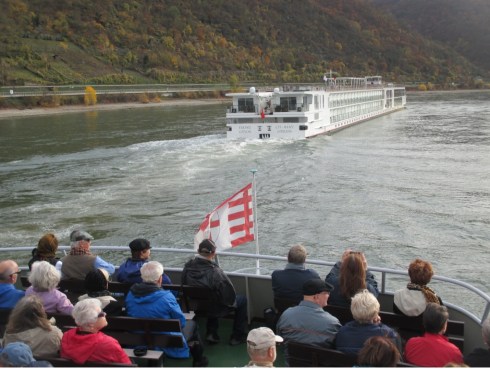
So, instead of seeing the castles from our ship, we all were transferred to the Konigsbacher – a tourist/sight-seeing boat – for the remainder of the day.

 We played “cat and mouse” with the Gefjon all the way to Bingen – we would be in front for a while, then the Gefjon would be in front.  Fun to watch, with the crew waving at us as we passed each other. 

 We did see some castles (we counted 31) while we sailed, and Carl West described them to us.  However, as it was beginning to get too dark to see any other castles, Carl announced that it would be another 90 minutes before we could board the Gefjon again!  Many groans!!  I looked at Fred and vehemently said – “where’s my Kindle???!!!”  Unfortunately, it was locked up in the safe in our room.  It was a rather boring 90 minutes, for sure.  Billie (our concierge)  and the boat’s crew brought out cake and tea for us – charged to Viking, which was nice.

There was a flag flying on the Konigsbacher and I wondered what it represented.  When I asked the crew, they said it represents their home town.

We finally stopped at Bingen, and both the Gefjon and the Konigsbacher were lashed together, so there were only a few steps to get across to get to the Gefjon.

We were finally able to get to supper at 7:30 p.m.  Our table mates were Nancy and Jim from Arizona (they formerly lived in Metro West in Orlando), and Rachael and her mother, Carol, from Sacramento, California.  Rachael earned her law degree from UNM (the University of New Mexico).

Bed by 10:00 p.m. and we were very tired!

~~~~~~~~~~To Be Continued~~~~~~~~~~

Judy is living in Central Florida with her retired U.S. Air Force husband of 50+ years. Born in Dallas, Texas, she grew up in the Southwestern United States.She met her husband at their church, where he was attending the university in her town. After college and seminary, he entered the Air Force, and their adventures began.They lived in eight of our United States, and spent six years in Europe, where their oldest daughter was born. She was a stay-at-home mom for many years .

  Judy has always been involved with music, both playing the piano and singing. Always interested in exercise, she was an aerobic dancing instructor, as well as a piano teacher for many years, and continues to faithfully exercise at home.

After moving to Central Florida, she served as a church secretary for nearly nine years.Her main hobby at this point in time is scanning pictures and 35mm slides into the computer. She also enjoys scrapbooking.She and her husband have two married daughters and four grandchildren, including grandtwins as well as a great-grandson and a great-granddaughter. She and her husband enjoy the Disney parks as often as possible.