Tag Archives: History

The Cruise of a Lifetime-Part 11

17 Aug

SUNDAY MEMORIES

Judy Wills

Reblog

November 16th, Monday.  We were up at 6:00 a.m. to shower and dress.  We had breakfast at 7:15 a.m., with Richard, Judy and Lucy joining us (they don’t get up as early as we do).  By 8:00 a.m. we arrived at Emmersdorf, Austria.

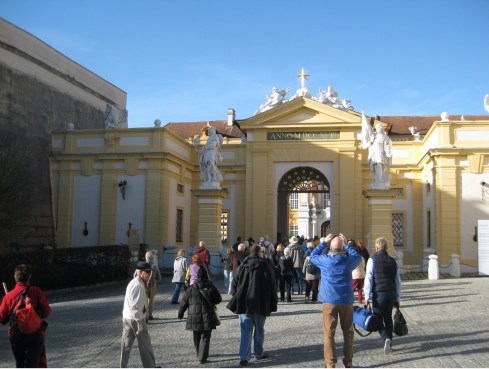
At 9:30 a.m. we took a bus to the 900-year-old Melk Abbey.  It is situated on an outcrop rising above the Danube, crowned by twin towers.

Here is a model of the Abbey 
As you can see…we are fascinated by pipe organs 
They were not without music 

While the abbey was founded in 1089, and given to the Benedictine monks, the current abbey was renovated between 1702 and 1736.  It was originally a royal palace with ceremonial courts, guest apartments, grand halls and a library – which contains around 80,000 medieval manuscripts.

Courtesy Wikipedia 

The abbey has a blue room,

 a green room,

a marble room, and the mirrored room.

Many of the floors have beautiful wood-inlay.

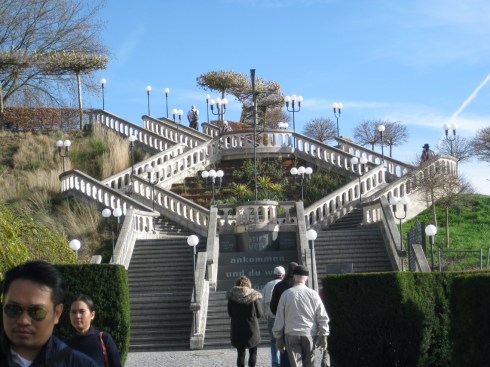
This beautiful stairway is the beginning of the grounds.  However, since I still couldn’t maneuver stairs very well, we walked down (and later up) the ramp.

By 12:10 p.m. we were back on board the ship, and had lunch in the Lounge with Janice and John from Ontario.  We were also joined by the couple from Los Angles (originally Denmark) but we still did not get their names.

At 2:00 p.m. we sailed through the Wachau Valley.

The countryside is stunningly beautiful.  Both banks are dotted with ruined castles and medieval towns and are lined with terraced vineyards.   The Wachau is described as “an outstanding example of a riverine landscape.”  Noted for its cultural importance as well as its physical beauty, it is described:  “The architecture, the human settlements, and the agricultural use of the land in the Wachau vividly illustrate a basically medieval landscape which has evolved organically and harmoniously over time.”

At 4:00 p.m. we docked in Krems.

Fred and I decided to stay on board the ship because it would be getting dark soon and it was cool and windy.  Before dinner Fred and I watched the Monuments Men movie in our stateroom.  Really good movie, and gave us some insight into the Nazi greed and stupidity.

At 6:45 p.m. we went to the preview of tomorrow’s Vienna excursions.  Carl West told us we have to change ships again.  Following much groaning from the passengers – during which he remained silent – he said, “thank you.”

At 7:15 p.m. we had a traditional Austrian dinner.  We had our first schnitzle with potatoes, a small piece of chicken, wurst, and dessert.   Richard, Judy and Lucy ate with us. 

We sailed to Vienna overnight.

~~~~~~~~~~To Be Continued~~~~~~~~~~

Judy is living in Central Florida with her retired U.S. Air Force husband of 50+ years. Born in Dallas, Texas, she grew up in the Southwestern United States.She met her husband at their church, where he was attending the university in her town. After college and seminary, he entered the Air Force, and their adventures began.They lived in eight of our United States, and spent six years in Europe, where their oldest daughter was born. She was a stay-at-home mom for many years .

  Judy has always been involved with music, both playing the piano and singing. Always interested in exercise, she was an aerobic dancing instructor, as well as a piano teacher for many years, and continues to faithfully exercise at home.

After moving to Central Florida, she served as a church secretary for nearly nine years.Her main hobby at this point in time is scanning pictures and 35mm slides into the computer. She also enjoys scrapbooking.She and her husband have two married daughters and four grandchildren, including grandtwins as well as a great-grandson and a great-granddaughter. She and her husband enjoy the Disney parks as often as possible.

The Cruise of a Lifetime-Part 4

8 Jun

SUNDAY MEMORIES

Judy Wills

Re-blog

I’ve not mentioned that, before each meal, Fred and I would “excuse” ourselves from the rest of the table, to say our blessing.  This morning, at the breakfast table, as we were beginning to excuse ourselves, the other gentleman at the table leaned toward me, arm and hand outstretched across the empty chair between us, and said, “Looks like you are about to thank the Lord.”  When I agreed, we all took hands and prayed.  After prayer, I told him that he sounded like a preacher.  He grinned and said, “well…….”

They turned out to be Richard and Judy, with their widowed friend, Lucy (Richard called her “Lucy B”).  They are from Fort Worth, Texas, and he is the Worship Leader for the 8:00 a.m. service at the North Richland Hills Baptist Church.  He also directs the Senior Adult Choir there.  So while he is not a preacher, he is in the Christian ministry.

Richard and Judy flank Lucy 

We found several points in common:  His wife’s name is Judy – I am Judy.  She is a pianist – I am a pianist (of sorts).  I asked her one time:  If you are eating a piece of cake, what is your favorite part, the cake or the icing?  Her response?  THE ICING!  I gave an air fist pump and a whoop of joy – because that’s MY favorite part of a piece of cake, as well!  WOW….are we twins?

We struck up an instant friendship.   Judy is the pianist for the service at their church (he affectionately calls her “Sister Judy” – i.e. “play us something in the key of G, Sister Judy”).   He would address me occasionally as “Judy2.”

Just a note here to say that the first four years Fred and I were married were spent in Fort Worth, while Fred attended and graduated from Southwestern Baptist Theological Seminary.  We are quite familiar with Fort Worth.

Southwestern Baptist Theological Seminary, the Rotunda 

While Lucy was up getting her food, we talked about Fort Worth and seminary.  He mentioned that Lucy was a Baylor University graduate, and I told him about my Dad being one of the three students at Baylor in the very first graduating class in the School of Music in 1924.

When Lucy returned, he informed her that my Dad was a Baylor grad.  She blinked and looked at me.  Our conversation took off from there.  She is a die-hard Baylorite!

There is also another connection between Richard and us – he was the Minister of Music  for the First Baptist Church in Albuquerque, New Mexico – my original home church – in the 1970’s!   We began comparing notes on people we both had known while there.  Absolutely amazing!


Original building, First Baptist Church, Albuquerque, New Mexico 

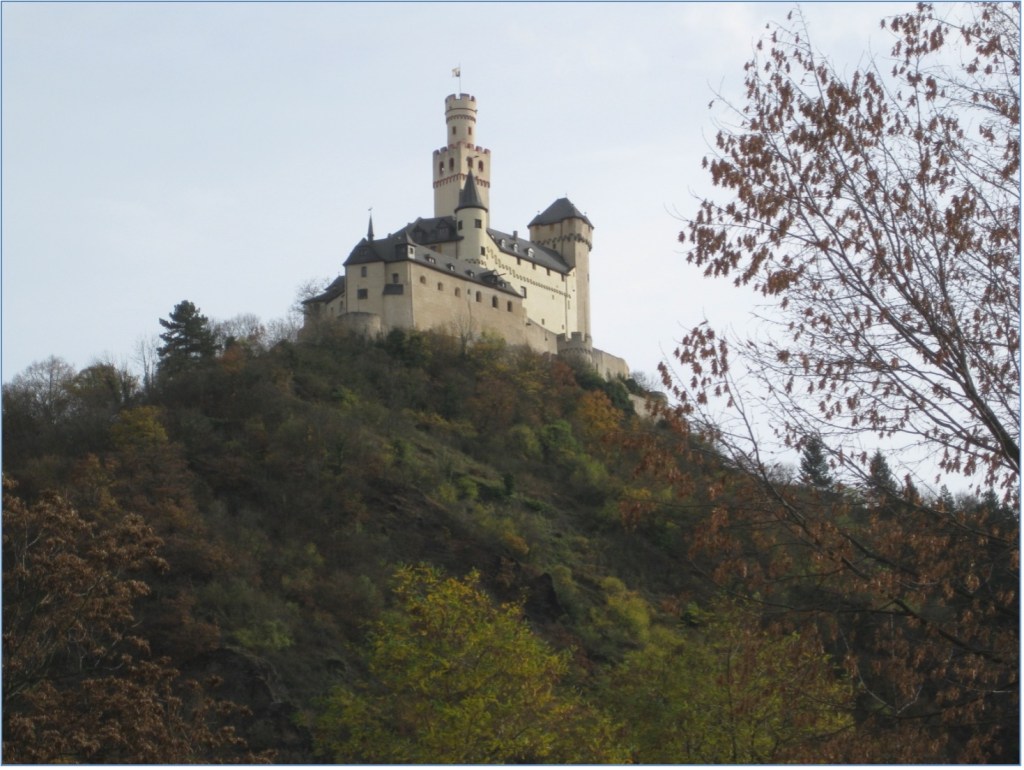
Following breakfast, I wasn’t feeling very well, so I stayed in the stateroom, while Fred went on an excursion (walking tour) to the Marksburg Castle.  He came back saying that it had been a VERY difficult walk/climb, and I would not have been able to manage all the steps and the climb.  I was glad I had stayed home!  But he took lots of pictures, and said it was a delightful castle to explore.  I’m glad he was able to make the jaunt by himself.

~~~~~~~~~~Part 4 to be continued~~~~~~~~~

Judy is living in Central Florida with her retired U.S. Air Force husband of 50+ years. Born in Dallas, Texas, she grew up in the Southwestern United States.She met her husband at their church, where he was attending the university in her town. After college and seminary, he entered the Air Force, and their adventures began.They lived in eight of our United States, and spent six years in Europe, where their oldest daughter was born. She was a stay-at-home mom for many years .

  Judy has always been involved with music, both playing the piano and singing. Always interested in exercise, she was an aerobic dancing instructor, as well as a piano teacher for many years, and continues to faithfully exercise at home.

After moving to Central Florida, she served as a church secretary for nearly nine years.Her main hobby at this point in time is scanning pictures and 35mm slides into the computer. She also enjoys scrapbooking.She and her husband have two married daughters and four grandchildren, including grandtwins as well as a great-grandson and a great-granddaughter. She and her husband enjoy the Disney parks as often as possible.

Hope in Thanksgiving

28 Nov

Guest Post

Rebekah Lyn

Reblogged from Rebekah Lyn’s Kitchen

This week, Americans celebrate Thanksgiving. A group of settlers known as the Pilgrims celebrated the first feast of Thanksgiving in the “New World”. These “separatists,” as the Church called them, refused to acknowledge the Queen as the Head of the Church, placing herself above the Lord Jesus Christ. The church bishops’ support for this usurpation was evidence to the Pilgrims of the total corruption of the Church. For this rebellion, the Pilgrims faced bulling, taxation, imprisonment on false charges, and societal marginalization. First, they fled to Holland, but life wasn’t any easier there, so they decided to sail for the “New World”.

Challenges plagued their journey from the start. When they landed at Cape Cod, they found a wild wilderness with no protection from fierce winter storms. Scouts found a more sheltered area farther south and upriver, deep enough for the Mayflower to sail in. They spent that first winter onboard their ship while they built shelters ashore. Working in the cold to the point of exhaustion, simple colds grew into pneumonia, killing many. The more adversity they faced, the more fervently they prayed for God’s provision.

All the while, they knew Indians roamed outside their palisade, but only once did they experience a skirmish in which none were injured. March brought more roaring wind along with the introduction to Samoset, a chief of the Algonquin tribe. Samoset spoke flawless English, which he learned from fishing captains who came ashore in Maine near his home. He’d come to the area with one of those captains to explore for the Council of New England.

Several days later, Samoset returned with another Indian who also spoke English, Squanto, and who was originally from this land the Pilgrims had settled. Samoset, Squanto, and Massasoit, chief of the local Wampanoag tribe, met with the Pilgrims and a peace treaty of mutual aid and assistance was reached. Squanto remained when Massasoit and his warriors returned to their homes. He showed the Pilgrims how to fish, to plant corn, to hunt, which native plants were good to eat and which were good for medicine, and much more.

With the harvest of 1621 complete, the colony’s governor, William Bradford, organized a celebration, inviting Squanto and Massasoit, who had been so helpful. When Massasoit arrived, he brought ninety others with him, but they didn’t come empty-handed. They brought deer and turkeys, taught the Pilgrims how to make hoecakes and pudding from cornmeal and maple syrup. The feast lasted three days, and the celebration included sporting competitions between the Pilgrims and the Wampanoags.

More than 150 years later, in 1789, George Washington issued the first national Thanksgiving proclamation to celebrate the conclusion of the American Revolution. The United States did not officially adopt Thanksgiving as an annual holiday until 1863, during the height of the Civil War. By 1939, it was already turning into a commercial holiday, when Franklin Roosevelt moved it up a week hoping to spur retail sales during the Great Depression. Following extreme backlash, Roosevelt signed a bill in 1941, assigning the fourth Thursday in November as Thanksgiving.

Our history is increasingly distorted and many view the founding of America as a bloodthirsty invasion that disregarded the people already living in this unknown land. It is important to remember, the further away we get from an event, the more likely it is to be rewritten to fit a particular narrative or agenda. I’m reading The Light and the Glory by Peter Marshall and David Manuel, first published in 1977. This book traces the history of America, delving into the questions “Did God call Columbus to discover new lands?” and “Was God leading the early settlers to America?”. It’s a fascinating read that challenges much of what our current historians are espousing.

Today, Americans rarely think about how the tradition started or why those first celebrants were in the “New World” to begin with. The holiday has become a day for football, a competitive kick-off to Christmas shopping, a dreaded day of family gathering.

As Christians, we are called to live every day with thanksgiving. Psalm 100 is a song of David that says:

Shout for joy to the Lord, all the earth. Worship the Lord with gladness; come before Him with joyful songs. Know that the Lord is God. It is He who made us, and we are His; we are His people, the sheep of His pasture. Enter His gates with thanksgiving and His courts with praise; give thanks to Him and praise His name. For the Lord is good and His love endures forever; His faithfulness continues through all generations.

I hope this Thanksgiving you will take time to reflect on what God has done in your lives. Rejoice in the adversity, give thanks in the blessings, and be kind to others.

2023 Road Trip-Part 18

17 Jan

A Slice of Life

Bill Lites

Day 18 – August 1

 After breakfast this morning, I packed up my things and called my son, Billy, to let him know I was on my way to pick him up.  We said our goodbyes to Lacey (she had to go to work) and Lisa (she was driving their car back to Florida) and Billy and I headed south 25 miles, thru morning rush-hour traffic, on I-85 & I-285 to visit the Waffle House Museum located in Decatur, GA.  This small museum is located on the site where Joe Rogers and Tom Forkner opened their first Waffle House Restaurant in 1955. Since we didn’t have a tour appointment, we just took photos and headed for our next museum on today’s list.

Photo Credit: Bill Lites

Now it was only 15 miles southwest on I-20 & I-85 (more morning traffic) to visit the Hapeville Depot Museum located in Hapeville, GA but it was closed.  So, we continued south another 10 miles on I-75 to visit the Old Train Depot Museum located in Jonesboro, GA.  This museum is situated in the old 1867 M&W Railroad depot that replaced the original 1846 M&W depot and was restored in 1880.  The museum displays early 1800s railroad artifacts and memorabilia, as well as being the home of the ‘Road to Tara’ Museum, which has a collection of ‘Gone with the Wind’ artifacts, costumes, and movie memorabilia.

Photo Credit: Bill Lites

After that interesting museum visit, it was only about 15 miles south on US-41 where we tried to visit the Army Aviation Museum located adjacent to the Clayton County Airport in Hampton, GA.  We had no trouble finding the airport, and the sign for the museum.  We followed the arrow on the sign, over some really rough roads and behinds some airplane hangars, but we just couldn’t find the museum anywhere.

Photo Credit: Bill Lites

So, we gave up on finding that museum and continued south about 100 miles to visit the Georgia Rural Telephone Museum located in Leslie, GA.  For some reason Greta (my Garmin) took us over many back roads on a circuitous route (supposedly on US-19) to get us to this museum.  We finally arrived at the museum and found it to be one of the largest and most interesting museums we have visited on this road trip.  There were literally thousands of telephones, arranged in pretty much chronological order, dating from that instrument’s inception, in 1875 by Alexander Graham Bell, to the present.  This is a very impressive museum!  It was worth the trouble we went thru to find it.

Photo Credit: Bill Lites

After that amazing tour of the Telephone Museum, we discovered we had ended up almost 20 miles west of I-75 (the reason for all those back roads to get to Leslie).  Now we needed to head back east on US-280 to visit the Cordele Rail Museum located in Cordele, GA but found that it was closed when we got there.  So, we continued south another 40 miles on I-75 where we visited the Tifton Terminal Railway Museum located in Tifton, GA. This museum is situated in the old restored 1910 Atlantic Coast Line (ACL) depot and displays antique railroad exhibits, artifacts, and memorabilia dating from the mid-1800s.

Photo Credit: Bill Lites

By now we were getting hungry, and I gave Greta (my Garmin) the address of the motel 50 miles south, in Valdosta, GA and she took us right to it.  I had told Billy the night before that I had a leftover Pork Chop dinner from the night before, so Lisa had made him some ham and cheese sandwiches for his dinner in the motel tonight.  He told me that he was tired and was going to head to bed after we finished our dinner, so I warmed up my leftover Pork Chop plate and enjoyed that delicious meal again.  What a treat that was.  As usual I couldn’t find anything on TV to hold my interest, so I just recorded the day’s activities and went to bed.

Photo Credit: https://images.search.yahoo.com/search/pork+chops+greenbean+cassarole+potatos+gravy

—–To Be Continued—–

Bill is a retired Mechanical engineer living with his wonderful artist/writer wife, DiVoran, of 65 years in Titusville, Florida. He was born and raised in the Southwest, did a tour of duty with the U.S. Navy, attended Northrop University in Southern California and ended up working on America’s Manned Space Program for 35 years. He currently is retired and spends most of his time building and flying R/C model airplanes, traveling, writing blogs about his travels for Word Press and supporting his wife’s hobbies with framing, editing and marketing.  He also volunteers with a local church Car Care Ministry and as a tour guide at the Valiant Air Command Warbird Museum there in Titusville.  Bill has two wonderful children, two outstanding grandchildren, and a loving sister and her husband, all of whom also live in Central Florida, so he and DiVoran are rewarded by having family close to spend lots of quality time with.

One of Bill’s favorite Scriptures is:  John 10:10

2023 Road Trip-Part 15

27 Dec

A Slice of Life

Bill Lites                                                    

Day 15 – July 29: 

 After Breakfast this morning, I packed up my things and headed east out of Little Rock on I-40 for 30 minutes to visit the Lonoke County Museum in Lonoke, AR but they were closed.  So, I continued east on I-40 for another 45 minutes to visit the Central Delta Railroad Museum located in Brinkley, AR.  This museum is housed in the restored 1912 Union Railroad Depot and displays antique railroad artifacts and memorabilia related to the influence of the railroad on the Monroe County area over the years, dating from the early 1800s.

Photo Credit: Bill Lites 

Continuing east on I-40 for another 25 miles, I visited the St. Francis County Museum located in Forest City, AR.  This museum has recently been moved into the Historic 1906 Rush-Gates house and displays artifacts from Dr. J. O. Rush, such as his medical clinic, a Native American room, including many pre-historic items from Dr. Rush’s collection, a parlor room, and a ’Hall of Schools’ room depicting the evolution of the St. Francis County education system over the years.  Other display rooms include a genealogy room and a railroad room.

Photo Credit: Bill Lites 

Now it was another 45-minute drive east on I-40, across the famous Mississippi River (the border), to visit the Metal Museum located adjacent to De Soto Park in Memphis, TN.  I had visited Memphis on another road trip, but most of the museums I had visited on that trip revolved around Elvis Presley and the Country Music Industry.  I found that the Metal Museum is very unusual and is dedicated to the art of ornamental metal design.  The museum displays a wide range of metal artwork ranging from jewelry to weathervanes, swords, unique BBQ devices, and many others.  The museum offers visitors an opportunity to watch a blacksmith at work forging metal artwork of all types.  His creative ability is simply amazing!

Photo Credit: Bill Lites 

It was just a few blocks drive from the Metal Museum to where I visited the Edge Motor Museum located in downtown Memphis.  This museum displays a variety of some 25+ sport and muscle cars dating from a 1913 Ford T Runabout, that tell the story of the American Sport Car from the prospective of their historical and cultural significance.  

The cars come from different sources, and the selection is rotated from time to time as other cars become available for display.

Photo Credit: Bill Lites 

Over a couple of streets from the Edge Motor Museum I visited the Fire Museum of Memphis.  This museum is situated in the restored 1910 Fire House #1 and displays fire engines, firefighting equipment, and memorabilia dating from the late 1800s.  A unique ‘Fire Simulation Room’ demonstrates how residential fires can start and how the local fire departments fight and control those fires.  Interactive firefighting stations are available for the education of persons of all ages.

Photo Credit: Bill Lites 

My plan was to visit the PT Boats Museum located in Germantown on my way out of Memphis, but they were closed.  Bummer!  I had been looking forward to that museum as I love the WWII version of ‘David vs. Goliath’ with the small plywood PT Boat up against the giant Japanese Battleship.  Oh well, maybe next time I’m in the area.  So, now it was southeast on US-72 another 10 miles to visit the Morton Museum of Collierville History located in Collierville, TN.  This small museum displays antique artifacts and memorabilia related to the Bellevue Female College that operated in Collierville from 1872–1904 and the many lives that this educational institution touched over the years.

Photo Credit: Bill Lites 

On my way out of Collierville, I stopped to take a photo of the Battle of Collierville historical marker.  The marker describes one of the bloodiest Civil War Battles, for control of Collierville’s Union Supply Base, to take place in Shelby County during that war. 

Photo Credit: Bill Lites 

Continuing east on US-72 for about an hour, I crossed the border into Mississippi and wanted to tour the Cocoa Cola Bottling plant located in Corinth, MS but there were no tours today.   So, not to be discouraged, I drove over to visit the Historic Corinth Depot (also known as the Corinth Crossroads Museum) there in Corinth.  This museum is housed in the third railroad depot to be built on this site (1st -1857, 2nd -1912 & 3rd-1960), and displays antique railroad artifacts and many Civil War memorabilia related to the fight for control of this strategic railroad crossroad during historic that war.

Photo Credit: Bill Lites 

It was almost time to head for the motel for the evening, there in Corinth, so I gave Greta (My Garmin) the address.  But on the way I spotted the local Cracker Barrel and stopped for a plate of their Crusted Fried Pork Chop with green beans, mashed potatoes and gravy, and one of their famous biscuits with butter and honey for dessert.  Yummmm!  I can’t eat all that food at one sitting.  That means there was plenty left over for another delicious meal tomorrow evening.

Photo Credit: 

https://images.search.yahoo.com/search/pork+chops+greenbean+cass arole+potatos+gravy  

By the time I got to the motel, there in Corinth, I was ready to relax and I recorded today’s activities.  No TV tonight, as I was tired and ready for a good night’s sleep.  So, ZZZZ….. 

—–To Be Continued—– 

Bill is a retired Mechanical engineer living with his wonderful artist/writer wife, DiVoran, of 65 years in Titusville, Florida. He was born and raised in the Southwest, did a tour of duty with the U.S. Navy, attended Northrop University in Southern California and ended up working on America’s Manned Space Program for 35 years. He currently is retired and spends most of his time building and flying R/C model airplanes, traveling, writing blogs about his travels for Word Press and supporting his wife’s hobbies with framing, editing and marketing.  He also volunteers with a local church Car Care Ministry and as a tour guide at the Valiant Air Command Warbird Museum there in Titusville.  Bill has two wonderful children, two outstanding grandchildren, and a loving sister and her husband, all of whom also live in Central Florida, so he and DiVoran are rewarded by having family close to spend lots of quality time with.

One of Bill’s favorite Scriptures is:  John 10:10

Min’s Cafe-Part 1

25 Jul

My Take

DiVoran Lites

Photo credit: Come to Life Colorado

Min’s Café, Westcliffe, Colorado

1945-1952

The seven years between 1945 and 1952 in Westcliffe, Colorado, were some of the best years of my life. This picture shows the mountains we saw from our bedroom windows.  

Dad (Ivan) and Mother (Dora) bought Min’s Café with the G. I. Bill. They kept the name because the restaurant had a fine reputation in the town, and Minnie was a favorite cook and bottle washer. The Wet Mountain Valley, where Westcliffe was located, had two major enterprises, ranching, and fishing. Saturdays, the ranchers, and their families came to town for staples such as coffee, flour, and sugar. Their ranches yielded meat. And vegetables grew in the spring and summer and were preserved in cellars in the winter. The Ranchers’ main product was cows. They had milk from cows and sold the milk and many herds of cows. They cared for chickens for eggs and meat, and they grew vegetables for their use. In autumn, the girls and women filled every Mason Jar with vegetables and fruit to last the cold winter.  

In 1945 and on, Westcliffe had two bars and grills, and the two cafes were directly across Main Street. The owners, my parents, and the family across the street were best friends. When I was about eight years old, I started babysitting the two little girls who belonged in the living quarters of their café. 

The pharmacy was two doors down the street from Min’s. Sometimes when the pharmacist and his wife, the mother of his children, Mr. and Mrs. Cope went out for an evening at our Café three doors up the street or the café and bard one across the street, I looked after Cope’s children. My good friend Patience tells me she got to look after them too. I wonder if Cope (as we called him) had left anyone to sell to. He was kind and appreciated all the children. I went in to say hello to him almost every day as I went back and forth from Min’s to the Railroad duplex. 

We both were pleased when Mr. Cope gave us comic books with the covers removed so he could send the comics back to the factory. My friend had five brothers, so I’m sure those comic books had a thorough reading. Come to think about it; Patience was cousin to the Sheriff’s family, who had nine children. All the kids from both these families were at the top in school. 

We played in their yards and staged plays. 

To be continued.

DiVoran has been writing for most of her life. Her first attempt at a story was when she was seven years old and her mother got a new typewriter. DiVoran got to use it and when her dad saw her writing he asked what she was writing about. DiVoran answered that she was writing the story of her life. Her dad’s only comment was, “Well, it’s going to be a very short story.” After most of a lifetime of writing and helping other writers, DiVoran finally launched her own dream which was to write a novel of her own. She now has her Florida Springs trilogy and her novel, a Christian Western Romance, Go West available on Amazon. When speaking about her road to publication, she gives thanks to the Lord for all the people who helped her grow and learn.  She says, “I could never have done it by myself, but when I got going everything fell beautifully into place, and I was glad I had started on my dream.”

Colonial Williamsburg, Virginia

19 Jun

SUNDAY MEMORIES

Judy Wills

Recently, Fred and I made a trip to Virginia to see our youngest daughter, her husband, and our grandtwins.  We always love being with them.  They live in Williamsburg, but not in the restored colonial area.  But every time we visit there, we always walk through the restored area.

When we returned Stateside from Heidelberg, West Germany in 1983, Fred was stationed at Langley AFB, Hampton, Virginia.  Neither of us had ever lived in Virginia, so it was to prove to be a new and exciting experience for both of us – actually all four of us, since our daughters were still living at home.

We were excited to realize that we lived just eight miles from Yorktown, and that is within the “Historic Triangle” of Williamsburg, Yorktown, and Jamestown.  That area is just oozing with American history.  While that had not been much of an interest to me prior to our time in Virginia, I found myself totally engaged in it.

And Colonial Williamsburg helped that viewpoint.  In that vein, we purchased what they called the “Patriot Pass” – essentially an annual pass.  Since we lived only about 30 minutes from Colonial Williamsburg, we went there often – so often that our girls grew a bit tired of it.  Not only did we take them with us, but their schools had field trips there, as well.  Eventually, we felt we had seen just about everything they had to offer, and let our Patriot Pass lapse.  We could still walk the streets and see the gardens and shops, but we couldn’t go into the “attractions” where the “interpreters” told what was going on in their areas in colonial times.  

All that to say, this time when we visited, we decided to get the Patriot Pass and go through as many of the attractions as possible.  We are so glad we did – it was new and refreshing to hear the explanations of what was done in those areas, by people dressed in period costumes, and telling just what it might be like in colonial times to do their jobs.  

We stopped at the seamstress shop (I was especially interested in how they got the printed fabric),

Trend & Tradition – Autumn 2021

 The printer

Credit National Graphic – Visiting Our Past – America’s Historylands

The apothecary, the boot and shoemaker,

Credit National Graphic – Visiting Our Past – America’s Historylands

 The Capitol, 

Credit Williamsburg Before and After

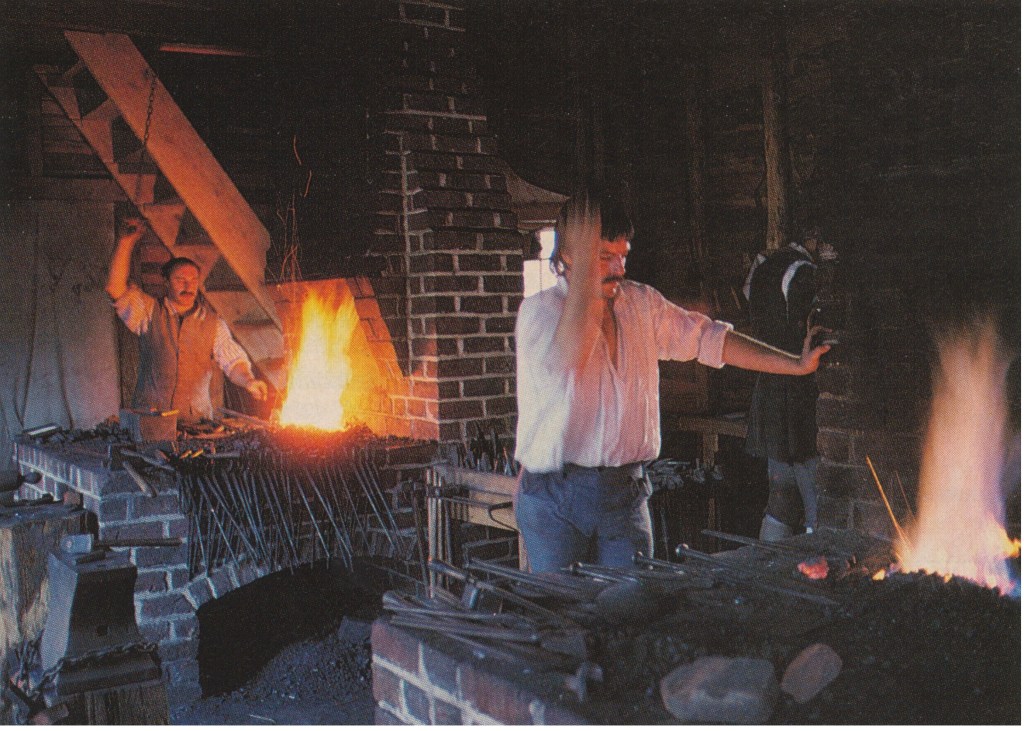
The blacksmith among others.

Credit Military Lifestyle – March 1992

The tour of Raleigh’s Tavern was especially interesting, as we were told it was the birthplace of Phi Beta Kappa!  And there was a gentleman walking the Duke of Gloucester Street, dressed in period costume (along with a yes-man sidekick) who told about how his house was so much better than his brother’s house.  Just delightful!

Credit Trend & Tradition – Winter 2022

We had hoped to go through the Governor’s Palace, but the line was exceedingly too long, with about five or six groups ahead of us.  By the time we were on our way back there, we were both too tired, and skipped that one.

Credit Military Lifestyle – March 1992

We wanted to go in the Bruton Parish Church (that’s BRuton not Burton!!),

Credit Williamsburg Before and After

 which we had seen quite often, but it was closed that day.  It is still an active Anglican church, and was the site of many of the country’s beginnings.  It is especially beautifully decorated at Christmas time.  Just a note here – all the private residences within Colonial Williamsburg, as well as all the stores and attractions, are required to decorate the outsides of their facilities/houses, and it must be all living decorations – no silk flowers or fake fruit – it must be real.  It’s amazing what they come up with.

Credit Trend & Tradition – Winter 2022

Credit Trend & Tradition – Autumn 2021

The Capitol is at one end of the Duke of Gloucester Street, and Merchant’s Square is at the other end, just across the street from the Wren Building on the College of William and Mary.  Many shops and eateries there, which are fun to patronize.  Duke of Gloucester Street is about one mile long.

Here is a book we purchased titled Williamsburg Before and After.  Many of the pictures in this post are from that book. 

Duke of Gloucester Street – 1928

I am so glad someone decided to restore this area!

Judy is living in Central Florida with her retired U.S. Air Force husband of 50+ years. Born in Dallas, Texas, she grew up in the Southwestern United States.She met her husband at their church, where he was attending the university in her town. After college and seminary, he entered the Air Force, and their adventures began.They lived in eight of our United States, and spent six years in Europe, where their oldest daughter was born. She was a stay-at-home mom for many years .

  Judy has always been involved with music, both playing the piano and singing. Always interested in exercise, she was an aerobic dancing instructor, as well as a piano teacher for many years, and continues to faithfully exercise at home.

After moving to Central Florida, she served as a church secretary for nearly nine years.Her main hobby at this point in time is scanning pictures and 35mm slides into the computer. She also enjoys scrapbooking.She and her husband have two married daughters and four grandchildren, including grandtwins as well as a great-grandson and a great-granddaughter. She and her husband enjoy the Disney parks as often as possible.

Paul Revere’s Helper

3 Aug

The Storyteller Almanac

The latest greatest episode in my ongoing podcast series, The Storyteller Almanac is now live and available online. The title of this one is, “Paul Revere’s Helper.” It’s a true story about the famous ride of Paul Revere. But it talks about a helper Paul had that night back in Colonial Days you might not have ever been taught in your school days. Presented in the Paul Harvey, “Rest Of The Story Format,” ya’ gotta stick with me until the end of this short story to fully get the impact and surprise ending.

Click HERE to listen

The podcasts can be found on any of the major podcast platforms such as Apple Podcasts, Google Podcasts, Spotify and more. You can also go directly to my podcast home page at www.StotytellerAlmanac.com 

Also on my homepage is a donation button if you feel so inlcined to make a contribution to help keep the podcast up and running. Additionally, please follow or subscribe to the podcast on any of the aforementioned podcast platforms so you won’t miss any future episodes.

Thanks for droppin’ by neighbor! Mike – The Storyteller” 

I’ve been ‘clickin’ the shutter since I was about 16. I morphed into video production when I went to work for The Walt Disney Company many years ago. Currently, I still work for Disney. But my real passion and path is utilizing my photography and multimedia skill sets for the greater good. Translated, anything or anybody that deserves recognition, appreciation or documenting for future history, I’m all over it. Too many important things just slip away in a fast moving, fast paced world / society. ‘If ya’ wanna know where you’re going, ya’ gotta know where ya’ come from’ (Sir Lawrence Olivier – The Jazz Singer 1980). 

If you feel so inclined, I’d sure appreciate you subscribing to Storyteller Almanac on any of the major podcast platforms like Apple Podcasts, Spotify, Google Podcasts and more. Really helps me grow the po

To contact me for any reason, please click or copy & paste: 

MikeThomasImagery@gmail.com

Who is Michael

19 Jan

On the Porch

Onisha Ellis

My very talented friend, Mike Thomas has premiered a podcast, The Storyteller Almanac. Some podcasts will include a “mystery” character or story from the pages of history. Listen as he narrates the story of a famous man.

Who is Michael?

CLICK TO LISTEN

Did you guess? I didn’t.

Now, a little about Mike.

I’ve been ‘clickin’ the shutter since I was about 16. I morphed into video production when I went to work for The Walt Disney Company many years ago. Currently, I still work for Disney. But my real passion and path is utilizing my photography and multimedia skill sets for the greater good. Translated, anything or anybody that deserves recognition, appreciation or documenting for future history, I’m all over it. Too many important things just slip away in a fast moving, fast paced world / society. ‘If ya’ wanna know where you’re going, ya’ gotta know where ya’ come from’ (Sir Lawrence Olivier – The Jazz Singer 1980). 

To contact me for any reason, please click or copy & paste: 

MikeThomasImagery@gmail.com

http://mikethomasimagery.com/about-me

Japanese Neighbors

11 Nov

My Take

DiVoran Lites

By Dora Bowers as told to DiVoran Lites

Crowley Colorado, 1942

Description: C:\Users\DiVoran\Pictures\Old Family Pictures\Bowers 3 (4).jpg

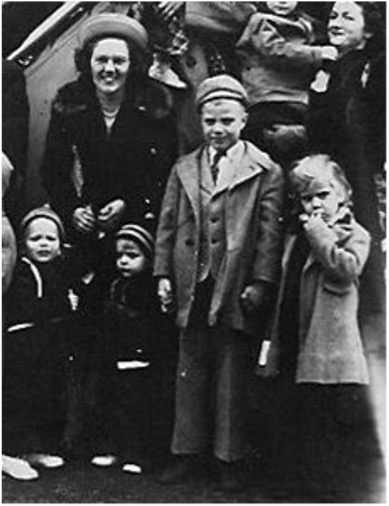
Circa early 40s Dora, DiVoran, Ivan, and David Bowers

In the time of writers like Lloyd C. Douglas who wrote The Robe, and C. S. Lewis…The Screwtape Letters. WW2 was heating up. Japan bombed Pearl Harbor triggering an outrage of fear so heavy that President Roosevelt decided to send families of over 117,000 Japanese Americans, many of them American citizens, to internment camps in order to pacify the millions of Americans who were afraid that if left free the Japanese would spy for the     enemy. 

Not long before the big, “Amache,” Internment camp was built near Crowley, Colorado where the Bowers family lived,         Japanese people arrived and were housed in section housing. One family moved in next door to the Bowers family on the outskirts of town.

The father was about the same size as Ivan, which was small for a man. He had dark shiny hair and a sweet smile. He always bowed low as he left to go to work (gratis) in the sugarcane field and returned in the evening. For this family bathing together was the highlight of their life. Their bathhouse was practically under our bedroom window. Night after night, I fell asleep to the sound of soft voices and laugher, a pleasant memory from our time in Crowley. 
On the few occasions when our Japanese neighbors visited us, they brought gifts of thoroughly cleaned vegetables from their garden. As they arrived, they removed their thong shoes by the front door. They were good, kind neighbors and in spite of the war between our two countries, we liked them and enjoyed getting to know a few of their traditions. 

If you are squeamish, please don’t read the next two paragraphs. 

Most regular folk in those days kept chickens for their eggs and for the pot. Being chicken people, we were interested in        Japanese methods of preparing them for supper. They selected a chicken, hung it upside down from a branch, and pierced the roof of its mouth so the blood could drain out. They could tell that the chicken’s insides were dry when its feathers turned down. 

Our way was to wring a chicken’s neck or cut its head off with an ax. If the headless chicken got loose, it ran around in circles until it dropped. From such necessities came sayings such as, “I’m so mad, I could wring his neck” and “running around like a chicken with its head cut off.”

Once the camps were finished the internees built model   communities with schools, health clinics, and, libraries. We were sorry to hear later that the Japanese families who had lived in camps for three years had been cheated out of their houses, cars, and businesses. Many suffered separation, poverty, and sometimes people just disappeared. It has been considered one of the most atrocious violations of American civil rights in the 20th century. 

The internment camps lasted from 1942-1945 when the   Japanese Americans were finally released to start all over again from scratch and the camps were eventually torn down. 

Dorothea Lange censored photographs.     

Author, Poet and Artist

DiVoran has been writing for most of her life. Her first attempt at a story was when she was seven years old and her mother got a new typewriter. DiVoran got to use it and when her dad saw her writing he asked what she was writing about. DiVoran answered that she was writing the story of her life. Her dad’s only comment was, “Well, it’s going to be a very short story.” After most of a lifetime of writing and helping other writers, DiVoran finally launched her own dream which was to write a novel of her own. She now has her Florida Springs trilogy and her novel, a Christian Western Romance, Go West available on Amazon. When speaking about her road to publication, she gives thanks to the Lord for all the people who helped her grow and learn.  She says, “I could never have done it by myself, but when I got going everything fell beautifully into place, and I was glad I had started on my dream.”