Tag Archives: Travel Series

Transition to Maine~Part 3

24 Aug

SUNDAY MEMORIES

Judy Wills
JUDY


In addition to setting up house at Loring AFB, we started looking for a church home. There weren’t very many Southern Baptist Churches in that area – actually only one – so we scoped it out. They didn’t have their own building, and were meeting in the Odd Fellows hall in Caribou. It wasn’t ideal, especially on the Sundays after the Odd Fellows had been having a party on Saturday night with beer flowing freely. We frequently had to clean up the hall before we could hold our services on Sunday. (Fred and I were only in Maine for 13 months, and after we left, the church rented space on Sundays from the Knights of Columbus. Several years after that, they built their own building). However, the church was strong and the fellowship was tremendous. One of the best things we found in the churches we were in that had a large military membership – the rank came off when we walked through the door. We were all just fellow believers in Christ. We met many people there who became good friends, and some we’ve even retained contact with throughout the years. We’ve also had the pleasure of meeting up with them when they have come down to Orlando for their time at Disney. That’s such a joy!

2

3


The Weather Detachment that Fred was assigned to was a fairly cohesive group, as well. He started in working right away. Loring AFB was a first-defense base with bombers, aerial refueling and interceptor aircraft stationed there. One section of the base was on constant alert. Loring was the closest U.S. base to Europe and U.S.S.R.

Loring AFB was named in 1954 posthumously for Major Charles J. Loring, Jr., USAF, a Medal of Honor recipient during the Korean War. During the morning of 22 November 1952, he led a flight of F-80 Shooting Stars on patrol over Kunwha. After beginning a dive bombing run and getting hit, he entered into a controlled dive and destroyed a Chinese gun emplacement on Sniper Ridge which was harassing United Nations troops, by deliberately crashing his aircraft into the emplacement.

4

Public schools in Aroostock County started in August. They were in session for three weeks then broke for two or three weeks for the potato harvest. Local farmers hired students and airmen looking for some extra money to help with the harvest. Then school resumed.

There was only pre-kindergarten through elementary grades on base – other grades/schools are in town. Karen was able to attend a part-time pre-k there. She got to ride a bus to school and was thrilled. Unfortunately, Fred and I were in tears to see her go!

The Gunnison Adventures~Part 1

19 Aug

A Few Thoughts

Patricia Franklin

We will try to fill you in on our latest adventures in gorgeous Gunnison. While everyone here was baking in the July heat, we were relaxing in the nice cool mountains in the glorious Gunnison Country… truly God’s country… and half-way to heaven. We spent about half the time in town and the rest driving all over the mountains.

The flowers were gorgeous this year because of the moisture and we were there at just the right time. A couple of outings were particularly fun and beautiful.  We had a day trip to Powderhorn, Lake City and up Slumgullion Pass — half-way to Creede. We stopped and took a picture of the beautiful waterfall that you would never know is there unless you knew about it. Although they finally did post a sign pointing to it. The land looks flat, but about 1/4 mile off the main road a creek runs through the mountain meadow, widens out a little and then drops off 100 feet or more into a ravine cut into the flat land.. a beautiful hidden waterfall.

1

We then went back to the old mining town of Lake City with its wooden sidewalks, dirt streets and old buildings. It is not real touristy there, just a small old-fashioned community surrounded by mountains. We had lunch there and some ice cream at the ice cream parlor, then took an old side road back to Gunnison. The guys thought they remembered how to get there, but after coming to a dead-end and trying a couple of roads, we finally found the back way home. Luckily we missed the downpours that were just ahead of us or behind us in that area. We have had many violent thunderstorms with flash floods, hail and tornado-like winds this summer.

Several miles out in the high country we discovered a huge summer sheep camp in a large mountain meadow. There must have been 1000 sheep, a shepherd with his camper and four dogs tending the sheep. We did not stop to talk to him but regretted it later, as just about 1 – 2 miles from the camp, before we got to it, a mountain lion streaked across the road and was headed in that direction. We were sorry we had not warned the shepherd. Anyway, we made it back

2

My Western Trip Part~15

13 Aug

A Slice of Life

Bill Lites

Bill

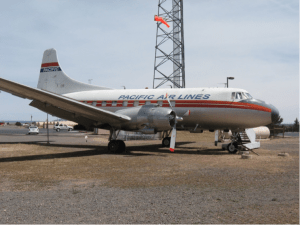
 Heading back west from Meteor Crater, I passed signs for roads leading to some of the most unique sounding towns, such as Two Guns and Twin Arrows. Then a little ways farther down the road, I passed a man carrying a cross with wheels on the long end. What a sight that was. It reminded me of Arthur Blessitt, who carried a cross from the west coast to the east coast of the U.S. back in the late 1960s. When I got to Williams, AZ I took another little side trip, north on S.R. 64 to Valle, AZ to visit the Planes of Fame Air Museum. This museum has a couple of the planes that are special to me, one being General Douglas MacArthur’s Lockheed C-121A Constellation (N422NA) that he named “Bataan.” The other is a Pacific Air Lines Martin 4-0-4 (N636X) that I worked on at the Los Angeles International Airport in 1958-1960s while I was attending Northrop University.

1

Next door to the POF Air Museum is the Grand Canyon Valle Airport, which has a very nice collection of vintage aircraft and vehicles. Their movie and airline famous1929 5-AT-C Ford Tri-motor (N414H) is painted in the colors of Scenic Airways (predecessor to Grand Canyon Airlines), and among its many other awards, won the National Aviation Heritage Invitational (NAHI) Howard Hughes Trophy at the 2012 Reno Air Races.

2


Then I headed west on I-40 again, this time toward Las Vegas, my beginning and ending destination for this trip. I passed thru Ash Fork and Seligman before stopping at the Airport in Kingman, AZ to visit the Kingman Army Airfield Museum. But again, they were closed that day, so I continued on into Kingman to visit the Powerhouse Route 66 Museum and the Kingman Railroad Museum.

3


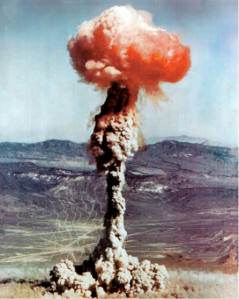
Since time was beginning to get a little tight, I didn’t spend a lot of time in those two museums, but got back on the road for Las Vegas. I made it into town in time to visit the National Atomic Testing Museum, which documents the history of U.S. nuclear testing at the Nevada Test Site (NTS), which was originally called The Nevada Proving Grounds. The NTS is located in the desert only 65 miles north of Las Vegas, and has been the location for 928 nuclear tests of all types and sizes, since the first detonation on January 27, 1951. This includes above-ground, underground and atmospheric tests.

4

I began the next morning by turning in the rental car (3356 miles), and then it was stand in line for baggage check-in, Security checks, and wait for my Southwest flight back to the “Green” of Orlando, FL and home. We had made arrangements for my sister Judy and her husband Fred to meet DiVoran and me at Sonny’s BBQ for dinner upon my arrival, so we had a great dinner of Baby Back Ribs, with all the trimmings. Then it was onto S.R. 528 and east to Titusville for a good night’s sleep in my own bed. Boy did that feel good! I really enjoyed this trip, and am looking forward to the next one, but DiVoran says I will need to cut back a little on that one. I hope you have enjoyed reading about “My Western Trip” as much as I have enjoyed writing about it.

5


—–The End—–


My Western Trip Part~14

6 Aug

A Slice of Life

By Bill Lites

Bill Lites

Bill Lites


The next day, before leaving the Phoenix area, I tried the Wingspan Air Museum again, but they weren’t open until late in the morning, so I located the Arizona Model Aviators field in Usery Park, near Apache Junction, AZ to see if anyone was flying, but not that morning.   It had been 96-98 degrees in Tucson the three days I was there, and 87-89 degrees in Phoenix, so I was in shorts and a tee shirt as I headed for Flagstaff, AZ to check out a couple museums there. It wasn’t that long of a drive, so I didn’t even get out of the car until I stopped for some lunch on the outskirts of Flagstaff. I hadn’t noticed the gradual climb out of the desert, but I sure did when I stepped out of the car. Wow! What a shock! It was only 46 degrees and the wind was blowing. I almost froze before I could get into the restaurant where it was warm. I had forgotten that the elevation in Flagstaff was almost 7000 feet and what a difference that makes in the daily temperature. After I checked into the motel and changed into jeans and a long sleeved shirt and jacket, I went in search of the Museum of Northern Arizona, located just north of the city. The museum’s exhibits relate mainly to the anthropology, biology, geology, and fine art of the unique cultures of the Hopi, Navajo, Zuni, and other Native American tribes that live on what’s called the Colorado Plateau.

1


Next, and just down the road a few miles, I visited the Pioneer Museum, which was originally built in 1908 as a hospital and served as such until 1938. The exhibits at this the museum reflect the history of Flagstaff and northern Arizona including the local history of ranching, logging, transportation and life in Pioneer Flagstaff. Festivals and events are also held on the museum grounds including the annual Wool and Fiber Festival, the Folk Festival and the Heritage Festival. That evening I took the advice of our friends Jim and Charlene to try the Chile Rellenos at La Fonda Mexican Restaurant, and was I glad. They prepare Chile Rellenos like no other restaurant I have ever eaten at, and they were delicious. Their Tacos and Enchiladas were also excellent.

2


The next morning, since I was in the area, I took a side trip to see the Meteor Crater, and it was well worth the time. That’s a really big hole in the ground. The Arizona crater is 3,900 feet in diameter and 570 feet deep, and the rim of the crater rises 148 feet above the surrounding plain. Scientists have estimated that a nickel-iron meteorite about 165 feet across impacted the earth at a speed of around 28,600 mph. It is also believed that about half of the meteorite’s bulk (150,000 tons) was vaporized during its descent before it hit the ground, with an impact energy estimated at between 10 & 20 megatons. And, just think, there are another 184  confirmed impact craters that have been discovered around the world, and listed in the Earth Impact Database. I would say, our planet home (Earth) has been banged around pretty good over the centuries. I guess Earth would look much like our Moon if it weren’t for our own protective atmosphere.

3


—–To Be Continued—–

Transition to Maine~Part 1

3 Aug

SUNDAY MEMORIES

Judy Wills

JUDY


In previous musings, I’ve mentioned how we were assigned to Loring AFB, Maine (Do you think if we ask for New Mexico, they’ll send us to Maine??). And they did.

Our Karen was born in Wiesbaden, West Germany, and was not quite three-years-old when we rotated stateside. That was an eight-hour flight back to the States, so I had purchased a few “new” toys that I hadn’t let her play with, just to keep her occupied on the plane trip. As we took off and began the long flight, I glanced at her and saw her eyes closing. And I exclaimed – “Oh no you don’t!” – and brought out some of the toys. Those eyes instantly popped open. We had a set of little books – about 3½” by 4″ – just kid-hand-sized, with about six books in there. Wish I had kept them. We had a blow-up doggie that we deflated before landing. You get the picture. We played/read for a while, then they brought lunch. After we ate, Fred and I put up the arm rests between our seats, and Karen stretched out across our laps for her nap. Fred and I slept for a couple of hours each before Karen woke up. Perfect timing.

Fred’s parents were living in King of Prussia, PA at the time, and picked us up from the airport at McGuire AFB, NJ and took us to their house. We stayed a few days with them, then flew to New Mexico for a visit with my mom, grandmother and Aunt Jessie.

Karen and "Oma" - her grandmother

Karen and “Oma” – her grandmother


Four Generations

Four Generations


Then we flew to Detroit, MI to pick up the new car we had ordered, then off to Fred’s sister’s house for a few days. She and her husband had a little boy, just one year younger than our Karen. They had a grand time together.

From there we drove up to Loring AFB, Maine. It was July, and we caught the “two weeks of summer” right away. We learned about the black flies that make their appearance in Maine during that time. They were really pesky! We stayed in a furnished guest house while awaiting assignment of quarters. While there we ordered some furniture from a local store, since we had been living in furnished government quarters for the three years in Germany.We learned that we were living in Aroostock County, which is a Native American word for Beautiful River.


5


What surprised us the most was that Aroostock County is one of the largest potato producing areas in the country (Idaho and Wyoming being in that mix). It is also the largest county – land area – east of the Mississippi River. We were nearly on the upper tip of the state, only three miles from the Canadian border, and the nearest town was Limestone, with Caribou being the closest “large” town. We were four hours driving time north of Bangor, and that was on the interstate – which was a two-lane road! The County Seat is Houlton. You might remember that from all the weather reports in winter that pronounce it to be the coldest spot in the U.S.

My Western Trip~Part 13

30 Jul

A Slice of Life

Bill Lites

Bill Small Red Plane

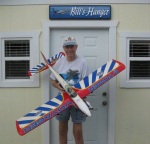
I started out early the next day so I could stop at the Timpa R/C Model Airfield to see what kind of planes they might be flying. There was a small crowd as the winds had been blowing fairly hard the day before and the weather man had forecasted more of the same. The Timpa R/C site is located on 160 acres of unobstructed land for radio control airplane and helicopter flying, with a 750’ paved runway, paved run-up area and covered assembly area with tables. It was one of the nicest R/C sites I have seen in a long time. The club members were very cordial and I got some great photos of them and their planes.

1


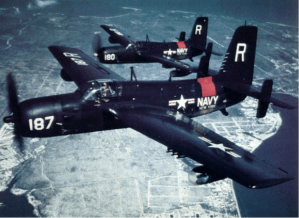
My next stop was to visit the CAF Arizona Airbase Museum in Mesa, AZ. This was a very enjoyable visit, as the museum had a great collection of well-restored aircraft including the only Grumman AF-2S Guardian I had ever seen. The Guardian was a huge aircraft and I couldn’t believe it was carrier rated back when U.S. carriers only had smaller straight flight decks. The plane was in their restoration hanger in the final stages of preparation for its first post restoration flight test.

2


The Wings of Flight Museum was on the other side of the Falcon Field Airport, so I hitched a ride with one of the local FBO fueling employees in his electric cart. Wings of Flight turned out to be a private aerobatic team that hires out for airshows and other aviation events mainly in the immediate Arizona area. Two of the pilots were taking a break from an aircraft inspection and invited me to join them for a cup of coffee. They told me about how their eight-plane business had gotten started with just two of them, and how it just kept on growing. They didn’t seem to be in any kind of a hurry and could have talked to me all day if I had wanted to. They seemed like a really great bunch of guys, doing what they all loved to do – fly.

3


Next, I headed to Peoria, AZ to visit the Challenger Space Center that actually turned out to be a children’s learning center. So I headed down the road to Chandler, AZ to visit the Rawhide Western Town. This was a smaller version of Tombstone, but was more about attractions and a Steakhouse than anything else. When the street barkers started calling for people to head for the O.K. Corral shootout show, the whole place became deserted, and I left. Somewhere on one of the smaller roads on my way to or from the Rawhide Western Town, a Roadrunner ran across the road in front of my car, and I was instantly transported back to when I was much younger, driving on a two-lane road somewhere in New Mexico, where it was a common sight to see Roadrunners run from one side of the road to the other. What a thrill that was!   By the time I got back into Phoenix, and found the Wingspan Air Museum, they were closed. So I stopped and had a delicious Fuddruckers ¼-pound BBQ Burger and Raspberry Ice Tea, after which i went to the motel for some rest and TV.

4


—–To Be Continued—–


My Western Trip Part~12

23 Jul

A Slice of Life

Bill Lites

Bill


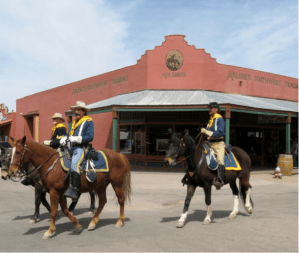
After lunch, I headed south to visit the city of Tombstone, a historic western town in Cochise County, Arizona, founded in 1879 in what was then Arizona Territory. It was one of the last wide-open frontier boomtowns in the American Old West. By the early 1890s, prosperity from silver mining, the town had expanded to the point where the ladies and gentlemen of Tombstone could attend operas presented by visiting acting troupes at the Schieffelin Hall opera house, while the miners and cowboys saw shows at the Bird Cage Theatre, said to be “the wildest, wickedest night spot found anywhere between Basin Street and the Barbary Coast.” The U.S. Army attempted to keep some kind of order in the Territory, but under the surface tensions were growing. 

1


Shortly after the Earp brothers arrived in Tombstone in late 1879, an ongoing conflict developed between them and the Clanton brothers and Tom McLaury. The cowboys repeatedly threatened the Earp brothers, over the years, until the conflict escalated into a deadly confrontation that turned into a shootout, the now-famous Gunfight at the O.K. Corral. The city of Tombstone has survived the ravages of time, and is now a thriving tourist attraction, with many period clad characters walking the streets, encouraging visitors to enter their particular establishment to get in out of the heat. I had a sarsaparilla in Doc Holiday’s Emporium , and it really did quench my thirst.

2


Before leaving Tombstone, I visited the Wyatt Earp House & Gallery, which was closed at the time, but I was able to look in the windows of the house and read the inscriptions on the bronze statue of the famous lawman. Just outside the town of Tombstone was the famous Boothill Grave Yard (originally called The Tombstone Cemetery until around 1884), were many of the area bad guys are buried. And, of course, I couldn’t leave Tombstone without visiting that historic site. Well, as you might guess, the grave yard was full of famous named people, and the Curator even has a brochure you can purchase, listing many of the 250 people buried there; when and how they died, and who killed them, if known. A few of the famous Tombstone legends you will see on the headstones & markers throughout the grave yard include, Frank and Billy Clanton (O.K. Corral shootout) and their father “Old Man Clanton” (killed by Mexican cattle rustlers on a cattle drive), Tom McLaury (also of the O.K. Corral Shootout) and 3-fingered Jack Dunlap (a train robber) who was shot while attempting to rob an express car guarded by Jeff Milton. On my way back to Tucson I stopped in Benson, AZ to visit the Benson Railroad Museum, but it was also closed, so I just headed back to my motel for a nap and some dinner.

3


—–To Be Continued—–


My Western Trip~Part 11

16 Jul

A Slice of Life

Bill Lites

Bill Lites

While I was in Tucson I had several other places I wanted to visit, so the next place on my list, was the Titan Missile Museum just 20 miles south of Tucson, in Sahuarita, AZ. I was not aware that any of our ICBM silos here in the U.S. had survived the missile reduction treaties (SALT) over the years, which was part of the “world-wide weapon systems modernization program.” As it turns out, this preserved missile site, officially known as Titan II ICBM site 571-7, is all that remains of the 54 “Cold War” Titan II missile sites that were on alert across the United States from 1963 to 1987. It is now a Registered National Historic Landmark.

1


On my way back to Tucson from the Titan Missile Museum, I stopped to check out the San Xavier del Bac Mission (White Dove of the Desert) just off I-19. The mission was very simple inside, but very beautifully decorated at the same time. As I was leaving, I noticed a number of wooden shade structures near the parking area where several local women were cooking a verity of dishes for sale to the visitors and parishioners. It was getting close to dinner time, and I was tempted to try some of the food, but then thought better of it, since a trip like this is not the time to come down with a case of Montezuma’s Revenge.                  

2


I started the next day with a trip to the Saguaro National Park (West) that our family had driven thru back in 1975, as part of a six-week cross-country camping trip we had taken, when I was between jobs. We were impressed with the tall multi-armed Saguaro cactus, which can grow to as high as 70 feet tall, and filled that part of the Sonoran Desert. Next, I visited the Sonora Desert Museum, which we had also visited in 1975, but it had expanded and changed so much over the years that I didn’t recognize any part of it, except the entrance. Luckily, this time I had chosen a better time of year to visit, so, instead of mid-July and 120 degrees in the shade, it was early April with a mild breeze and a pleasant humidity free 80 degrees.

3


Next on the list, and just down the road was the Old Tucson Studios, which was originally built in 1938 by Columbia Pictures as a replica of 1860s Tucson for the movie “Arizona.” It was fun walking the dusty streets of Old Tucson and recalling some of the great movies that had been filmed there, over the years. Films such as The Bells of St. Mary’s (1945), starring Bing Crosby & Ingrid Bergman. The Last Round-Up (1947) with Gene Autry, Winchester ’73 (1950) with James Stewart, The Last Outpost (1951) with Ronald Reagan,  Gunfight at the O.K. Corral (1957), The Lone Ranger and the Lost City of Gold (1958) and Cimarron (1959). My hero, John Wayne, starred in four movies filmed at Old Tucson Studios; Rio Bravo (1959), McLintock! (1963), El Dorado (1966) and Rio Lobo (1970. Movies have continued to be made there, with the latest being in 2013. Old Tucson Studios was opened to the public as a tourist attraction in 1960, and the many extras wondering the streets in their period costumes added much to the nostalgia.

4


—–To Be Continued—–


My Western Trip~Part 10

9 Jul

A Slice of Life

Bill Lites

Bill


Heading for the Point Loma Peninsula, I checked out the Cabrillo National Monument, which commemorates the landing of Juan Rodriguez Cabrillo in the San Diego Bay on September 28, 1542. After that beautiful drive, I visited the famous San Diego Maritime Museum, Seaport Village, the Seafood Grotto, the Tribute to Bob Hope wartime tours, and the WWII V.J. Day Monument. The tribute to Bob Hope was unique, in that it consisted of a group of bronze figures representing all the U.S. Military Services, gathered around Bob, while he told many of his funniest jokes (via recordings) to anyone who was listening.

1


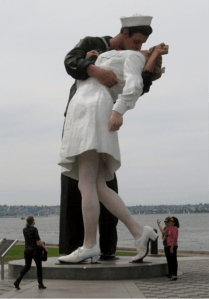
And then, there was the gigantic WW V.J. Day Monument, depicting the famous 1945 Time Square celebration picture of a sailor kissing a dental technician. Many, along with me, had always thought she was a nurse, because of her white uniform, but the base plaque said she was not a nurse, but a dental technician. I finished the day with a wonderful visit with our high school friends Jim and Charlene, while we ate dinner at the Brigantide Seafood Restaurant.

2


The next morning I headed east to visit the Pacific Southwest Railroad Museums in La Mesa and Campo, Ca. Unfortunately, they were both closed, so I just kept heading east toward Yuma, AZ where I planned to visit the Yuma Territorial Prison. Now there was a place you would never have wanted to be incarcerated, as a criminal, in the late 1800s. Amazingly, even though most inmates were sentenced to do time at the Territorial Prison for violent crimes, some were sent there for things such as polygamy, forgery and violations of the Neutrality Act. While in Yuma, I also visited the U.S. Quartermaster Depot which was used by the U.S. Army to store and distribute supplies for military posts in the territories of Arizona, Nevada, Utah, New Mexico, and Texas from 1864 to 1883.

3


Next, it was on East for another 240 miles of desert, thru Gila Bend and a lot more desert, to Tucson, AZ where I was looking forward to visiting the Pima Air & Space Museum and AMARG (Better known as the Bone yard). The next day was Friday, and I was up bright and early so I could be first in line for tickets to both the Museum and the Bone Yard, since they only gave Bone Yard tours M-F. What a great time I had there! The Museum itself encompasses four large hangers of beautifully restored aircraft, and 30+ acres of static display aircraft outdoors. The Bone Yard consists of over 300 acres, where literally thousands of discontinued U.S. Military aircraft are stored, reclaimed or restored to flying condition when needed.   Luckily, the Museum provides bus tours of both the Museum grounds and the Bone Yard, so people like me can see most all there is to see in about 4-6 hours. It really boggled my mind to see acres and acres of airplanes stored like that, all in one place!

4


—–To Be Continued—–


My Western Trip Part~9

2 Jul

A Slice of Life

Bill Lites

Bill Lites

Bill Lites

The next morning I visited the Joe Martin Miniature Engineering Museum in Carlsbad, CA.   I had received emails about the detailed aluminum model aircraft that Young Park had built. Maybe you have seen pictures of them. When I researched his planes, I discovered he had donated a couple of his masterpieces to the Joe Martin Museum, and I wanted to see them up close. They are unbelievably detailed!

1

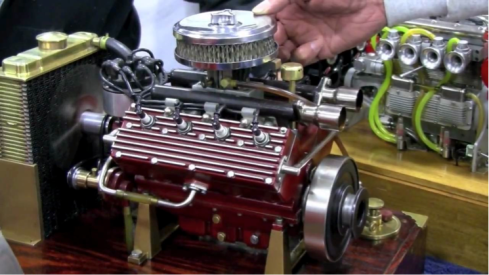
Well, I was absolutely overwhelmed by the many museum models! There were miniatures of just about everything mechanical you can think of. They were all scratch built, and all work just as the full sized item would. It’s hard for me to grasp the idea that people have the skill and patience to build these working miniatures. There were several examples of model steam engines (operated by air pressure), and a demonstration of a model V-8 auto engine, that had the coolest sound. If you can imagine a soprano Vroom-Vroom!!!

2


And, then there was the model “external” combustion engine demonstration, which included the answer to one of my life long questions. In the early days of the railroad, how did they keep the water tanks you see being used (in the movies) to replenish the steam engines, filled with water? Answer; External Combustion Engines (not usually seen) used to pump water from a well near the tank. Also not seen, is the job of the train’s engineer, who would stoke the pump’s external engine fire source when he finished filling his train’s water tank. I find these engine pumps fascinating. There are some really cool examples of model “external combustion engines” on YouTube. If you Google “External Combustion Engine” some of the schematics are even animated, giving you a good idea of how the engine and its pump works. Check them out for yourself, it’s really interesting.

3


Needless to say, I spent a lot more time at the Joe Martin Museum than I had planned. But, once I was able to tear myself away from all those fabulous models, I headed for San Diego. I made stops on the way at the Antique Car & Steam Engine Museum, the Mission San Luis Ray and the Flying Leatherneck Aviation Museum. The next morning I went to Balboa Park to visit the San Diego Air & Space Museum, the San Diego Auto Museum and the San Diego Model Railroad Museum. I had been to the Air & Space Museum and the Auto Museum (Google; Louie Mattar’s Fabulous Car & Old Plank Road) two years ago, but I had missed the Model Railroad Museum. Supported by at least four local model railroad clubs, this is one of the largest (27,000 sq. ft.) model train layouts in the country. They must have had 15 or 20 tracks coming into the rail yard and turntable area from all directions. I wished my friend Leon, who works with Model Circus Train clubs in Albuquerque, NM, could have been with me to see this fabulous layout.

4


—–To Be Continued—–