SUNDAY MEMORIES
Judy Wills

Today’s adventure in greater London was a bus tour to Windsor Castle.

Credit Google Search and Wikipedia
Fred and I had visited this magnificent castle back in 1970, and I shall present some of the pictures we took at that time in this post.
We were told that Windsor Castle is Queen Elizabeth II’s favorite castle. While I don’t remember going inside anywhere, I can still see why she loves it so much.
We saw many beautiful parts of this castle. We saw the King Henry VIII Gate.

We saw King George’s Chapel (here with a corner of the barracks).

We were allowed to be and see the inside courtyard, and took several pictures from different angles.


I really loved the stoneworks that make up this castle. It’s just lovely.
Back in 1970, as we were walking toward the castle, we were told by the guide to be very careful during the changing of the guards. Especially as they headed toward the barracks. He said that, because they had been on duty and were tired, that they stopped for no one on their march to the barracks!! So watch out!! Don’t get in their way, or you will be run over!
Outside the castle itself, we saw the castle from the distance, along with a bronze statue of Queen Victoria – in the middle of the street! It is well kept.

Credit Google Search and Mapio.net

While we enjoyed our tour of the castle grounds, Fred and I had the pleasure, back in 1970, of seeing a part of Windsor that is seldom seen by the general public. We were told, back then, that we would be able to see the Queen’s Apartment Gardens – but only because she was not in attendance at Windsor at that time. We were thrilled!! That was a once-in-a-lifetime event for us. Here are the pictures we took – of the Queen’s apartment, and the gardens she saw when she looked out her windows. Beautiful!

The Queen’s Apartments from the gardens

The Queen’s Gardens
Back in 1970, from one point in Windsor, we were able to see Eton College. Here is a picture from then.

From Windsor, we went to Hampton Court Palace.

This is another lovely piece of English history. The building was begun in 1515 by Cardinal Thomas Wolsey. In reading some articles on Google, it seems that King Henry VIII more-or-less confiscated it from Wolsey following a falling-out between them, in 1529. Henry then enlarged the palace for his own pleasure.

Anne Boleyn’s gate with clock tower


Hampton Court is a great place to visit if you are ever in the London area. And I would like to say here, that if you ever come to Orlando, and go do Disney World, and EPCOT especially, when you get to the country of “England” – look at the front of the store and you will see Hampton Court. The store front looks like Anne Boleyn’s Gate. But also look up at the brick chimneys – they remind me so much of Hampton Court! I hope they were built at EPCOT with that just in mind. Delightful!
~~~~~~~~~~To Be Continued~~~~~~~~~~












 we finally got there just before dusk. Newton Cottage B & B was an “Olde Worlde” (circ.1670) thatched roof house, that we learned was listed as a building of historic and architectural interest. It was typical of a lot of the homes in this area, many of which had been converted into B & Bs. This was the only B & B reservation we had made from the U.S. and we were thrilled with the accommodations. Of course, the doorways and ceilings were very low, the stairs and floors squeaked, and when the ad said “Central Heat” that meant warm enough for the English, not for someone use to Florida weather.
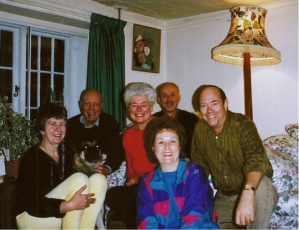 wonderful time comparing travel notes. The local Pub, where we took our evening meals, was just across the street from our B & B, and down a small tree covered lane. What a picture that made! As it turned out, the Pub owner collected matchbook covers, as I did, and he gave me some of his duplicates. I made arrangements to send him some of my duplicates as soon as we got home. (Another fun hobby lost to the demands of the environmentalists).
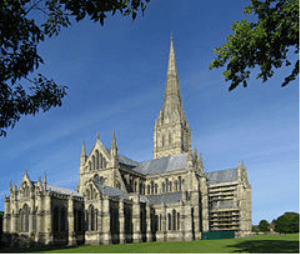 1260 AD, after the city was first established in approximately 1220 AD. We visited a unique War Memorial and cemetery for the men from this southern Wilshire area who fought and died in what was then called “The Great War” (1914-1917).
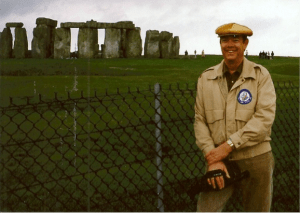 many different cultures. Whatever religious, mystical or spiritual elements were central to the construction of Stonehenge over the centuries, its design includes a celestial observatory function, which might have allowed for the prediction of eclipse, solstice, equinox and other celestial events important to contemporary religions of those different times.

 Old Things R New