A Slice of Life
By Bill Lites

Next, it was over to Simi Valley, CA for a tour of the Ronald Reagan Presidential Library & Museum. I was impressed with the 24 different galleries, which traced Reagan’s life from his early days as local hero, college standout, glamorous Hollywood actor, then as governor of California, and ultimately to the presidency of the United States. There was even a full-sized replica of the Oval Office in one of the galleries. But, of course the thing that impressed me the most was Air Force One (S/N 27000), also known as “The Flying Whitehouse” and the Marine One helicopter (S/N 150611), both of which Reagan used while President. I asked one of the Docents how they got the plane in the building, and she said, “They built three sides of the new building, took the wings and tail assembly off the plane, so they could bring it in through the fourth opening, and re-assembled the airplane inside. Then they finished the fourth all glass wall. For the full story of how the U.S. President’s airplane got its name, Google “Air Force One.” It’s a fascinating story I think you will enjoy knowing.

Before leaving Simi Valley, I stopped at the Santa Susana Railroad Depot & Museum to get the history of an early California railroad depot and its operations. This was one of the most unusual and interesting small museums. The depot is an example of what the Southern Pacific Railroad called their Standard No. 22 Depot in 1903. The depot has been meticulously restored with many original furnishings and working equipment, that the Docent uses to explain to visitors how the depots operated in the early 20th century. Today, on what was the old Southern Pacific rails, Amtrak’s Coast Starlight trains head up and down the coast, and the daily Surfliner and Metrolink trains ferry commuters in and out of Los Angeles.

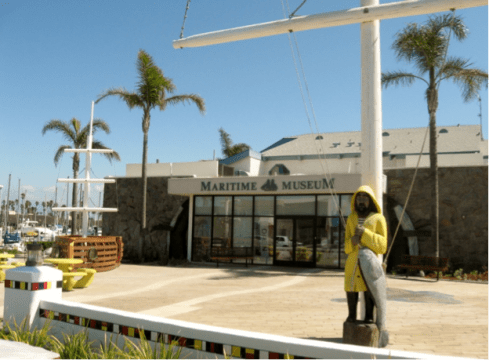
Now, because of a time constraint, I headed west to Oxnard, CA where I quickly visited the small Mullin Automotive and Murphy Auto Museums. I also visited the Channel Island Maritime Museum, there in Oxnard, where I learned something very interesting about some of the early 17th century Dutch Maritime painters. It seems that some of them painted in such detail that (with a very strong magnifying glass) one can see that each of the distant subjects in the painting has been given details such as a pipe in the mouth, some with a mustache and all with a nose, ears and even eyebrows. The kind of details you might expect in a close-up portrait painting, but not in a battle scene at sea. And, then there were the fabulous model ships, many of them crafted by the Curator/Docent that took me on a tour of the museum. The model ship detail was outstanding! What a great tour.
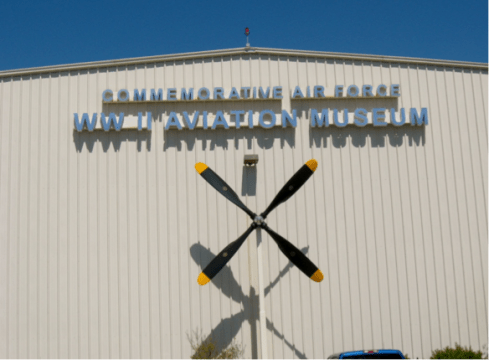
Then, to round out the day, I visited the CAF WWII Aviation Museum in Camarillo, CA. This museum is very similar in size and display aircraft to the Valiant Air Command Warbird Museum here in Titusville, FL where I volunteer as a tour guide one day each week. They had an AT-6 and a two-place P-51 Mustang, both actively giving rides while I was there, and I got some really good close-up photos of both as they fired up their engines, taxied out with their passengers and took off. I always get a thrill when I hear the sound of a Rolls-Royce Merlin engine at full throttle passing overhead.
—–To Be Continued—–



 extended on station, the Navy had to come up with a way to transport me back to the states. So, I received orders to be flown from Japan to Treasure Island Naval Station in California for separation. With everything I owned in my duffle bag, my first attempt to get to an airport was a four-hour hot and bumpy school bus ride, on some of the roughest roads I had ever traveled, to Itazuke AFB. Since I was enlisted, which is as low as it gets in the military, when it comes to travel authorization, several officers bumped me off that flight, and I had to endure another 4-hour bus ride back to the ship.
 accounted for. Once they got the doors closed, we taxied to the end of the runway, the pilot did his pre-flight engine checks, and we headed down the runway at full power. Well, full power didn’t last long, as at least one of the engines started backfiring and the pilot aborted the takeoff. We stopped at the end of the runway, and the pilot did more engine checks. Since there still was no wind from any direction, the pilot turned back on the runway, and headed off at full power again. This time an engine caught on fire, and thank God the pilot had time to abort the takeoff. We all hurriedly deplaned, dripping wet, on shaky legs, and walked back to the terminal, leaving the flight crew and fire department to deal with the smoking engine. That episode didn’t give me a lot of confidence in any C-124 being able to get me safely back to the states.
 was only bumped off one flight there, before I was given a seat on a TWA Super “G” Constellation flight headed for San Francisco. The flight consisted of three, very long 8-hour, over water flight legs, with stops at Wake Island, then at Honolulu, Hawaii and finally to San Francisco International Airport. Even though that flight was luxurious, compared to what the C-124 flight on MATS would have been, I was still mighty glad to be on the ground, and at the end of that trip.
 Naval Reserve, to finish my 6-year tour of duty I had signed up for. I spent most of my free time visiting many of the tourist spots San Francisco is best known for, such as “Alcatraz Island”, Coit Tower, the Planetarium at Golden Gate Park, and of course, Fisherman’s Wharf, where I enjoyed some of their world famous seafood more than once.








 Old Things R New