Tag Archives: Travel Tuesday

The Cruise of a Lifetime~Part 12

8 May

SUNDAY MEMORIES

Judy Wills
JUDY


After breakfast, we began a partial bus-and-walking tour of Vienna, Austria. There’s just so much to see. It seems strange to have an ultra-new building with the old buildings, but they seem to fit together rather well. For the entire six years we lived in Germany, I hounded Fred about taking me/us to Vienna. Never happened! So this trip finally put us in that beautiful city.


I’m not a terribly good historian, but I have heard of the Hapsburg Dynasty. Austria was the home for that dynasty. The ship’s info sheet stated: The rise and fall of the House of Hapsburg began along the Danube’s banks in 1276. With Austria firmly in their grasp, the family gained new territories by marriage until their serial nuptials put most of Europe under their power. As their wealth and territory grew, few royal families remained to help them acquire more kingdoms. Their solution to this problem may have also been their undoing. While the dynasty actually had its beginning in 1020, it wasn’t until 1273 when it moved to Austria.

The info sheet also said: The Hapsburgs sought to retain their massive power through intermarriage between cousins or uncle and niece. “The best spouse for a Hapsburg is another Hapsburg,” went the proverb. The last of the Spanish line, Charles 2, was disabled from birth, perhaps from a genetic disorder typical in children born from siblings, and died. It’s likely that the Austrian Hapsburg line ended for the same reasons.

While there are still living relatives of the Hapsburgs, for all intents and purposes, the dynasty died out in 1918, at the close of World War 1.

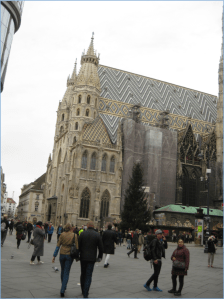
We walked through Saint Stephen’s Cathedral, which has a really dark interior. I was unable to get any good pictures there.
11

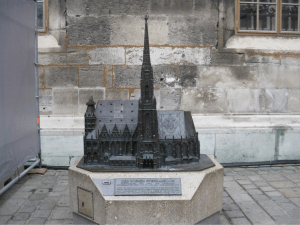
But the outside is remarkable. There is even a bronze model of the cathedral outside, that is to scale.
12

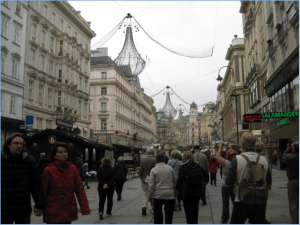
We then walked through some of their Christmas Market. It was still rather early in the season for the Christmas Market to be up and running, but there were a few booths set up already, and we enjoyed seeing them.
13

At 12:45 we met under the clock on the square and headed back to the bus and into the ship for lunch, which we had with Richard, Judy and Lucy.

At 2:00 p.m. we took a tour of the Schönbrunn Palace. It’s very opulent, but beautiful.

On our way into the Palace, there was a man on the sidewalk, covered in gold. He was standing on a box, and was singing some Mozart – advertising a concert. I just thought it was cute. I gave him a short curtsy, and he replied with a small bow.

17

We had an early dinner (6:00 p.m.) with Richard, Judy and Lucy. At 7:00 p.m. some of the group left for a Mozart and Strauss Concert, that was free to all who wanted to attend, since we had to change ships again. Fred and I decided to stay onboard and pack. Then we read some, and then were in bed and asleep by 9:30 p.m.

~~~~~~~~~~To Be Continued~~~~~~~~~~

The Cruise of a Lifetime~Part 11

1 May


SUNDAY MEMORIES

Judy Wills

JUDY

November 16th, Monday- We were up at 6:00 a.m. to shower and dress. We had breakfast at 7:15 a.m., with Richard, Judy and Lucy joining us (they don’t get up as early as we do). By 8:00 a.m. we arrived at Emmersdorf, Austria.


At 9:30 a.m. we took a bus to the 900-year-old Melk Abbey. It is situated on an outcrop rising above the Danube, crowned by twin towers.

While the abbey was founded in 1089, and given to the Benedictine monks, the current abbey was renovated between 1702 and 1736. It was originally a royal palace with ceremonial courts, guest apartments, grand halls and a library – which contains around 80,000 medieval manuscripts.

Courtesy Wikipedia

Courtesy Wikipedia

The abbey has a blue room,

16


a green room,

17


a marble room, and the mirrored room.

18


Many of the floors have beautiful wood-inlay.


This beautiful stairway is the beginning of the grounds. However, since I still couldn’t maneuver stairs very well, we walked down (and later up) the ramp.

23


By 12:10 p.m. we were back on board the ship, and had lunch in the Lounge with Janice and John from Ontario. We were also joined by the couple from Los Angles (originally Denmark) but we still did not get their names.

At 2:00 p.m. we sailed through the Wachau Valley.

24


The countryside is stunningly beautiful. Both banks are dotted with ruined castles and medieval towns and are lined with terraced vineyards.   The Wachau is described as “an outstanding example of a riverine landscape.” Noted for its cultural importance as well as its physical beauty, it is described: “The architecture, the human settlements, and the agricultural use of the land in the Wachau vividly illustrate a basically medieval landscape which has evolved organically and harmoniously over time.”

At 4:00 p.m. we docked in Krems.

29


Fred and I decided to stay on board the ship because it would be getting dark soon and it was cool and windy. Before dinner Fred and I watched the Monuments Men movie in our stateroom. Really good movie, and gave us some insight into the Nazi greed and stupidity.

At 6:45 p.m. we went to the preview of tomorrow’s Vienna excursions. Carl West told us we have to change ships again. Following much groaning from the passengers – during which he remained silent – he said, “thank you.”

At 7:15 p.m. we had a traditional Austrian dinner. We had our first schnitzle with potatoes, a small piece of chicken, wurst, and dessert. Richard, Judy and Lucy ate with us.

We sailed to Vienna overnight.


~~~~~~~~~~To Be Continued~~~~~~~~~~

The Cruise of a Lifetime~Part 8

3 Apr

SUNDAY MEMORIES

Judy Wills 

JUDY


Friday, November 13, 2015

We were up early and were at breakfast by 7:15. We were to have a very busy day this day.We arrived at Nuremberg at 9:00 a.m. and we began the World War 2 tour. We visited Zeppelin Field, the Congress Hall, Documentation House, and the Memorium Nuremberg Trials.

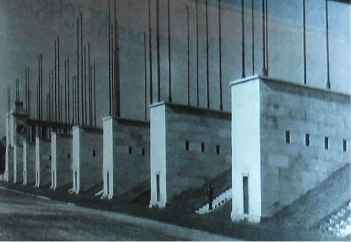
The Zeppelin Field was where many of the Nazi rallies was held. It was not as large as we had expected. The buildings had been reduced to just a few, and the center building had sported the Swastika that was blasted off after the war (famous picture of that event).

Every few yards along the perimeter, there was a building. When the guide asked if we knew what they were, many in the group suggest one thing or another. He said, “it’s really very simple.” When I said, “restrooms,” he said, “that’s right.” With the 250,000 people assembled, they had to have facilities for them. (These two pictures were taken by me and cropped)

5


We visited the Documentation House, which is attached to the Congress Hall.

6


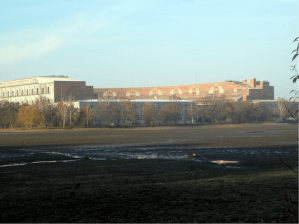
The Congress Hall was built at Hitler’s demand, and was to be used only for one time each year. When Hitler was asked how all these buildings would be paid for, he replied that, after they won the war, they would get the money from those Germany conquered. The Congress Hall was built in the shape that was to duplicate the Roman Coliseum. The Documentation House held many photos and memorabilia from the Nazi era.

7


We sat in the courtroom where the Nuremberg Trials were held in the Palace of Justice. Fascinating room, with large placards holding pictures and notes about the trials.

8

Lots of information was given – through the placards as well as our knowledgeable guide. He mentioned Robert H. Jackson, who President Truman appointed as U.S. Chief of Counsel for the prosecution of Nazi war criminals. He made some outstanding statements (courtesy Wikipedia):

Closing Argument for Conviction of Nazi War Criminals

Robert H. Jackson, U.S. chief of counsel for the prosecution of Nazi war criminals

An advocate can be confronted with few more formidable tasks than to select his closing arguments where there is great disparity between his appropriate time and his available material. In eight months – a short time as state trials go – we have introduced evidence which embraces as vast and varied a panorama of events as has ever been compressed within the framework of a litigation. It is impossible in summation to do more than outline with bold strokes the vitals of this trial’s made and melancholy record, which will live as the historical text of the Twentieth Century’s shame and depravity.

Nuremberg Prosecutor (1945-1946) Speeches


One of the most famous statements he made was:

“The true applicant before the bar of this court is civilization.”

Strategies of the American Chief Prosecutor Robert H. Jackson


It all had a profound impact upon us.

~~~~~~~~~To Be Continued~~~~~~~~~~


The Cruise of a Lifetime~Part 7

27 Mar

SUNDAY MEMORIES

Judy Wills

JUDY


Thursday, November 12.

Since we hadn’t reached Bamberg yet – scheduled to arrive about 1:00 p.m. – and it was another sailing morning, we slept in, getting to breakfast at 8:00 a.m. Before we finished, Richard, Judy, and Lucy arrived. They got their breakfast, and we visited until 9:30.a.m. We went through several locks, which was fun to experience.

Carl West, Program Director for the Gefjon, gave detailed information about the tours in Vienna, Budapest and other cities, which Fred attended, followed by lunch in the lounge.

At 1:30 we left the ship on a bus transfer to the city of Bamberg.

2

We went on a walking tour of Bamberg, seeing many beautiful and unusual types of architecture and statuary.

We saw beautiful churches and buildings, including St. Michael’s Abbey for the training of the clergy.

We even saw a “Green Goose” pub!

10

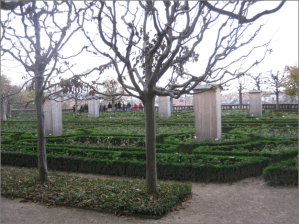
It always seemed funny to us to see English words in a German town. We even found a Kätie Wohlfahrt Christmas store in town! We walked through a garden, with a few flowers still in bloom.

11

According to the info sheet from the ship: “One of the few cities in Germany not destroyed by World War 2 bombing, Bamberg is the largest Old Town to retain its medieval structures…Along with its Gothic, baroque and Romanesque architecture, the city was laid out according to medieval planning rules as a cross with churches at the four cardinal points.”

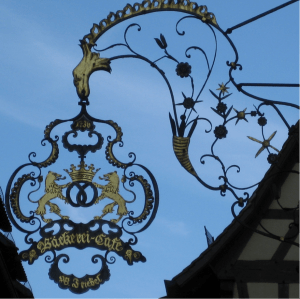
Ever since we lived in Germany, I have been fascinated with the hotel/store/restaurant signs. Back in the days when the “common” folk were more or less illiterate, the signs were posted so everyone would know just what the establishment was. If it was a bakery, there was a pretzel within the sign.

12


The butcher could have an animal within the sign. The drug store or apothecary usually had a mortar and pestle within the sign.

13


You get the picture. But the signs were usually quite ornate and beautiful. I looked for them above each store and took as many pictures of them as I could.

While in Bamburg, we stopped in a Karstadt department store (comparable to our Dillards, and one of our favorite places to shop when we lived in Germany) to purchase some socks. I walked up to a saleslady and said, “Entschuldigen (excuse me).” She smiled at me, and then I said, “Ich habe nur ein bischen Deutch. (I have only a little German) Haben sie….?” and pulled up my pant leg to show her my knee socks. She immediately took me to where the women’s socks were. I thanked her profusely. They were lovely, soft socks, and I enjoyed wearing them.

Here is a picture of a plaque with a date.

14

Our guide asked if we understood the date. It looks to be 1867 – but we are told that’s not correct. The “8″ is not complete – and therefore is actually a “4″ or half of the “8.” So the correct date would be 1467. Interesting.

We were all to meet at Neptune’s statue, to get back on the bus for the return trip to the Gefjon. While waiting to get to the bus, I was “baptized” by bird droppings while sitting under a tree.

15

We had dinner in the ship’s restaurant again, and to bed by 10:00 p.m.