Tag Archives: Travel Series

The Cruise of a Lifetime~Part 11

1 May


SUNDAY MEMORIES

Judy Wills
JUDY

November 16th, Monday- We were up at 6:00 a.m. to shower and dress. We had breakfast at 7:15 a.m., with Richard, Judy and Lucy joining us (they don’t get up as early as we do). By 8:00 a.m. we arrived at Emmersdorf, Austria.


At 9:30 a.m. we took a bus to the 900-year-old Melk Abbey. It is situated on an outcrop rising above the Danube, crowned by twin towers.

While the abbey was founded in 1089, and given to the Benedictine monks, the current abbey was renovated between 1702 and 1736. It was originally a royal palace with ceremonial courts, guest apartments, grand halls and a library – which contains around 80,000 medieval manuscripts.

Courtesy Wikipedia

Courtesy Wikipedia

The abbey has a blue room,

16


a green room,

17


a marble room, and the mirrored room.

18


Many of the floors have beautiful wood-inlay.


This beautiful stairway is the beginning of the grounds. However, since I still couldn’t maneuver stairs very well, we walked down (and later up) the ramp.

23


By 12:10 p.m. we were back on board the ship, and had lunch in the Lounge with Janice and John from Ontario. We were also joined by the couple from Los Angles (originally Denmark) but we still did not get their names.

At 2:00 p.m. we sailed through the Wachau Valley.

24


The countryside is stunningly beautiful. Both banks are dotted with ruined castles and medieval towns and are lined with terraced vineyards.   The Wachau is described as “an outstanding example of a riverine landscape.” Noted for its cultural importance as well as its physical beauty, it is described: “The architecture, the human settlements, and the agricultural use of the land in the Wachau vividly illustrate a basically medieval landscape which has evolved organically and harmoniously over time.”

At 4:00 p.m. we docked in Krems.

29


Fred and I decided to stay on board the ship because it would be getting dark soon and it was cool and windy. Before dinner Fred and I watched the Monuments Men movie in our stateroom. Really good movie, and gave us some insight into the Nazi greed and stupidity.

At 6:45 p.m. we went to the preview of tomorrow’s Vienna excursions. Carl West told us we have to change ships again. Following much groaning from the passengers – during which he remained silent – he said, “thank you.”

At 7:15 p.m. we had a traditional Austrian dinner. We had our first schnitzle with potatoes, a small piece of chicken, wurst, and dessert. Richard, Judy and Lucy ate with us.

We sailed to Vienna overnight.


~~~~~~~~~~To Be Continued~~~~~~~~~~

The Cruise of a Lifetime~Part 10

24 Apr

SUNDAY MEMORIES

Judy Wills

JUDY


2


This is the day we would be transferring from the Gefjon to the Skadi.

Therefore, we were up at 5:30 a.m., dressed and finished packing. We had breakfast at 6:45 a.m. with Richard, Judy and Lucy, and Danny who is retired military. Richard liked to tease Danny, so we had a lively breakfast conversation.

We had to have our bags outside our door by 8:30 a.m. We were also to have our room keys turned in by 8:30 a.m. We boarded bus number 3 and left at 9:00 a.m. along with three other buses bound for Passau. We rode the bus for one-and-a-half hours to Passau.

We checked into the Skadi. It was essentially the same ship, just a bit older. We even had the same room number, 325. We unpacked our tote bags (they would bring our suitcases later), then at 11:30 a.m. we went on a one-and-a-half-hour walking tour of Passau.

Passau (pass-ow) is known as the “City of Three Rivers.” It lies at the confluence of the Inn, the Danube and the Ilz rivers. It was originally a settlement of the Boil Celtic tribe, and later the site of the Roman fort, Castra Batava. Passau was an important medieval center for the salt trade, the “white gold.” It was transported from the Alpine salt mines to Passau, where it was processed by entrepreneurs called Salzfertiger. The salt imports to Passau were forbidden in 1707, and that trade was lost.

During the Renaissance, Passau became famous for making high-quality knife and sword blades. Local smiths stamped their blades with the Passau wolf, and superstitious warriors believed that the wolf granted them invulnerability.

When fires ravaged the city in the 17th century, it was rebuilt to reflect the baroque character that survives today. Today, Passau is home to 50,000 people.

We were back on board the Skadi by 1:30 p.m. and had lunch in the lounge with Richard, Judy and Lucy. By the time we had finished lunch, our suitcases were in our room, so we unpacked them. We hoped this would be the only transfer we would have on this cruise. One nice thing about a cruise – you usually get to stay in the same room for the duration, which makes it quite nice. This was just a small disruption.

After we had unpacked, we went back into town. We saw St. Michael’s cathedral first,

and then Saint Stephen’s.

It is one of the town’s foremost baroque landmarks and boasts the largest pipe organ outside the United States. Beautiful. It has 17,974 organ pipes, 233 stops and four carillons. All five parts of the organ can be played from the main keyboard, one at a time, or all together.

The Skadi sailed at 5:00 p.m. At 7:00 p.m. we had dinner with John and Denise from California, and a couple from Los Angeles who were originally from Denmark (never got their names). He was a German teacher in a high school in Los Angeles.More interesting sights in Passau:

~~~~~~~~~~To Be Continued~~~~~~~~~~

The Cruise of a Lifetime~Part 9

17 Apr

SUNDAY MEMORIES

Judy Wills

JUDY


Saturday was a sailing morning, so we slept in a bit, and went to breakfast at 8:15a.m. We had our breakfast with Richard, Judy and Lucy.

We are now on the Danube River. We went through the last two locks on our journey during breakfast. These are the first locks that lower the water level rather than raising us up a level. Most interesting process to watch.

We spent time with the Richard, Judy and Lucy until lunch, which we shared with them. They are such fun people to be with. Still reminiscing about Albuquerque.

Carl West had informed the passengers that we would be able to purchase a flash drive with all the pictures he had taken on this trip. Fred purchased one for us. I had taken quite a few pictures, but thought that the ones Carl had taken would just add to our experience and memories. NOTE: Carl West followed each day’s excursions, and was snapping pictures all the time – usually of the groups and what we were seeing.

We docked at Regensburg at 1:30 p.m.

6

At 2:00 we began a walking tour of Regensburg. Regensburg is the oldest city on the Danube, and one of Bavaria’s most beautiful, best-preserved medieval towns in Europe. The Roman Gates of 179 AD are still standing. It was a very cold and very windy day, so we were back on the ship by 3:45. As Fred’s Mother, Kitty Wills once said when we were with her and Charlie in Edinburgh, Scotland, “I’m just about as cold and wet as I care to be!” So we returned to the ship.

There is an area in Regensburg that has brass plaques in the bricks with people’s names and dates on it. They were murdered by the Nazis during World War 2. Their relatives never wanted them to be forgotten, so this was their way of memorializing them.

7

Occasionally the Danube overflows its banks, and the river water floods the city. Here are a few markers with dates – about 15′ to 20′ above the river’s normal level: February 1893 and June 2013.

8

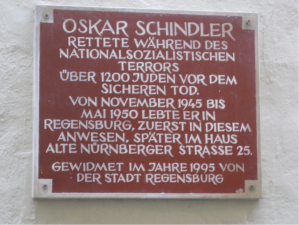
Oskar Schindler (of Schindler’s List fame) lived in Regensburg from 1945-1950 in the Goliath House.

Notice Goliath's left arm around the window frame

Notice Goliath’s left arm around the window frame

He immigrated to Argentina in 1950. He died in 1974, and at his request, is buried in Jerusalem.

11


A point of interest: Pope Benedict XVI (2005-2013) grew up in Regensburg. He was the first pope to resign since Gregory XII in 1415.

We stayed on the ship the remainder of the afternoon, since the weather was not too good. We had a short nap, and just rested.

At 6:45p.m. we were in the lounge where Carl West gave us all the information on the ship transfer the next day.We had dinner with Jane and Steve (Colorado) and another couple.

By 9:00 we were back in the room to pack is much as we could of our clothes for the transfer the next day. Because we would have to get up early the next morning, we took our showers before we went to bed.

Some interesting pictures in Regensburg:

~~~~~~~~~~To Be Continued~~~~~~~~~~


The Cruise of a Lifetime~Part 7

27 Mar

SUNDAY MEMORIES

Judy Wills

JUDY


Thursday, November 12.

Since we hadn’t reached Bamberg yet – scheduled to arrive about 1:00 p.m. – and it was another sailing morning, we slept in, getting to breakfast at 8:00 a.m. Before we finished, Richard, Judy, and Lucy arrived. They got their breakfast, and we visited until 9:30.a.m. We went through several locks, which was fun to experience.

Carl West, Program Director for the Gefjon, gave detailed information about the tours in Vienna, Budapest and other cities, which Fred attended, followed by lunch in the lounge.

At 1:30 we left the ship on a bus transfer to the city of Bamberg.

2

We went on a walking tour of Bamberg, seeing many beautiful and unusual types of architecture and statuary.

We saw beautiful churches and buildings, including St. Michael’s Abbey for the training of the clergy.

We even saw a “Green Goose” pub!

10

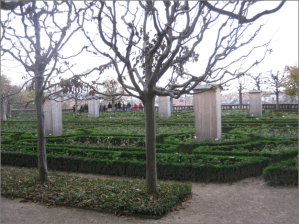
It always seemed funny to us to see English words in a German town. We even found a Kätie Wohlfahrt Christmas store in town! We walked through a garden, with a few flowers still in bloom.

11

According to the info sheet from the ship: “One of the few cities in Germany not destroyed by World War 2 bombing, Bamberg is the largest Old Town to retain its medieval structures…Along with its Gothic, baroque and Romanesque architecture, the city was laid out according to medieval planning rules as a cross with churches at the four cardinal points.”

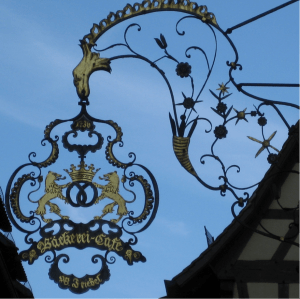
Ever since we lived in Germany, I have been fascinated with the hotel/store/restaurant signs. Back in the days when the “common” folk were more or less illiterate, the signs were posted so everyone would know just what the establishment was. If it was a bakery, there was a pretzel within the sign.

12


The butcher could have an animal within the sign. The drug store or apothecary usually had a mortar and pestle within the sign.

13


You get the picture. But the signs were usually quite ornate and beautiful. I looked for them above each store and took as many pictures of them as I could.

While in Bamburg, we stopped in a Karstadt department store (comparable to our Dillards, and one of our favorite places to shop when we lived in Germany) to purchase some socks. I walked up to a saleslady and said, “Entschuldigen (excuse me).” She smiled at me, and then I said, “Ich habe nur ein bischen Deutch. (I have only a little German) Haben sie….?” and pulled up my pant leg to show her my knee socks. She immediately took me to where the women’s socks were. I thanked her profusely. They were lovely, soft socks, and I enjoyed wearing them.

Here is a picture of a plaque with a date.

14

Our guide asked if we understood the date. It looks to be 1867 – but we are told that’s not correct. The “8″ is not complete – and therefore is actually a “4″ or half of the “8.” So the correct date would be 1467. Interesting.

We were all to meet at Neptune’s statue, to get back on the bus for the return trip to the Gefjon. While waiting to get to the bus, I was “baptized” by bird droppings while sitting under a tree.

15

We had dinner in the ship’s restaurant again, and to bed by 10:00 p.m.


The Cruise of a Lifetime~Part 6

20 Mar

SUNDAY MEMORIES

Judy Wills

JUDY


2


After we found “the door,”

12

we walked some more of the town and found a Jewish area that included a garden and some tombstones. We took pictures of some of them. We had never found this area before in all the times we had visited there.

When we lived in Germany, we were occasionally stopped by Germans on the street and asked for directions – in German! Apparently we looked the part! Made us feel pretty good, not to be ugly Americans. All that to say that, as we walked out on the “Pinocchio” part of Rothenburg, I heard “Entschuldigen…Entschuldigen!” (Excuse me…excuse me!). A German couple wanted directions to a café. They seemed a bit put-off when I said – in German – that I only knew it a little German. After they moved on I turned to Fred and said, “we’ve still got it!” Yea!

Rothenberg is part of the “Romantic Road” through southern Germany…”linking a number of picturesque towns and castles. In medieval times it was a trade route that connected the center of Germany with the south. Today this region is thought by many international travelers to possess “quintessentially German” scenery and culture, in towns and cities such as NördlingenDinkelsbühl  and in castles such as Burg Harburg and the famous Neuschwanstein.” (courtesy Wikipedia)

Again from Wikipedia: In March 1945 in World War II, German soldiers were stationed in Rothenburg to defend it. On March 31, bombs were dropped over Rothenburg by 16 planes, killing 37 people and destroying 306 houses, 6 public buildings, 9 watchtowers, and over 2,000 feet of the wall. The U.S Assistant Secretary of War John McCloy knew about the historic importance and beauty of Rothenburg, so he ordered US Army General Jacob L. Devers not to use artillery in taking Rothenburg. Battalion commander Frank Burke ordered six soldiers of the 12th Infantry Regiment, 4th Division to march into Rothenburg on a three-hour mission and negotiate the surrender of the town. When stopped by a German soldier, Private Lichey who spoke fluent German and served as the group’s translator, held up a white flag and explained, “We are representatives of our division commander. We bring you his offer to spare the city of Rothenburg from shelling and bombing if you agree not to defend it. We have been given three hours to get this message to you. If we haven’t returned to our lines by 1800 hours, the town will be bombed and shelled to the ground.”  The local military commander gave up the town, ignoring the order of Adolf Hitler for all towns to fight to the end and thereby saving it from total destruction by artillery. American troops occupied the town on April 17, 1945. After the war, the residents of the city quickly repaired the bombing damage. Donations for the rebuilding were received from all over the world.

We walked back to the bus and drove back to Würtzburg.

As it had been a rather long day, I decided to go back with the bus to the ship, while Fred toured the Würtzburg Residence. Fred said later that, while it was most interesting, there were a lot of stairs, and I would have been uncomfortable. So, again, it’s a good thing I did not go on that excursion.

9


Dinner with the Richard, Judy and Lucy again. 10 o’clock to bed.


~~~~~~~~~~To Be Continued~~~~~~~~~~

Here are some interesting shots of Rothenburg:


The Cruise of a Lifetime~Part 6

13 Mar

SUNDAY MEMORIES


Judy Wills

JUDY


1

Wednesday, we arrived in Wűrzburg, Germany.

We were up early, showered and dressed. At 7:30 a.m. we went to breakfast in the restaurant. Richard, Judy, and Lucy joined us just about the time we had finished our meal. We stayed and talked with them for a while. Judy and I compared piano stories, such as when I was playing for Margaret Nikol (concert violinist; see my post on October 7, 2012) and my sheet music began to fall. I had to stop playing and place both hands on the music to make it stay up. Margaret was on a long note, and just continued to play. When she was ready to move on, I was ready, as well. When I apologized later, she told me that no one noticed. And she was right! Even Fred, who had heard me practice so many times, didn’t notice. Judy said that happened to her, except that the piece of music fell to the floor and she just looked down at it and kept playing!

We had some time before our first excursion, so I transferred the pictures of Miltenberg from our camera to the flash drive I had brought with us. And it’s a good thing I did – we took a LOT more pictures!

At 9:45 a.m. we boarded a tour bus for the 75 minute ride to Rothenburg ob der Tauber.

3

While on the bus, the guide told us about part of Rothenburg’s history. Rothenburg has always been one of our favorite German cities. It is a medieval walled town, and there is a 1.5 mile walkway at the top of the wall that encircles the town, that is still walkable. According to the info sheet: “The wall connects five medieval gates, complete with guard towers that date from the 13th to 16th centuries.” Fascinating!

4

When we arrived in the town center, there was an impromptu brass concert going on, with the players all dressed in German outfits. They were quite good, and we enjoyed their music.

5

At 12:00 all of those on the Viking tour that had taken the Rothenburg excursion, met for lunch at the Gasthof Glocke.

6

It was a neat old eatery, and they were open just for us.

7

Unfortunately, they only had one menu: bratwurst, sauerkraut and mashed potatoes. I know it was easier for them to only serve one menu for that many people, but we were really looking forward to schnitzel. Fortunately, since Fred doesn’t touch sauerkraut, he was able to get his without the sauerkraut. It was still a good meal. We sat at a table for four, kind of in a booth. We didn’t get the names of our table mates.

8

After lunch, we were on our own to explore Rothenburg. We found a shop we had seen on the tour, and purchased a Christmas table runner. We found Käthe Wohlfahrt’s Christmas shop – a favorite place to shop for Christmas ornaments. We purchased three Christmas brass ornaments for Christmas gifts.

We walked around and found “the door” that we had been looking for (please see my post on December 13, 2015 titled “The Door”)

12


~~~~~~~~~~Part 6 – To Be Continued~~~~~~~~~~


Cruise of a Lifetime~Part 5

6 Mar

SUNDAY MEMORIES

Judy Wills

JUDY

After sailing all night, we have moved onto the Main River (pronounced mine). Today was a sailing morning so we slept in. We got up, showered, dressed and went to breakfast. We were joined by Richard, Judy and Lucy, better knowing as Lucy B.

2

We went through one lock during breakfast. We had gone through many locks overnight. It is a fascinating procedure to watch…and sometimes a bit nerve-wracking!! The ship is designed so that, when we go under a low bridge, all the chairs on the top deck are flattened, the sunscreen is collapsed, and the “bridge” is banished to its hiding place, so that everything up top is “flat.”

At 10:00 there was a glass blowing demonstration in the Lounge. The glass blower did the traditional demonstration in the Chilhuly style. He makes his products like Pyrex. According to the info sheet: “(he) creates an exquisite work of art from industrial glass in this captivating demonstration.” He displayed his wares, and they were fascinating. He had oil and vinegar bottles that I would have loved to get for myself and our girls, but we had to think about shipment, and so didn’t. He had jewelry – earrings and such. Really beautiful artwork. Below are a few examples of Chilhuly glass works.

(Credit to: By Patche99z – Own work, Public Domain, https://commons.wikimedia.org/w/index.php?curid=5328589

After lunch in the restaurant, we began the walking tour of Miltenberg, “The Pearl of the Main River.”

6

It is a neat old town. Fred and I thought we had been there before, when we lived in Germany, but we didn’t recognize anything we saw. Here are some good pictures of the town that we took.


We had a good guide. (NOTE: all the guides that Viking uses are locals, and they really know their stuff about the towns we visited. We were impressed) There is a red sandstone that is used locally as well as sent all over the world, as it is quite desirable. We walked and walked the town. Quite unique.

We were back on board the ship after a bus ride from the foot of the Red Stone Bridge. The ship had traveled farther up the river, and we caught up with it and re-boarded.

We had dinner in the ship’s restaurant, and our table mates were Velma and Jeff from Australia

and two others, whose names we didn’t get. Velma suggested a way that she designated her pictures: She would take a photo of the daily information sheet that is given to each cabin, with the date visible, and any photos following that photo belonged to that day. I thought it was a good way to keep track of the photos I was taking, and began doing what she suggested. It seemed to work out quite well. I was impressed with her suggestion, and told her so with my thanks.

We were really tired and so to bed early. Our old age is showing!


~~~~~~~~~~To Be Continued~~~~~~~~~~


The Cruise of a Lifetime~ Part 4

21 Feb

SUNDAY MEMORIES

Judy WillsJUDY

I’ve not mentioned that, before each meal, Fred and I would “excuse” ourselves from the rest of the table, to say our blessing. This morning, at the breakfast table, as we were beginning to excuse ourselves, the other gentleman at the table leaned toward me, arm and hand outstretched across the empty chair between us, and said, “Looks like you are about to thank the Lord.” When I agreed, we all took hands and prayed. After prayer, I told him that he sounded like a preacher. He grinned and said, “well…….”

They turned out to be Richard and Judy, with their widowed friend, Lucy (Richard called her “Lucy B”). They are from Fort Worth, Texas, and he is the Worship Leader for the 8:00 a.m. service at the North Richland Hills Baptist Church. He also directs the Senior Adult Choir there. So while he is not a preacher, he is in the Christian ministry.

Richard and Judy flank Lucy

Richard and Judy flank Lucy

We found several points in common: His wife’s name is Judy – I am Judy. She is a pianist – I am a pianist (of sorts). I asked her one time: If you are eating a piece of cake, what is your favorite part, the cake or the icing? Her response? THE ICING! I gave an air fist pump and a whoop of joy – because that’s MY favorite part of a piece of cake, as well! WOW….are we twins?

We struck up an instant friendship.   Judy is the pianist for the service at their church (he affectionately calls her “Sister Judy” – i.e. “play us something in the key of G, Sister Judy”). He would address me occasionally as “Judy2.”

Just a note here to say that the first four years Fred and I were married were spent in Fort Worth, while Fred attended and graduated from Southwestern Baptist Theological Seminary. We are quite familiar with Fort Worth.

4

Southwestern Baptist Theological Seminary – the Rotunda

While Lucy was up getting her food, we talked about Fort Worth and seminary. He mentioned that Lucy was a Baylor University graduate, and I told him about my Dad being one of the three students at Baylor in the very first graduating class in the School of Music in 1924.

6

When Lucy returned, he informed her that my Dad was a Baylor grad. She blinked and looked at me. Our conversation took off from there. She is a die-hard Baylorite!

7

There is also another connection between Richard and us – he was the Minister of Music for the First Baptist Church in Albuquerque, New Mexico – my original home church – in the 1970’s! We began comparing notes on people we both had known while there. Absolutely amazing!

Original building, First Baptist Church, Albuquerque, New Mexico

Original building, First Baptist Church, Albuquerque, New Mexico


Following breakfast, I wasn’t feeling very well, so I stayed in the stateroom, while Fred went on an excursion (walking tour) to the Marksburg Castle. He came back saying that it had been a VERY difficult walk/climb, and I would not have been able to manage all the steps and the climb. I was glad I had stayed home! But he took lots of pictures, and said it was a delightful castle to explore. I’m glad he was able to make the jaunt by himself.


~~~~~~~~~~Part 4 to be continued~~~~~~~~~~


The Cruise of a Lifetime~Part 3

14 Feb

SUNDAY MEMORIES

Judy Wills

JUDY


Our second morning began again with breakfast. We shared our table with Tina and Bob.

We had sailed overnight to Cologne, Germany, and arrived about 10:30 a.m. Shortly thereafter, we began the walking tour of the historical center of the city. Our guide told us that Cologne is the oldest city in Germany. It dates back to around AD 50, when the Romans established a major settlement.   We had a really interesting guide. He told us how the Romans conquered one side of the river – the side we were on – but couldn’t get across to the other side. They called the people on the other side “barbarians.” Now, the politically correct people call them the “cross-eyed” people instead.

In 1709, Italian expat and Cologne resident Giovani Farina created a citrus-scented toiletry he dubbed “Eau de Cologne” in honor of his adopted city. Other perfumeries followed, especially Wilhelm Meulhens, who founded the famous “4711″ brand (named after the address of his manufacturing building). There are several museums in the area, as well as a Chocolate Museum – which we didn’t get to!

Because it was Sunday we could not get into the cathedral until after services, so we walked around the outside of it and the square. Our guide told us about the cathedral, how long it took to build which part, which was the oldest, etc. He gave us other information about Cologne. He was a very interesting man.


Many years ago, while we were living in Germany and took our own tours of the country, we visited Cologne, and found a fountain that depicted an interesting and funny story about German workers.


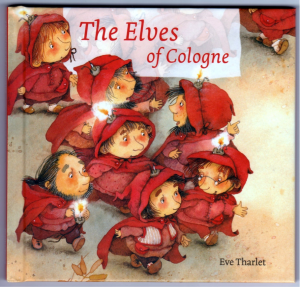
While on our tour, we walked right up to the fountain – called the Elves of Cologne. We were so excited! We thought we would have to find it on our own, and there it was! Wikipedia says: The Heinzelmännchen are a race of creatures appearing in a tale connected with the city of Cologne in Germany. The little house gnomes are said to have done all the work of the citizens of Cologne during the night, so that the inhabitants of Cologne could be very lazy during the day. According to the legend, this went on until a tailor’s wife got so curious to see the gnomes that she scattered peas onto the floor of the workshop to make the gnomes slip and fall. The gnomes, being infuriated, disappeared and never returned. From that time on, the citizens of Cologne had to do all their work by themselves.


After lunch and naps on the ship, Fred and I went back out into Cologne to find a book on the Elves of Cologne, which we found in the “information” building. The story is essentially what I remember about it.

15


Our dinner companions that night were an Australian couple, Velma and Jeff.

16


We also had Jill and Roy from Albuquerque, New Mexico (actually Belen). He is a retired veterinarian, and she is a retired nurse. We had a most interesting talk about Albuquerque   We also had dinner with Rich and Mary from Pennsylvania who we ate with the first night on board.

Back to the room and relatively early to bed. These are long days, and we still aren’t over our jet-lag.


~~~~~~~~~~To Be Continued~~~~~~~~~~


The Cruise of a Lifetime~Part 2

7 Feb

SUNDAY MEMORIES

Judy Wills

JUDY


The first real day of our cruise started with breakfast. There is a “buffet” breakfast in the restaurant, with a chef making omelets – made to order.

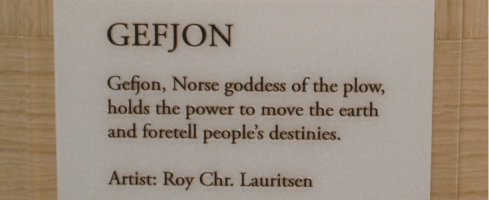
Our ship, the Gefjon (gef’- ee – on) is named after a Norwegian goddess.   Interesting.


Our first excursion took us to Kinderdijk (kinder-dike), Holland (the Netherlands).


This is a UNESCO World Heritage Site. We saw a building with three huge Archimedes screws.

6

From the original 150 windmills in the area, only 28 are left, and Kinderdijk has the largest collection of working windmills in that small area – 19 in all.

7


We saw the windmills – went into one – and saw the polders the windmills gather water from. The windmills are used to pump water from the polders using internal or external scoops into reservoirs on two levels.   We were amazed at the size of the mills, and sails that are placed on the blades – it is all mechanical. We were also amazed to see that the caretakers actually lived within the windmill. Small spaces, and usually when the father died, the son took over.

The one we went in was old – made entirely from bricks. The newer ones looked like they were made from “shingles.” Most of these windmills date from 1738 through 1740.

10

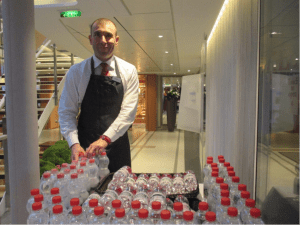
The ship supplied us with “receivers” and ear pieces that we plugged into the receivers that hung from lanyards around our necks. Each tour guide had a “channel” that we tuned into. That way they could talk normally and we couldn’t hear what the other guides were saying (different channel). It was a very convenient way to do the tours. We had them with us at all times on our excursions. The ship also supplied us each with bottled water on each excursion.

11

Back on board, we began our sail to Cologne, Germany. Still being rather tired, we both took a nap, until it was time for the mandatory safety drill – including wearing our life jackets. We have to get over that jet lag!

We had a light lunch in the Aquavit Lounge. Usually set up as a buffet on the Terrace – much quicker and as good as in the restaurant.

After lunch we checked on our e-mail. Fred got one of the hostesses to set up our phones to receive e-mail.

We took in a Dutch teatime in the Aquavit Lounge. They served lots of goodies, and flavorful, interesting hot tea.

Nearing dinnertime, there was a “Toast to Our Guests” by Captain Marcel Stephan and Hotel Manager Harald Halswanter in the Aquavit Lounge.

12

It was a welcome time for the guests of the ship. That room was used for many things, including the daily briefing about the next day’s excursions by Program Director, Carl West. Carl followed the tours on each excursion, taking pictures. Each evening, those pictures would scroll through the two monitors set up in the lounge. It was fun to find pictures of yourselves on those monitors.

Dinner in the restaurant. Everyone at the table had the Chateaubriand, and it was wonderful!

14

Our table mates were Steve and Jane from Colorado, and Lola and Judy from Minnesota. Jane had recently had back surgery, and while in physical therapy, fell onto her back and re-injured herself. She was moving rather gingerly and always used a cane when she walked.

Another long, busy day, and the bed felt really good!!


~~~~~~~~~~To Be Continued~~~~~~~~~~