
A Slice of Life
Bill Lites

Now we headed west thru Portsmouth and Southampton toward Salisbury, with no Garmin, GPS tracker or cell phone to aid us. I don’t know how we ever found our way the rest of that almost 85 miles to South Newton, Salisbury and to our first B & B, but  we finally got there just before dusk. Newton Cottage B & B was an “Olde Worlde” (circ.1670) thatched roof house, that we learned was listed as a building of historic and architectural interest. It was typical of a lot of the homes in this area, many of which had been converted into B & Bs. This was the only B & B reservation we had made from the U.S. and we were thrilled with the accommodations. Of course, the doorways and ceilings were very low, the stairs and floors squeaked, and when the ad said “Central Heat” that meant warm enough for the English, not for someone use to Florida weather.
There was another couple staying at Newton Cottage with us and we all had a 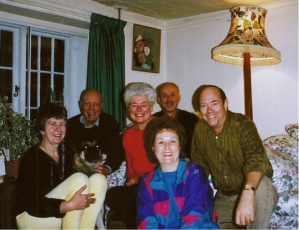 wonderful time comparing travel notes. The local Pub, where we took our evening meals, was just across the street from our B & B, and down a small tree covered lane. What a picture that made! As it turned out, the Pub owner collected matchbook covers, as I did, and he gave me some of his duplicates. I made arrangements to send him some of my duplicates as soon as we got home. (Another fun hobby lost to the demands of the environmentalists).
DiVoran remembers sitting in the kitchen one morning with Mrs. Clark, looking at a field across the road, full of gamboling lambs, and saying how sweet they were. The mistress said, “Indeed they are adorable. But, every spring when I see them, I must school myself not to think of roasted lamb.“
We stayed at Newton Cottage two nights while we spent the days visiting the sites in and around Salisbury. Salisbury has a beautiful Cathedral which was finished around 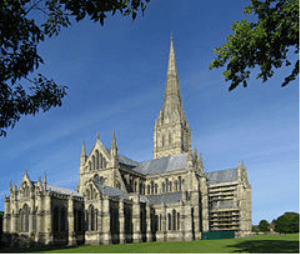 1260 AD, after the city was first established in approximately 1220 AD. We visited a unique War Memorial and cemetery for the men from this southern Wilshire area who fought and died in what was then called “The Great War” (1914-1917).
And, of course, we visited prehistoric Stonehenge, which is located only 8 miles north of Salisbury. Archeologists now believed construction of the stone structure, as we know it, could have begun as early as 2500-3000 BC. There are no written records of who built the monument or why, but the most popular theories are that over the years it was most probably used as an ancestral worship center and burial ground for 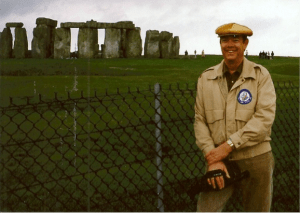 many different cultures. Whatever religious, mystical or spiritual elements were central to the construction of Stonehenge over the centuries, its design includes a celestial observatory function, which might have allowed for the prediction of eclipse, solstice, equinox and other celestial events important to contemporary religions of those different times.
We asked our hosts at the Newton Cottage B & B to look over our guidebook, for the town of our next planned night’s stop, and give us their recommendations for accommodations. This turned out to be a wonderful way to set up our lodgings for the whole trip, as most of the time the B & B owners knew each other, or they knew of other respectable B & Bs which would best suit our needs. This took a lot of pressure off us and made our trip much more enjoyable.
—–To Be Continued—–


 Old Things R New