SUNDAY MEMORIES
Judy Wills
Let me start off by saying that, after four years of college, Fred had another  four years of schooling at the Southwestern Baptist Theological Seminary in Fort Worth, Texas.
During that time, his father, a U.S. Air Force Chaplain,  was stationed at Barksdale AFB, Louisiana, just four hours away from us. We drove over frequently to spend a weekend with them.
After they had been in Louisiana for a few years, dad was transferred to Hawaii. As Fred’s education started coming to a close, we began to think  about giving ourselves a graduation present by joining them in Hawaii for a visit. We were getting really excited about that prospect.
But Uncle Sam had other ideas! In January 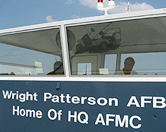 before Fred graduated in May, dad was promoted again and reassigned to Wright-Patterson AFB, in Dayton, Ohio. It was quite a bit of culture shock to go from tropical Hawaii to winter in Ohio in a few short weeks!
And there went our dream of a Hawaiian vacation! Shucks!
Fast forward about 39 years – boy that really zipped by, didn’t it? Fred’s parents were living in an assisted-living facility in Washington State. They had thought to make a trip to Maui for a week in a time-share owned by their youngest daughter and her husband, but needed/wanted some of the family to be with them to sort-of keep an eye on them. Since Fred and I were retired at the time, we graciously volunteered for that job. Really had to twist our arms to do that, right??!!
Two weeks before we were scheduled to depart, Fred’s mother, already afflicted with Alzheimer’s Disease, had a major set-back. She was placed in the Special Care Unit of the facility, where there were trained staff to care for her.
Since Fred’s dad had been trying care for her by himself – and he was encouraged not to visit her for a few weeks so she would become adjusted to her new home – we decided to go ahead with our plans. Frankly, he needed the rest from all that stress.
So Fred and I flew to Seattle, rented a car and dropped our luggage at the hotel where we would be staying for just one night. We drove to Shelton, an hour’s drive away, and spent the rest of the day with Fred’s mother, father, sister and her husband. We three then drove back to Seattle for the night, as our flight out was quite early the next morning.
In spite of being on the West Coast, the non-stop flight was really long to Maui. We arrived at the Kahului airport in the capital of Maui.
We had arranged for a rental car, picked it up, stopped by the Costco nearby and picked up groceries for the mornings we would be there. We planned on partaking of all the wonderful island foods for lunches and dinners.

~~~~More to Come~~~~
Tags: Air Force, Christian bloggers, Christianity, Hawaii, Maui, Military Life, Southwestern Baptist Theological Seminary


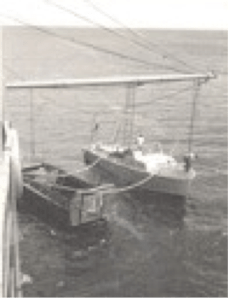 Boom, which was permanently attached to, and located, toward the aft portion of the ship. When a boat was required for any reason, the boat crew had to walk out on the Boat Boom to where their boat was tied-off, and go down the Jacob’s ladder to the boat. Then when they were done with the boat, they had to tie it off to the Painter Line, and climb up the Jacob’s ladder to the Boat Boom, and back to the ship. The first few times I had to do that, I had to walk very slow and it was very scary, since the 1”x 8” catwalk attached to the top of the beam, we had to walk on, was highly varnished, to protect it from the salty environment. This made it very slippery when wet, and I felt like I was “Walking the Plank” every time I went to or from the ship to a boat.
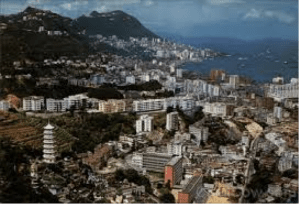 Enlisted Men’s Club or in Sasebo itself. Finally, after months of this routine, the ship made a trip to Hong Kong, to give the crew an opportunity to be exposed to other cultures of the world, and for a chance at some different scenery.
 Kong in 1957, was built into the hills surrounding it, and reminded me of the Mexican border cities of Juarez or Tijuana (except a lot cleaner & more beautiful), where a person could buy anything very reasonably. I bought a tailor-made Navy blue uniform and a beautiful Chinese Cheongsam silk dress for DiVoran for next to nothing, compared to what they would have cost in the states.
 Kong’s 60,000 boat dwellers lived. Here the boats had been tied so closely together, over so many years, that a person could step from one boat to the next, all the way across a portion of Aberdeen Harbor. The only boats that could get out of that mass, were the ones on the outer edge.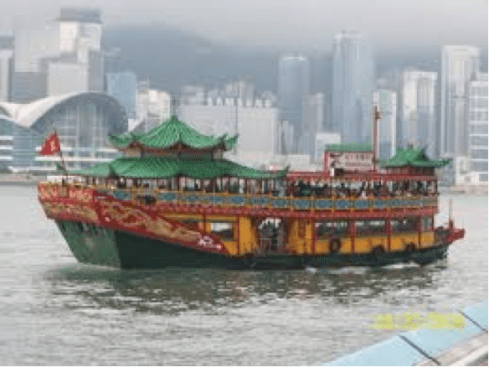


 Honolulu was everything the travel brochures advertise it to be. That was a marvelous time, with swimming, snorkeling, surfing, touring, and an occasional wonderful and delicious evening luau, with lots of pretty hula dancers.
 the type of repairs not extensive enough to require a shipyard. The USS Jason (AR-8), the sister ship we were relieving, had her steam up and was ready to head back to California when we arrived. There was a brief “Changing of the Guard” ceremony, then the Jason was gone, and we began the work for which the ship had been designed.
 many boat engines used by the ship, as well as boat duty. Since we were tied up to a buoy in Sasebo harbor, anyone needing to leave the ship to go anywhere (ship to ship, or ship to shore) had to go by boat. There was the Captain’s Gig, used by the Captain and the other ship’s officers, and the Liberty Launches, used to transport the ship’s enlisted personnel and for every other task know to man. The three-man crew for each boat consisted of a Boatswain’s mate, a Quartermaster and an Engineman. This meant the ship had to supply enough three-man crews to man all the boats the ship might have in the water at any one time, and still maintain adequate shipboard operations.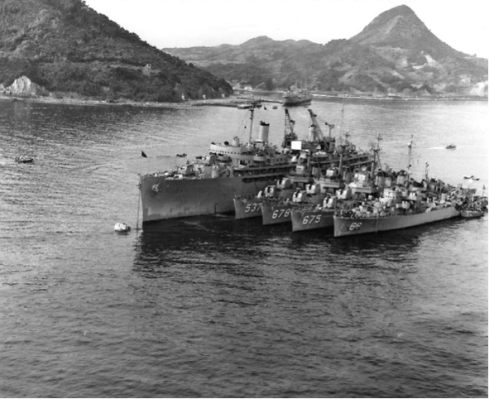


 Base in San Diego, and assignment to the fleet repair ship, USS Hector (AR-7). The Hector was one of three sister ships stationed in the Far East, to service the U.S. Pacific Fleet’s ships. The three ships usually rotated their operations between the U.S. west coast and Japan. The Commodore, who headed the Navy’s Pacific fleet repair organization, maintained his headquarters on board each of the three ships as they rotated through the San Diego Naval Base, about every six months or so. Soon after I reported aboard, I learned, as an Engineman Specialist, I qualified for the vacant position as the Commodore’s driver. What a cushy job that was! I spent most of my duty hours cleaning his Navy staff car, running errands for him, and driving him to and from his many meetings ashore, as well as, to and from his home in town.
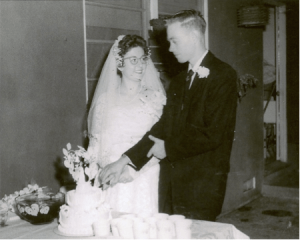 they returned to San Diego area so she could visit me. As she was leaving on that trip, her mother, Dora, had told her, “Now don’t do anything foolish while you are there.” Of course, once she got there, we decided it would be a good time to get married. Our mothers hurried out to California, made all the arrangements, and we did the deed on Labor Day weekend in La Mesa, California. DiVoran and I spent the next four months in marital bliss in our little one-room Balboa Park bungalow, located just five minutes from my work at the naval base.
  1932 Ford five-window coupe hotrod, and was in the process of restoring it in my spare time. The car had been chopped, channeled, and gutted for use as a dragster before I bought it, and had only one wooden bucket seat for the driver, bolted to the frame. Hey, it worked for me! The rear end had been locked, so when you went around a corner, the inside wheel burned rubber. DiVoran couldn’t reach the peddles, and complained, “This was not the kind of car she had expected her new husband to ask her to ride around in.” That was mainly because there was no seat for a passenger, and she had to ride on the plywood floorboard, with no backrest and no seatbelt. Also, she didn’t like having to ride the bus to get to work at the diner where she was waitressing,
  Mercury sedan. DiVoran could drive that car, and life was much more peaceful in our little love nest after that. When it was time for the Hector to leave for its six-month tour of duty in Japan, I took DiVoran and everything we owned, in that Mercury, back to Albuquerque, so she could stay with her parents, and attend beauty school while I was gone.

















 Old Things R New