SUNDAY MEMORIES
Judy Wills
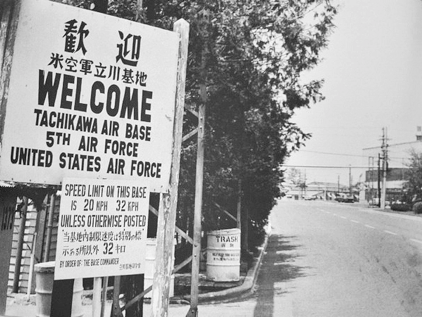
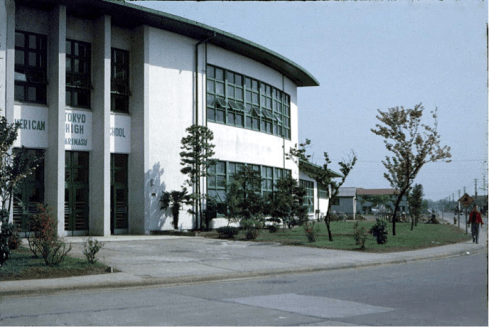
I remember that at both Tachikawa and Johnson, I rode a bus about 45 minutes to get from the housing area to Narimasu High School, which was in Grant Heights, which was in a housing area in Tokyo. It was about a 750 student school complex that went all the way from 5thgrade through 12thgrade. Even the high school portion was about 500 students, so it was a pretty good-sized school. (The entire Grand Heights area was demolished by the Japanese for the 1968 summer Olympics).

Narimasu High School
It was an interesting situation there, especially going to school in Japan. I remember several experiences with earthquakes. We never received any damage, but I remember how the chandeliers in our room would sway. I remember one time during one of the Baccalaureate services I was attending, and my Dad was preaching, that we had an earthquake. The whole building was moving around and shaking. One of the guys accused my Dad of being an “earthshaking” preacher.
In the Fall of 1955, a young airman started and led a Christian Youth Fellowship (CYF) that met every Sunday evening in the base Chapel. I decided to join this group. I soon recognized that four or five of the teens were different from the rest: they had purpose; were happy and helpful; and they did not curse or tell off-color jokes. In fact, they were the real Christians in the group. I wanted to be like them.
About the same time, my father brought home a book he found in a book store in Tokyo. The book was Letters to Young Churches by J. B. Phillips. It was, in fact, a contemporary translation of Paul’s New Testament letters. As I read the book – for the first time in my life God’s Word came alive to me.
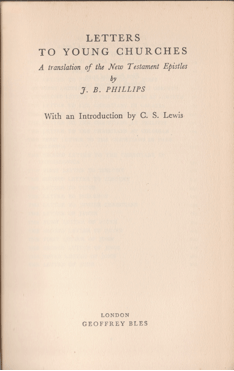
These two events: the few real believers in the CYF, and the modern translation of Paul’s letters, together with the testimony of both my parents, who were strong believers, combined to lead me to commit my life to Christ.

Chaplain and Mrs. Charles Wills
As stated in the previous blog, in the summer of 1956, my Dad was transferred from Tachi to Johnson AB, on the opposite side of Tokyo. Johnson AB did not have a CYF, so I started one. The first meeting was myself and my younger sister, Emily. Within a month or so, we were averaging over 20 teens attending, out of 28 who lived on the base.
In late summer of 1956, the CYF group from several military bases in the Tokyo area met for a retreat at a resort near the foot of Mount Fujiyama (affectionately known an Mt. Fuji). The two events I remember from the retreat are: (1) I preached my first sermon (about 20 minutes long), and (2) I climbed Mt. Fuji (12,395 feet above sea level).

The climb over loose rocks and large boulders was somewhat difficult. To aid the climb we purchased poles about 6 feet long and octagonal in shape. At each of the 10 stations along the trail, for a few cents, we had the poles marked with a wood burned stamp that gave the altitude and the name of the station. A few of the stations, including the top station, also sold small flags to attach to the pole. We started the climb in the evening and stopped at a shelter after midnight. We got up very early so we would arrive at the top before sunrise. I still remember that the sunrise at the top was fantastic!
Fred’s sister, Emily, adds
Yes, I did do a hike up Mt. Fuji, and I remember that Fred was with the group. (Actually I climbed it twice) . Great fun, and good exercise.
Emily still has her hiking stick – here is a picture of it, with stamps and flags
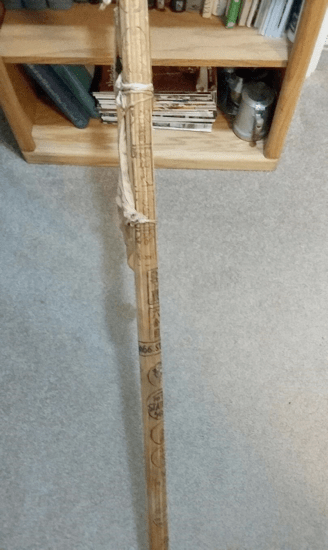
Emily’s hiking stick – Mt. Fuji
~~~~~~~~~~To Be Continued~~~~~~~~~~
 Judy is living in Central Florida with her retired U.S. Air Force husband of 50+ years. Born in Dallas, Texas, she grew up in the Southwestern United States.She met her husband at their church, where he was attending the university in her town. After college and seminary, he entered the Air Force, and their adventures began.They lived in eight of our United States, and spent six years in Europe, where their oldest daughter was born. She was a stay-at-home mom for many years








 Honolulu was everything the travel brochures advertise it to be. That was a marvelous time, with swimming, snorkeling, surfing, touring, and an occasional wonderful and delicious evening luau, with lots of pretty hula dancers.
 the type of repairs not extensive enough to require a shipyard. The USS Jason (AR-8), the sister ship we were relieving, had her steam up and was ready to head back to California when we arrived. There was a brief “Changing of the Guard” ceremony, then the Jason was gone, and we began the work for which the ship had been designed.
 many boat engines used by the ship, as well as boat duty. Since we were tied up to a buoy in Sasebo harbor, anyone needing to leave the ship to go anywhere (ship to ship, or ship to shore) had to go by boat. There was the Captain’s Gig, used by the Captain and the other ship’s officers, and the Liberty Launches, used to transport the ship’s enlisted personnel and for every other task know to man. The three-man crew for each boat consisted of a Boatswain’s mate, a Quartermaster and an Engineman. This meant the ship had to supply enough three-man crews to man all the boats the ship might have in the water at any one time, and still maintain adequate shipboard operations.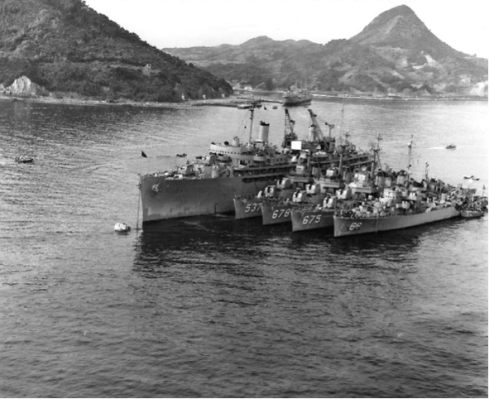


 Old Things R New