Tag Archives: Cold War

My Western Trip~Part 11

16 Jul

A Slice of Life

Bill Lites

Bill Lites

While I was in Tucson I had several other places I wanted to visit, so the next place on my list, was the Titan Missile Museum just 20 miles south of Tucson, in Sahuarita, AZ. I was not aware that any of our ICBM silos here in the U.S. had survived the missile reduction treaties (SALT) over the years, which was part of the “world-wide weapon systems modernization program.” As it turns out, this preserved missile site, officially known as Titan II ICBM site 571-7, is all that remains of the 54 “Cold War” Titan II missile sites that were on alert across the United States from 1963 to 1987. It is now a Registered National Historic Landmark.

1


On my way back to Tucson from the Titan Missile Museum, I stopped to check out the San Xavier del Bac Mission (White Dove of the Desert) just off I-19. The mission was very simple inside, but very beautifully decorated at the same time. As I was leaving, I noticed a number of wooden shade structures near the parking area where several local women were cooking a verity of dishes for sale to the visitors and parishioners. It was getting close to dinner time, and I was tempted to try some of the food, but then thought better of it, since a trip like this is not the time to come down with a case of Montezuma’s Revenge.                  

2


I started the next day with a trip to the Saguaro National Park (West) that our family had driven thru back in 1975, as part of a six-week cross-country camping trip we had taken, when I was between jobs. We were impressed with the tall multi-armed Saguaro cactus, which can grow to as high as 70 feet tall, and filled that part of the Sonoran Desert. Next, I visited the Sonora Desert Museum, which we had also visited in 1975, but it had expanded and changed so much over the years that I didn’t recognize any part of it, except the entrance. Luckily, this time I had chosen a better time of year to visit, so, instead of mid-July and 120 degrees in the shade, it was early April with a mild breeze and a pleasant humidity free 80 degrees.

3


Next on the list, and just down the road was the Old Tucson Studios, which was originally built in 1938 by Columbia Pictures as a replica of 1860s Tucson for the movie “Arizona.” It was fun walking the dusty streets of Old Tucson and recalling some of the great movies that had been filmed there, over the years. Films such as The Bells of St. Mary’s (1945), starring Bing Crosby & Ingrid Bergman. The Last Round-Up (1947) with Gene Autry, Winchester ’73 (1950) with James Stewart, The Last Outpost (1951) with Ronald Reagan,  Gunfight at the O.K. Corral (1957), The Lone Ranger and the Lost City of Gold (1958) and Cimarron (1959). My hero, John Wayne, starred in four movies filmed at Old Tucson Studios; Rio Bravo (1959), McLintock! (1963), El Dorado (1966) and Rio Lobo (1970. Movies have continued to be made there, with the latest being in 2013. Old Tucson Studios was opened to the public as a tourist attraction in 1960, and the many extras wondering the streets in their period costumes added much to the nostalgia.

4


—–To Be Continued—–


West Berlin Part~2

18 Aug

SUNDAY MEMORIES

 Judy Wills

JUDY


One of our favorite places to visit in West Berlin was the Charlottenburg Palace.

1It is very like many of the palaces and castles built by German King Ludwig, and part of it was influenced by those structures.  It is built in rococo and baroque style.  It was built in the late 1700’s.  The central area has a large domed area with a gilded nude statue of Fortune as a weather vane.  The grounds are beautifully landscaped, similar to Versailles in France.

3

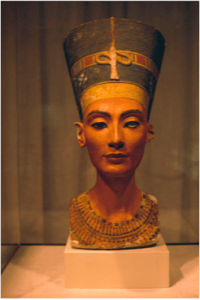
Within the Palace is the Charlottenburg Museum.  One of the most fascinating things in there is the original bust of Egyptian Queen Nefertiti.  We’ve always wondered why the original was in Germany and not England or even Egypt.

In the Tiergarten area of West Berlin (a large public park to the west of the city center) is the Russian Memorial.  It commemorates the 480,000 Russian war dead who died in the Battle of Berlin in April and May of 1945.  Throughout the Cold War, Soviet honor guards from the Soviet occupation zone were sent to stand watch at the memorial.  It is an impressive sight.

5Another impressive sight is the Victory Column, also in the Tiergarten area of Berlin.  It was built from 1864 to 1873 to commemorate the Prussian victory in the Prusso–Danish war in 1864.  The shaft of the monument is made of cannon captured from the enemies. The bronze figure at the top was added later, after further Prussian victories in wars against Austria (1866) and France (1870– 71); so the column marks also the unification of Germany after these victories.  It’s really beautiful.

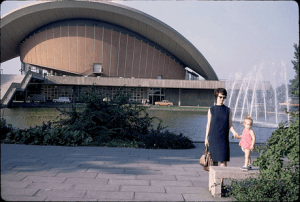
We had heard of the Congress Halle, and walked past it when our oldest daughter 6and I were in West Berlin with Fred, who was on a TDY (Temporary Duty) back in 1969.  It was built by the Americans and given to the Berliners as a symbol of friendship between the two countries.  Because of it’s unique design – an “open” oyster – it is affectionately known as the “pregnant oyster” by the locals.

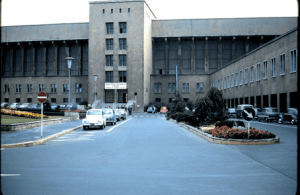
While we were with Fred on that TDY, we were staying in a hotel that was miscpart of  Templehof Airport, where the Berlin Airlift originated.  One day, I wasn’t feeling very well, kind of like I was getting the flu.  When I went down to the restaurant, the German server inquired about my health.  When I explained, he said he had just the thing for me – and he brought me a cup of the most delicious lentil soup I’ve ever had.  Mostly broth – nice and hot.  And then he put together a tray of very hot water with several tea bags and had it sent up to our room.  After all that TLC, I was back to normal by morning.

One of our fondest memories of West Berlin is the English-speaking Baptist church we visited.  There was a large group of English-speaking people in7West Berlin, and they managed to find each other and form a church.  All were welcome – including any Germans who might wish to attend an English-speaking service, even if it was more to increase their knowledge of English, than to worship our Lord.  But along the way, they were sure to be touched by the people around them, as well as the Holy Spirit, and perhaps come to know Christ as their personal Savior.

8

Our tour and trips to West Berlin were some of the most satisfying of our time in Europe.  Certainly something we will never forget.