A Slice of Life
Bill Lites
When Hadrian’s Wall was completed, it is said to have consisted of many “turrets” and what were called “milecastles” used, not only for defense purposes, but also to house the upwards of 10,000 Roman troops required to man this massive defense system. It is theorized to have been for the purpose of separating the Roman Empire subjects from the “Barbarians” to the North. However, a number of theories have been presented by recent historians, that if not wholly, at least partially, the wall was constructed to reflect the power of Rome, and was used as a political point by Hadrian.

I didn’t realize it at the time, but have read that only 20 years later, another Roman Emperor, Antoninus Pius, had expanded the Roman Empire in Britain another 100 miles North, and constructed another barrier between what was then the Roman Empire and the “Barbarians” to their North. Construction of this wall began in 142 AD, at Antoninus Pius’ order, and took about 12 years to complete. The Antonine Wall, as it was called, is a 40-mile long stone and turf fortification built across what is now the Central Belt of Scotland, between the Firth of Forth and the Firth of Clyde. The Antonine Wall was designed with 19 forts and 6 fortlets spaced along its length, and was manned by as many as 5,000 Roman troops. However, for military, political and economic reasons, maintenance and occupation varied at both Hadreain’s Wall and the Antonine Wall over the next 300 years, by which time both had been abandoned by the Romans.

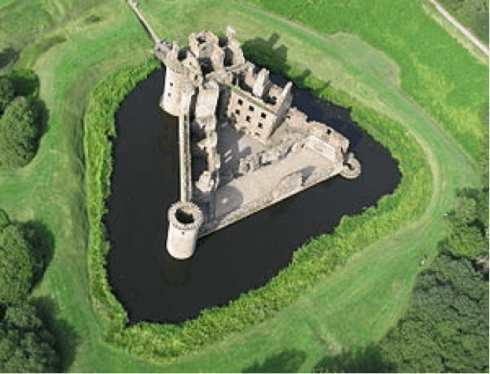
As we traveled north, next we stopped in Dumfries, Scotland where we visited the Robert Burns Center and drove across what is advertised as the oldest arch bridge (1431 AD) still in use in Scotland. The next day we visited the unique triangular-shaped 13th century Caerlaverock Castle with its high towers and moat. It was a stronghold of the Maxwell family from the 13th century until the 17th century. Then in the early 17th century, they built a new lodging within the walls, described as among the most ambitious early classical domestic architectures in Scotland.
One of the interesting features of the Scottish countryside was how rocky the soil was. The people had to remove the stones so they could cultivate their land so, over the centuries they have used the stones for everything imaginable. They built houses with them, they built fences with them and they lined the roads with them. Some of the country roads are pretty narrow, and when you are driving on one of them (on the left side of course) at night, with four foot high stone walls on both sides of the road, and you meet a car or truck coming the other way, it can be mighty scary, take my word for it!
At the “Locharthur House” B & B in Beeswing, Dumfries that evening, we met our wonderful hosts, Mr. & Mrs. Schoolings, and their cute little redheaded daughter Elizabeth. The next morning “Beth” invited us to follow her around as she did the chores. We saw her special fuzzy lop eared rabbits, her five young red pigs, and the cows in the field down by Loch Arthur. Of course she had on her Wellington Rubber Boots or “Wellies” and we didn’t, and as a result we got our feet sopping wet trekking thru the field with all its early morning dew. We were amazed when DiVoran asked Beth how old she was and she told us she was 12, and then added, “I’m wee for my age.” What a grand time we had experiencing the busy life of a young Scottish Lass and all her animals.

—–To Be Continued—–


 Old Things R New