
SUNDAY MEMORIES
Judy Wills

One of my fondest memories is of the old KiMo Theater (we pronounced it kee’-mo) in downtown Albuquerque. According to Google Search, it was built in 1927, and opened on September 19 of that year.

Credit Google Search and Daniel Schwen photographer
U.S. Route 66 was Central Avenue through Albuquerque, east to west, the main street through town. The KiMo Theater, located on Central Avenue, is now listed on the National Register of Historic Places, and the New Mexico Register of Cultural Properties (credit Wikipedia).

Credit Google Search and On The Road with Jim and Mary
The KiMo Theater began to fall into disrepair after a stage fire in the early 1960’s, and the “exodus” of much of the downtown. The Theater was scheduled for demolition, but the city of Albuquerque bought the KiMo building in 1977, and restored it to its original glory. It is considered to be Pueblo Deco architecture style, which combines the Indian cultures of the Southwest with the flavor of Art Deco.

“The colorful Kimo building in downtown Albuquerque, done inside and out in Indian motif, is of interest to all new-comers.” Theatre Posts Credit Google search
According to Wikipedia, The word KiMo translated means “Mountain Lion” in the Tewa language. This word is also loosely translated to mean “king of its kind”….Due to the use of the name outside it’s native Tiwa culture, it is now a ‘dead’ word and is no longer used by native speakers.
I remember being fascinated by all the Indian symbols around the theater. The decorations were absolutely unique, and different from any other movie theater in town. I spent many movie hours in that theater.
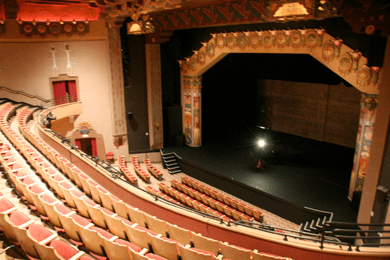
Credit Google Search and Mark Bayes Photography

Credit Google Search and Alamy

Credit Google Search and Mygola
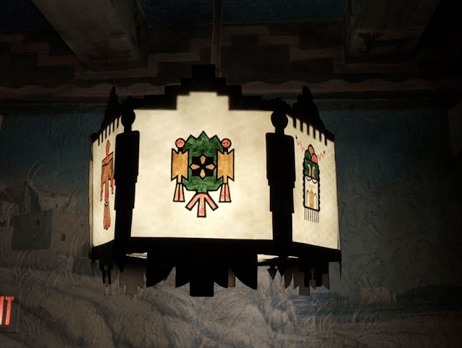
Credit Google Search and Trip Advisor

Credit Google Search and The wanderer.net

Credit Google Search and Getty Images
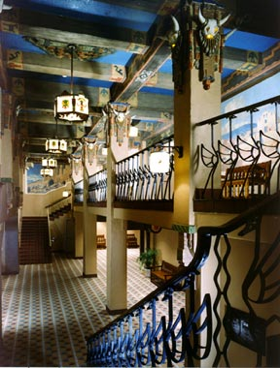
Credit Google Search

Credit Google Search and Trips Into History

Credit Google Search and Alamy
Although I don’t remember any mention of the theater being haunted, apparently KiMo has that reputation. Again, according to Wikipedia:
For decades the KiMo has housed the spirit of a restless child. In August of 1951 a 6-year-old boy, Robert “Bobby” Darnall was attending a screening of an Abbott and Costello movie at the KiMo with his parents.
Bobby was sitting in the balcony with friends when something on the screen frightened him. He ran down the stairwell just as a water heater or boiler in the basement under the lobby’s food concession counter exploded.
More than a dozen people were injured in this accident. Bobby was rushed to a hospital but died en route.
After his death his ghost returned to the KiMo theater. Bobby’s spirit quickly gained a reputation for impish behavior.
The KiMo Theater was beautifully restored in September, 2000 and is now a prime venue for concerts, civic events, and the performing arts. The theater’s resurgence represents the city’s recent upturn with new development and stores popping up throughout downtown. (Credit Cinema Treasures)
There has been a resurgence of “downtown” in many cities in recent years, and I’m glad to see it. Albuquerque wasn’t too large when I was young, and cruising “downtown” was one of our favorite things to do. It was especially fun at night – we would drive to the sand mesa to the west of town, turn around and drive slowly back to town, admiring the city lights all the time.
I was also in the Rainbow Girls organization, and our meetings were held in the Masonic Lodge, also located on Central Avenue, not far from the KiMo Theater.

I learned many years later that the Lodge had also been destroyed by fire. There was a lot of my history in downtown Albuquerque.
~~~~~~~~~~To Be Continued~~~~~~~~~~

 boarded up store fronts, while the Kimo Theater and the Indian Jewelry stores are still going strong. “Old town Albuquerque is a thriving tourist center, and the Rio Grande River actually had water in it. Of course, most of that water had probably come from the heavy rains and flooding in Colorado. The city has expanded toward all points of the compass, and is no longer the Albuquerque where I grew up. Now it’s just another big city, with all the big city problems, as far as I am concerned.
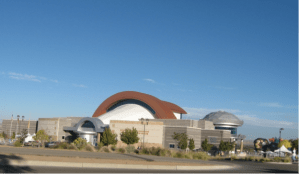 would have been really disappointed if I had traveled all that way for the Balloon Fiesta, only to have rainy and windy weather the only two days I was there. Actually, I hadn’t even realized I was going to be in Albuquerque during the Balloon Fiesta until I had made all my motel reservations, and couldn’t change them. However, the Anderson-Abruzzo International Balloon Museum Foundation has built a beautiful big Balloon Museum since I had last been in Albuquerque, so I was able to visit the museum in spite of the bad weather.
 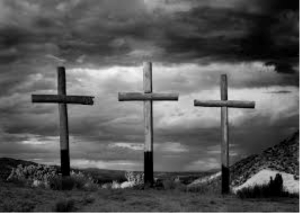 that had always been there since I was a teenager. We had heard all kinds of stories about the closed society of “Los Penitentes” or “The Brothers of the Pious Fraternity of Our Father Jesus the Nazarene” who lived somewhere in the Tijeras Canon area, and practiced their mysterious rituals there. They were known for their ascetic practices, which included self-flagellation in private ceremonies during Lent, and processions during Holy Week which ended with the reenactment of Christ’s crucifixion on Good Friday. Thus, the crosses we guessed. I never knew anyone who witnessed one of their ceremonies or knew a Penitente personally.
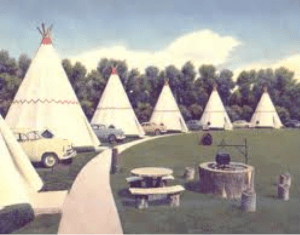 Then it was on thru Moriarty, NM with its Tee-Pee Motel and Santa Rosa, NM, which I had missed on that scary day, on my way to Albuquerque, just a few days before. Then I passed thru Tucumcari, NM, back across the border into West Texas, thru Wildorado,TX with its many wind generators, and finally into Amarillo, TX.
 the Texas Air & Space Museum located at the Rick Husband International Airport, and the Kwahadi Museum of the American Indian located on I-40 just east of the city. This American Indian Museum had some of the most beautiful paintings, and when I ask about them, was told most of them were painted by an author named Thomas E. Mails, as illustrations for his book “Mystic Warriors of the Plains.”


 Old Things R New