How to “SEE” the abstract world

6 Mar

A Time to Live

Melody Hendrix


In this post I hope to help you see and photograph abstracts. Since this is new for me too, many of the images are from the Internet for demonstration. Abstract photography is a challenge but there are some basic tips to get you started off in the right direction.


Believe it or not, your smart phone is the easiest way to take abstracts.


You can just hold up the screen and go on a search for cool close ups, walls, floors, architecture, nature, etc.. Most abstracts are seen by looking at a scene and getting closer and closer to it until you start seeing elements such as patterns, lines, shapes, colors and textures that photographed in a certain way (good composition) can make an appealing image.

Some of the best places to go to look for abstract opportunities are recreational places for kids. It’s always colorful with lines and boldness everywhere. Malls, tourist entertainment areas, gardens, etc are all places that surround you with possibilities.
You could just go around the house and use your phone as a frame and zero in on things that make  it’s own little picture. We  tend to see the entirety and the big picture of life. But looking at the world only through a tiny frame, gives you an entirely different perspective. If you imagine this grid inside your frame. This is an overlay grid in your camera that will appear on your screen. It will be in your menu. Or you can just imagine it over what you are photographing.


The idea is to place the most important features in your picture on one of the lines. Better yet, on one of the intersctions of the lines. You can hold this frame up to things letting your eyes only see within that frame. Turn your frame vertically, horizonally, diagonally. The idea is to see little miniture pictures within your frame.


There are no rules, but it is helpful if it has at least one of the items listed below.

The most important thing to remember is that after you find your point of interest, adjust your view of it by turning your frame in many directions until you find a good composition.


Composition takes some time to learn and feel, but basically it can be easy using a rule of thirds overlay from your camera or just imagine it over your scene.

Composition is one of the most important elements in any art form.

As well as being visually interesting, abstract photography can create a sense of mystery, making the viewer wonder what it is and whether there’s more to it than first meets the eye. But why you would want to create an image of something that the viewer won’t be able to immediately recognize?

The main purpose of abstract photography and art is to evoke some kind of emotional response from the viewer.
The viewer can create their own story about the image, based on their own reality, experiences and feelings.

Below are some other things to look for.

Look for Lines and Curves


Line and curves are going to give your viewer something to base their new meaning on and add visual interest. Without these shapes, your eye wouldn’t travel through and across the image. Lines have other uses too, like in visual design.

Go Macro.


As we get increasingly close to some subjects, the detail that was not apparent at regular viewing distance may emerge as an abstract photograph separate from the object photographed. Fill the entire frame with the subject, eliminating unwanted backgrounds which is essential for abstract photography.

Shoot Through Another Object


Abstract photography often makes use of objects and turn them into filters. Shooting through a glass bottle, a rain splattered window, or even water might give you just the distortion or light refraction you need to create a really interesting and truly abstract image.

Seek out Texture and Patterns


Emphasizing patterns is one way to take a picture of a normal object that is composed abstractly.

Abstraction by Movement

One way to reduce information, thus creating an abstract photograph is by using motion. This may be subject motion, photographer motion, camera motion, or a combination of any of the above. The easiest way to do this is to put your settings on scene mode landscape and take a picture moving the camera up and down, twirling around, back and forth, diagonally or wiggly is low light.

Choose Strong Shapes


Look for pleasing, interesting or dynamic shapes. They will add structure to your photograph and attract the viewer’s attention. Strong geometrical shapes with straight edges and angled corners will give your photo the most powerful visual impact. For a more subtle impact, choose softer organic shapes such as pebbles and flowers. Think about how to best capture the shape in the image and what angle to shoot it from.

Use Color To Grab Attention


Color is one of the first things that attracts the attention of the viewer, especially from a distance. It also serves to hold their attention for a longer period of time. Using highly saturated or intense colors is another way of grabbing the viewers attention. Contrasting colors will create dynamic photographs.

Look For Repeating Patterns

Emphasizing patterns is a great way of creating an abstract image out of an ordinary object. Using patterns can help to draw your eye around or into the image.

Photograph Reflections


Reflections in water or other shiny surfaces provide a fantastic source of abstract scenes to photograph. The distorted effects you get from rippled water or uneven reflective surfaces create an abstract alternative reality.

Most of all, have fun with your photography. It’s a rewarding hobby.
Next week will be a new adventure.


I am retired and enjoying life. My hobbies are my 5 grandchildren, son and daughter, and my loving husband. I am a photographer and extreme nature lover. I love spending time in my garden or in the wilderness connected to God my Creator.
Melody

Tea Party

5 Mar

My Take

DiVoran Lites


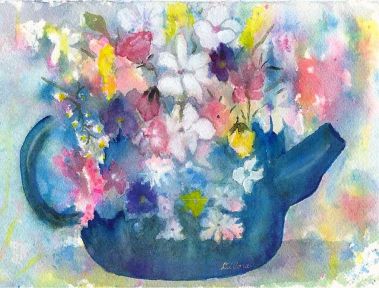
My friends love tea parties and so do I.
Grandmother Marie left me her
Collection of fancy teacups and
Mother Dora gave me her creme1940-s
“Ovenware” Tea Pot with flowers on it.
Mother told me all the stories in her world.


I heard about when she was a young mother
With two small kiddies. Every day
She would cook oatmeal on a coal stove
Like the one she was cleaning
Just before she went into labor
And had to go to the hospital g-r-u-n-g-y…


In those days the men went away
And the women held down the fort
Dora kept a clean, uncluttered house
After every meal.
She washed and dried the dishes
She gathered eggs,
Milked the goat
At five years old, I got to sit on the front step
And drink a glass of hot foamy milk
Dora fed chickens and gathered eggs.


Sewed clothes, repaired clothes
Washed clothes
Hung them on the line
To be examined by the neighbors.
And Grandmother Marie.


Early every morning
Mother hurried with her work so
She could dress up and
Walk her children down the block to
A neighbor or neighbors
Wanting to save her own cleaning effort
She couldn’t stay long
She had letters to write
To Daddy who was at the front.

Typing Class

4 Mar

SUNDAY MEMORIES

Judy Wills


When I was growing up, my parents had an old manual Underwood typewriter that I used to “play around” with.

Credit Google search

Like the computer keyboards, all the “keys” had a number or letter on them. And while it was fun to play on, I didn’t really know what I was doing.

I knew that my high school offered typing classes, but I wanted to get a jump-start on that capability. So, one summer, I enrolled in a summer school typing class. Now you must remember that, back in that day, summer school was usually for remedial study. That didn’t bother me, however, because I knew I was just doing the class to further myself.

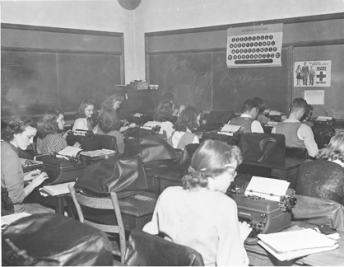
So I started the class. We had the standard, manual typewriters on each desk. However, there were NO numbers or letters on the keys – they were blank! But in front of the classroom – attached to a blackboard – was a chart with the typewriter keyboard on it – with the letters and numbers on each key.


Credit Google search – Pulaski County, Virginia l National Archives


As we began typing, we had to look at the chart – not our hands – to type what the teacher wanted us to type. In that way, we learned to type without looking at the keys or our hands. That has given me a lot of fast typing in all the jobs I held, as well as the letters I have written to friends.

As I was typing along one day, the teacher approached me and asked if he could ask me a question. When I agreed, he asked if I played the piano. Surprised by that question in a typing class, I said “yes.” In triumph he said, “I KNEW it! I can always tell the students who play the piano – they have a different dexterity to their fingering than those who don’t.”

That’s a fun memory that has stayed with me.

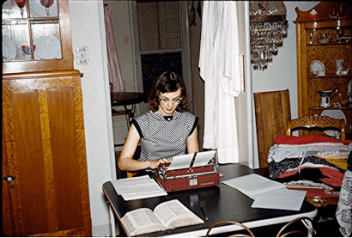
Following that class, I went on to take more typing classes in high school. When I graduated from high school, my parents purchased a portable, manual Olympia typewriter for me. I still have it. Here I am, typing my senior paper on my little portable typewriter at my Aunt Jessie’s house.


As I mentioned in another post (please see my post of December 18, 2016 – Out in the Cold), when I went back to work after 20+ years of being a stay-at-home mom, I tested out at 70+ correct words per minute on the computer!. That was a big surprise to me as well as those testing me. During those 20+ years between working in an office setting, and that testing for a new work situation, I had kept up my typing skills. Every letter I wrote home to my family was typed. My handwriting isn’t the best, and typing takes so much less time than hand-writing. So I typed all my letters. That helped keep up my typing skills.

I suppose many of you have seen pictures recently on facebook and other places that show old typing classes. That could have been me in that class! See the above picture!

Recently I had a visit to my primary care physician and for some reason we began talking about typing. She mentioned that people today can tell older computer typers as the keys “click.” That’s because when you learn to type on a manual typewriter, you must push the keys really hard to get it to actually meet the paper. Our wrists are in an up position (that’s a pianist position, as well), and we “attack” the keys.

It’s hard to let go of those habits, you know.

But, as I said – it’s a fun memory!


Let Light Shine Out of Darkness

28 Feb

The Abstract World

27 Feb

A Time to Live

Melody Hendrix


I wasn’t sure what I was going to blog about next. I thought and thought about it.  The next morning I was to go on a morning shoot to Lake Eola in downtown Orlando.

My friend and I set out to do some abstract photography of the buildings and water reflections. This is a new thing for us and an exciting one. So I decided that I would share this new interest with you. I have always loved abstract photography, but it is something that you have to be focused to see and do. You have to re-program your eyes to see differently. And we were ready.

Buildings

All photography works on an instinctive and subconscious level, but more-so with abstracts. When we look at these types of images we don’t necessarily have a rational response. The images are suggestive, sometimes shunning the logical and expected. They are mystifying rather than explanatory, unusual, quirky, idiosyncratic. Their uniqueness makes them very powerful and can engage our imagination very quickly.

The ocean/beach horizon at twilight.

Abstract photography is based on the photographers eye. We’re looking to capture something in a way that it would not usually be seen. Looking for the details, the patterns, the lines, the form, shape and colors that complete a subject and utilizing those key features to make an engaging image.

Sun lit palmetto leaf.


To capture an image in nature as an abstract, you don’t need any special equipment – just a camera, and the most importantly, your own imagination. What matters most is that your photograph reveals an eye-pleasing image, whether you can identify the actual subject or not. In fact it usually doesn’t have a subject. Only pleasing aspects that both calm and stimulate your mind.

Reflection in the water of a building.

If you want to try something different – the challenge of making something new out of something familiar couldn’t be better. Take an ordinary, everyday object in your home or yard and turn it into something of wonder and beauty.
Flower
You’ll never run out of subject matter. Imagine the possibilities – everything around you is potential material. You’ll uncover a whole new world. I love taking everyday objects and transforming them into something completely different and unrecognisable. It’s a great challenge to go beyond what we see and create an alternative view of the world.
Surface texture and color of an outdoor pottery flower pot.


There are no clear rules to abstract photography. The object of the photo may or may not be recognizable. Abstract images may contain a small portion of an object or multiple objects. An abstract will often concentrate on a limited area of a subject that reveals a shape, pattern, form, color or texture. Movement can also create abstract images, such as rushing water or the wind blowing a flower.

Tree landscape – the camera was moved up and down while the shutter was open. 


Beach waves at twilight. the camera was moved back and forth horizontally while the shutter was open.


In the next weeks to come I will talk about abstracts in detail. I will try to help you see. This is a rewarding type of photography because you can simply use your phone or any camera. There are no rules and once you get the hang of it, it can be come an obsession. Next week “How to look at things differently and zero in on another world.


The bow of a boat and it’s reflection.


I am retired and enjoying life. My hobbies are my 5 grandchildren, son and daughter, and my loving husband. I am a photographer and extreme nature lover. I love spending time in my garden or in the wilderness connected to God my Creator.
Melody

Geese

26 Feb

My Take

DiVoran Lites


I don’t know much about geese.

I know they are big birds with attitude.

I know they are wild or domestic.

I know there are a lot of them in some places.


I know Daddy bought a goose

To fatten for Thanksgiving

And kept it in the shed.

I was supposed to feed it,

But I thought too much and let the goose out

Daddy sent the kids to look for it

All we found was a hut woven of willow branches

Among the willow bushes

Next to Grape Greek.

Inside we saw a mat on the floor

And a picture of a woman

With an old fashioned hair-do

Propped nearby.

When we got home,

Daddy was perturbed, but didn’t punish.


In a big lake in Orlando where swans live too

Geese challenge people for the right of way

And you have to stand up for yourself

After all, God gave dominion did he not?


In that park we saw a woman filling

A plastic bag with large white eggs

Goose eggs or swan eggs?

And taking them to an official looking car.

Where were they going?

Puzzles

25 Feb

SUNDAY MEMORIES

Judy Wills


Puzzles. Do you like them? Enjoy working them? I’ve never been able to do crossword puzzles or any kind of word puzzles. My brain just doesn’t work that way. And especially when I’m told the crossword puzzles have a “language” all their own. Well, I have enough trouble with my native language – I don’t need any “hidden” language to trip me up!

But there is one kind of puzzle I’ve come to enjoy – jigsaw puzzles! Surprised? So am I. A few years ago, our daughter, Karen and her husband, Brian, gave us a Disney jigsaw puzzle for Christmas. We set up the card table in the family room and got to work. It was a fun thing to do, and took our minds of anything except the puzzle while working on it. Sometimes it’s a bit frustrating because that particular piece looks like it really should fit in that place – but it doesn’t! Hmmmm….why not? Oh, it fits over here instead!

I don’t remember just how long it took us to finish it, but here is the finished product.


When Fred and I were trying to sell our house in Virginia, before moving to Florida, we were a bit stressed out. So again, we set up the card table – this time in our large bedroom – and got to work on another jigsaw puzzle Karen and Brian had given us. It was of the Balloon Fiesta in Albuquerque, New Mexico. Working on that puzzle was a wonderful way to release that stress. All we could think of at the time, was finding just the right piece to fit in a particular spot.

Fred parents lived in a retirement facility for several years before they passed away. One of the interesting things about that facility was that puzzles were left out on tables in the hallways. Any of the residents could come and “pick up” just where the last person had left off, at any time. I thought it was a wonderful way for them to keep their minds sharp while trying to do the puzzle. It was also an entertainment for them. This facility was one of the most pleasant we had seen. It had lots of windows, was bright and airy, and smelled wonderfully clean and fresh. It was a delight to visit them, and they seemed to enjoy living there.

Karen and Brian gave us another puzzle this past Christmas. It has 21 pictures on it – all of Norman Rockwell’s Saturday Evening Post covers. Norman Rockwell is one of my favorite artists, so this puzzle is a joy to work – and a bit of work with all that many pictures – some quite small. I’ve learned to use the magnifying glass a lot to help identify some of the pieces. No…that is NOT cheating!! Here’s a picture of the front of the box – the puzzle isn’t finished just yet.


So how ’bout you? Are you into jigsaw puzzles? They can be a great deal of fun – sharpens your attention span, and is just a great way to kill some time. Give it a try. You just might like it – we do!


Be Strong and Courageous

21 Feb

On the Porch

Onisha Ellis


Courage seems to be my word for this season of life. Oddly, this is coupled with Rejoice. How can I rejoice as my heart is weeps? Because God has promised that He will be with me wherever I go, even into the depths of heartache He is there. All…the…time.


Crosscards.com


Amy VosKamp wrote a powerful post  Why God Doesn’t Heal People We Love, Brutally Honest, Psalm #3

How to Shoot Butterflies….With a Camera

20 Feb

A Life to Live

Melody Hendrix


Since people who love butterflies and would like to photograph them, are all at different skill levels, I am going to talk about two shooting methods. One for those who like to just point and shoot or use a cell phone and one for those who are advanced and like to shoot with manual controls.

First there are a few basic things that can greatly improve your butterfly pictures either way you shoot.

Take lots of pictures. When you find a butterfly, keep shooting until it flies away. This gives you the best odds of having at least one good one.

Start shooting from far away. Each step closer is a better and better shot.

Move in slowly as not to alarm the butterfly. You can crop later. Cropping is the finishing touch. There are a lot of simple software programs to use to crop, straighten, adjust exposure, sharpen and enhance. You can do this right in your camera in some models.

Getting a good sharp focus is one of the most difficult of achievements. Here are some tips to help with that:

The cameras now truly have artificial intelligence and usually do a great job. Most of the time, auto is a good choice, especially if you are doing a video clip. One thing I want to mention about videos is that no matter how good the video looks, if the camera is moving around, the video cannot be enjoyed. So be as steady as possible. Use a mono pod if you don’t have steady hands.

If you are taking still pictures, try using your macro mode (flower icon) if you can get close to a feeding butterfly on a flower. Some cameras can give you great closeups. You can even get a macro lens kit for your cell phone. They are not expensive and work pretty well.

If you are shooting a very active butterfly try using your scene mode – Action/Sports (or something similar)

Zoom in. Zooming in will help you get closer and also blur the background (shallow depth of field). It will also help the flash to be at a distance so it doesn’t wash out your subject. Zooming will also help you cut out distracting things surrounding your subject.

Use your flash. The more light the faster your shutter speed will be to stop motion. Check your shot and make sure the flash doesn’t white out your subject.

You can tape a little piece of white paper over your flash as a diffuser. This takes away the harshness of the flash and gives you soft light.

Using the flash in bright sunlight seems odd, but it helps to even out the light.

If a butterfly is in the sun and a shadow is next to it, position yourself so the shadow is behind the butterfly. Having a dark background will make the butterfly pop. Having a flower, nice greenery, distance (blurry background) or even the sky is also a nice background.

Sometimes instead of waiting for the perfect picture to just happen, you can create one.

Buy a nectar juicy potted plant (Milkweed, Penta, etc). After buying one, hose it down to remove pesticides and hydrate the plant. The more moisture, the more nectar. Find a nice background or shadow and place the plant there. The direction of the sun can help or hinder your shot.

Check out how the light looks.

It’s best to position the plant so light is coming from behind you. Have your camera on a tripod, bean bag or a secure place to set the camera. Have everything lined up and ready, and wait for your subject to land. Have a drink, a snack and some patience handy.

Here is my little secret.

Put a drop of red Gatorade on the flower. Once your subject discovers it, it should stay a while as most butterflies love it, giving you a perfect photo op. Keep shooting until it flies away.

Handholding the camera is probably the easiest way to shoot, but harder to get sharp pictures unless you have a steady hand. Just before you push the shutter button, watch the screen to detect any movement, hold your breath and gently, without moving the camera, press down on the shutter button. Try not to let the camera move downward as you press. Re-focus (press shutter button half way down) and shoot again. Keep camera as still as possible. Repeat, repeat, repeat.

Butterflies are cold blooded and need the warmth of the sun to allow it’s body to move freely. It will sit and wait to not only warm up, but to dry out from the morning dew. This may be a good opportunity to check the bushes for one. They will be sleepy and sluggish. You may even get one with some dew drops.

Shoot butterflies at different angles. Shoot them at eye level or slightly below. This reveals it’s face and body. It is more personal and shows more detail of it’s eyes and personality. Or shoot straight down and wait for it to open it’s wings to see color and patterns. Shoot a wide scene showing flowers and landscape as part of the picture.

There are many butterfly conservatories around Florida. This is such a fun opportunity to get many kinds, colors and shapes of butterflies. The light inside is usually diffused and butterfly subjects are everywhere. Look online for the one nearest you.

Truly the very best pictures you will ever get is when the butterfly first emerges from it’s chrysalis and sit’s pretty, waiting for it’s wings to dry. You can have your way with them and get stunning pictures.

Advanced shooting with DSLR (Digital Single Lens Reflex) camera with interchangeable lenses

Control your shutter speed: Your shutter speed are exposure settings that determines how quickly a photograph is taken. There are different ways of doing that. I prefer these camera settings that have worked out the best for me.

ISO – at least ISO 400. If your camera can handle noise well, you can use ISO 640-800. If the exposure is too bright go back to ISO 400.

Aperture – f6.3 – f8

focus – single point focus

Metering – SPOT meter is very important. This will allow you to pinpoint exposure of just the butterfly. You can even shoot into the sun with the spot meter on the butterfly. It makes a unique back lit image. Use your diffused flash to brighten it’s body, or no flash to create a silhouette image with a silver lining.

Light – Use a diffuser over the flash. Try setting your flash to high, but adjust your exposure compensation to -3. This will lessen the brightness on the butterfly and darken the background. Zooming in will also help soften the harshness of the flash. Try using a light ring. This works best with a captured butterfly. You can buy a light box. Set up your scene and put your butterflies in. This is for crazy must get a perfect shot people like me. haha

Photographing butterflies can be addictive. You must have patience and though you don’t have to have special equipment to get good butterfly pics, having the right equipment can greatly improve your pictures if you have a passion for butterflies and you are going to be taking a lot of them.

Below is an educational video I made to ID many Florida butterflies photographed in my yard and Oviedo Lucas Butterfly Conservatory.


https://www.youtube.com/watch?v=5kGmXjFD4t0&index=18&list=UU3BEsOLXTq0wHMMs0rKDurg


I am retired and enjoying life. My hobbies are my 5 grandchildren, son and daughter, and my loving husband. I am a photographer and extreme nature lover. I love spending time in my garden or in the wilderness connected to God my Creator.
Melody

Pencil Sharpeners

19 Feb

My Take

DiVoran Lites


I hear they have

Electric pencil sharpeners now

Bzzz and the point is made

When I was bored in grade-school

To amuse myself

I walked up front to the pencil sharpener

With my yellow number two.

Didn’t know there was another kind

Of pencil in the world

Nowadays I love to art

I have rainbows and lollipops of color in stick form

Inktense, watercolor, wax pastels,

Crayons, and colored pencils

Too many art supplies

But that’s because

Artists are art-store junkies

All my color sticks need to be

Sharpened periodically

I have many hand sharpeners

But for a tough job such as

A colored pencil with

A broken off head

I open to the secret on the linen closet wall

And hand grind the wood away

To expose the purple underneath

For stroking highlights into books,

Especially Holy Bibles on gossamer thin

Paper with light-catching golden edges.