Archive | February, 2019

Summer Has Arrived

28 Feb

On the Porch

Onisha Ellis


It’s February 28 and summer has arrived in Florida. Way…Too…Early. Temperatures in the 80s have triggered the annual pollen. My eyes are itchy but I can’t rub them. That is a huge No-NO for someone with cornea transplants. I miss my mountains.


Okay, my public whining is over. Notice I said public. I am sure I will continue to inwardly whine until I give myself an attitude adjustment and decide to choose thankfulness and joy.

It has been a busy week and aside from grumbling, I haven’t had any blog inspiration. So, I will leave you with this message from hot Florida:


I'm a winnerAfter my retirement, I decided to re-learn the canning and preserving skills I learned from my mother but hadn’t practiced for twenty years. I titled the blog Old Things R New to chronicle my experience.  Since then I have been blessed to have six other bloggers join me, DiVoran Lites, Bill Lites,  Judy Wills, Louise Gibson, Janet Perez Eckles and Melody Hendrix

In addition to blogging, I work as the publicist/marketer/ amateur editor and general  “mom Friday” for my author daughter, Rebekah Lyn. I also manage her website, Rebekah Lyn Books  where we frequently host the best in up and coming authors.

My 2019 goal is to use my love of photographs and words to be an encourager on social media. You can visit Real Life Books and Media You Tube Channel if you would like to view some of the mini-videos I have created for our church, Gateway Community in Titusville, Fl.


2018 Florida Road Trip Part 11

27 Feb

A Slice of Life

 Bill Lites


Day 11 Monday 10/29/2018


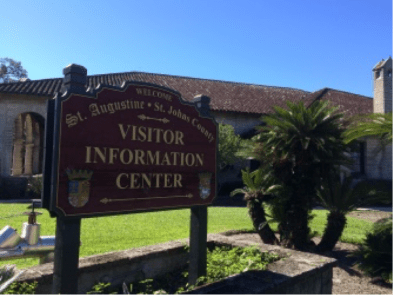
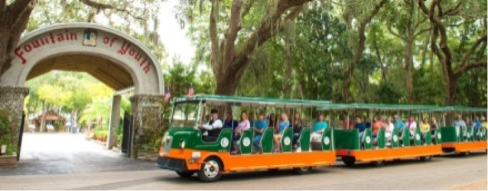
After a great breakfast at the motel this morning, I headed south on I-95 to visit the beautiful old Florida city of St. Augustine, with its many historic landmarks and museums. It had been several years since DiVoran and I had visited St. Augustine, and I had forgotten how difficult it is to find parking close to any of the museums or points of interest I was planning on visiting.  After wasting half an hour squeezing thru the narrow streets, looking for a parking place close to my first museum, I gave up and went to the Visitor Information Center. I bought an All-Day “On & Off” Old Town Trolley Tour ticket, which took care of most of my parking and museum access problems for the day.


I had allowed two days in St. Augustine to see the many museums and points of interest on my list, so the trolley tour approach should work out fine.  However, I had also forgotten just how many museums and other points of interest there really are in St. Augustine.  I had no way of knowing, at the time, just how long this day was going to turn out to be, or (now) just how long this day’s write-up was going to take me!  The Trolley Tour visited 23 different points of interest, and that didn’t take into consideration my personal list.  (This day’s activities will be divided into four parts, so bear with me).


At the visitor Center, I was informed that in 1565 King Philip II of Spain sent General Pedro Menendez de Aviles to Florida to settle the region and eliminate all French influence in the area.  Menendez claimed “La Florida” for Spain, at that time, and established “San Agustin” as the first Spanish settlement.  (Check Wikipedia for many interesting facts about the early Spanish claims to Florida).


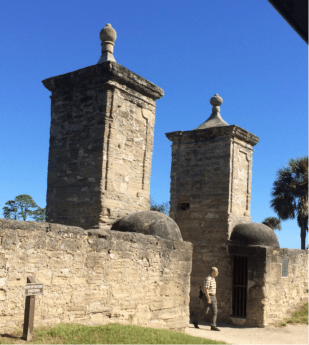
Since the Visitor Center was only a block or so from the original “San Agustin” main city gate, I walked over to take a photo.  Local information informs visitors that even though construction on the Castillo de San Marcos fort had begun as early as 1672, it did not deter the devastating attacks on the city by various enemy forces and pirates over the next 30 or so years.  When construction of the fort was completed in 1695, even that did not stop Sir Francis Drake and his British fleet from attacking “San Agustin” in 1698, and ultimately burning the city to the ground in 1702 (check Wikipedia for “Sir Francis Drake in St. Augustine” for a very interesting story about why he was in Florida).


In the years that followed, the city was rebuilt and additional fortifications began with the Cubo Line, a mote, and a main gate (made of massive coquina pillars and heavy wooden doors). At the time this gate was the only access to the city of  “San Agustin,” and was closed and locked each evening.


Once inside the city gate, the “Oldest City in the United States” opened up to me, and I began the typical tourist walk down St. George Street.  The first building I came to was the Oldest Wooden Schoolhouse.  Claiming to be the “Oldest Wooden Schoolhouse” still standing in the United States, we are told that the first school master, and his family, lived on the second floor of the building.  With no official records as to when this schoolhouse was actually built, it first shows up in city records in 1716, after the British burned the city to the ground in 1702.


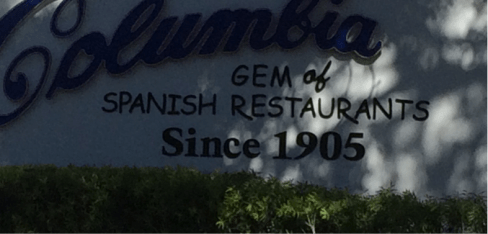
Just down the street, was the Spanish Bakery, with its delicious aromas wafting out across the street.  A little further down was the Columbia Restaurant and the Medieval Torture Collection.  I had not known there was a Columbia Restaurant in town and besides that, it was too early for lunch.  I wasn’t particularly interested in what kind of cruelty people had imposed upon each other back in the Middle Ages, so I kept going.


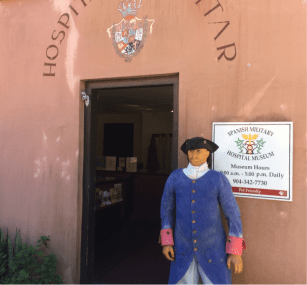
At King Street I turned left and started back north on Aviles Street to visit the Spanish Military Hospital Museum.  This is a very interesting museum, with a guided tour that includes an elaborate description of the tools and procedures used by military physicians during the Second Spanish Period (1784-1821) in “San Agustin.”


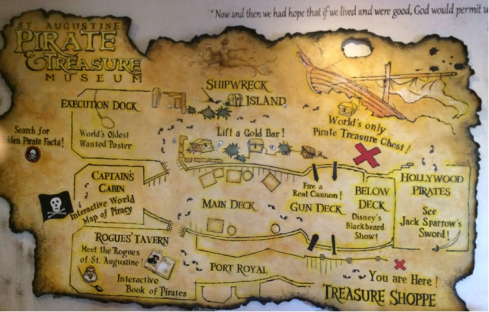
I continued north on Charlotte Street until I got to Castillo Drive and visited the Pirate & Treasure Museum.  I was amazed at how many individual exhibits and how many artifacts they were able to fit into this small museum.  They claim to have the largest collection of “authentic” pirate artifacts in the country (dating from the mid-1600s).


—–More of this day’s activities will be continued next week—–


Bill is a retired Mechanical engineer living with his wonderful artist/writer wife, DiVoran, of 61 years in Titusville, Florida. He was born and raised in the Southwest, did a tour of duty with the U.S. Navy, attended Northrop University in Southern California and ended up working on America’s Manned Space Program for 35 years. He currently is retired and spends most of his time building and flying R/C model airplanes, traveling, writing blogs about his travels for Word Press and supporting his wife’s hobbies with framing, editing and marketing.  He also volunteers with a local church Car Care Ministry and as a tour guide at the Valiant Air Command Warbird Museum there in Titusville.  Bill has two wonderful children, two outstanding grandchildren, and a loving sister and her husband, all of whom also live in Central Florida, so he and DiVoran are rewarded by having family close to spend lots of quality time with.


Bill


One of Bill’s favorite Scriptures is:  John 10:10

Brunswick Stew

26 Feb

On the Porch

Onisha Ellis


Brunswick stew. Those two words transport me back to childhood. Conrad had longish grey hair and his wife Lucille was on the thin side with brown hair. I think of Conrad dressed in white, and for some reason, I believe his trade was a painter. They were friends of my parents from when we lived in North Carolina. I don’t remember how they happened to be in Florida. For some reason, I think they moved about.

What I remember vividly is that when Conrad was in town, we would be having some Brunswick stew. I know there was a bit of prep work involved. I think Conrad would cook a hen and take the meat off the bone. There was pork also, but I am not sure if it was barbecued , smokes or simply boiled. Then there were the vegetables, corn freshly scraped from the cob along with butter beans, onion and potatoes.

Conrad brought a huge pot to cook it in. For some reason, I think it was cooked outside, possibly on our Coleman camp stove. It cooked for a long time, so heating up the kitchen could have been a factor. The aroma was divine and mom’s buttermilk biscuits, sweet tea and/or cornbread were the perfect accompaniment.

Conrad’s making Brunswick stew was music to my tummy.  I’m not sure why my mother didn’t make it, she was a great cook.

I have often wanted to make it but felt the task too daunting. There are so many recipes , I felt overwhelmed. Until yesterday. I had been mentally pulling together meal meats this past week with the idea “stewing” (had to use the pun) of attempting Brunswick stew. My Keto cookbook had a recipe that looked doable. It wouldn’t have the same vegetables as they are too carby, but the meats and seasonings felt familiar.

The stew was delicious and my husband had seconds. I made low carb cornbread to go with it and crumbled some in my bowl. Better than the flavor though, are the memories stirred up as I cooked. Simpler times. Family and friends time. Love.


Here is the video I watched before making Brunswick stew.


Home at Last

25 Feb

My Take

DiVoran Lites


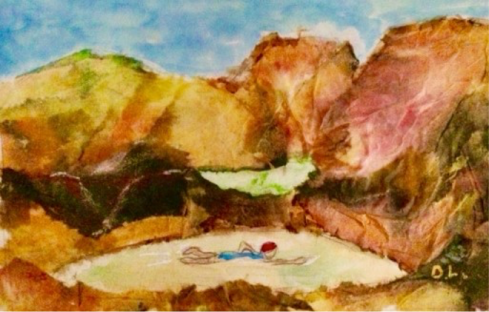
Painting by DiVoran Lites


After I was born, one of my first visitors was my great-grandmother from Illinois, Hester. She was my Granddad’s mother who came all the way to Colorado, then to Nevada for a family get-together. Grandma Bowers was blind, so she came with other family members.

Dora had one regret about the visit. Great-grandmother wanted to hold me, but Dora had strict instructions from the doctor not to pick me up or let anyone else pick me up between feedings, which were every four hours. Great-Grandmother stood by my bassinet (a bath for a baby) while Mother bathed me. The tiny blind lady moved close to the legs of the bassinet and rocked it with her knee. Once Dora became more experienced she realized it couldn’t have hurt to let an old blind grandmother hold her baby granddaughter.Fortunately,I got to meet her when I was twelve and Grandmother and Granddad took me to Illinois for a visit.

Dora didn’t work all the time. Sometimes she and dad went for walks in the desert hills around the town. Dad probably fished in the pond. That was where Mother liked to swim in the days of warm weather before I was born. She was surprised that I didn’t grow up terrified of snakes, as she often saw them swimming by.

Mother liked to take me out in my buggy for walks. One day she saw a nest under a bush and stopped to inspect it. When she saw some very small mice playing she took me out of the buggy and held me where I could watch the babies play.

We had a Setter called Red. The Doctor had told them to bundle me up and put me out in the sun for part of each day. It was a safe, small town, so they left Red to watch over me while I slept.


Photo by Ryan Stone on Unsplash

One day when mother was home alone a small fire got started somehow. She grabbed me and ran over to Walkama’s across the street and asked her to look after me until she got the fire out.

I wish I had more details, but I think once our folks are gone, we have many questions we wish we had asked while they were still with us. I do have to say, though, both Ivan and Dora were excellent story-tellers, and I’ve so grateful for that rich heritage.


Author, Poet and Artist

DiVoran has been writing for most of her life. Her first attempt at a story was when she was seven years old and her mother got a new typewriter. DiVoran got to use it and when her dad saw her writing he asked what she was writing about. DiVoran answered that she was writing the story of her life. Her dad’s only comment was, “Well, it’s going to be a very short story.” After most of a lifetime of writing and helping other writers, DiVoran finally launched her own dream which was to write a novel of her own. She now has her Florida Springs trilogy and her novel, a Christian Western Romance, Go West available on Amazon. When speaking about her road to publication, she gives thanks to the Lord for all the people who helped her grow and learn.  She says, “I could never have done it by myself, but when I got going everything fell beautifully into place, and I was glad I had started on my dream.”

White Sands

24 Feb

SUNDAY MEMORIES

Judy Wills


Have you ever had the opportunity to “play” in a sand dune?  I remember outside of Albuquerque, New Mexico, where I grew up, were some great sand dunes, and we used to drive there and just spend time romping through the dunes. It was great fun!

However, I remember once when I was working in a multi-storied building downtown that we were able to watch a huge sandstorm blowing from the east into town.  It was blowing a lot of that sand from the dunes – and it was a rather frightening thing to see.

Each of our 50 United States has a state motto. New Mexico’s motto is: The Land of Enchantment.  And then, when you are out in a sand storm, you must be careful not to get any of that “enchantment” in your eyes!
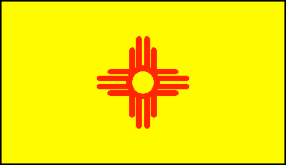


Perhaps you’ve heard of White Sands, New Mexico? It’s a U.S. National Monument (part of the U.S. National Park Service), and is located between Las Cruces and Alamogordo, in central-southern New Mexico.  It was established as a National Monument in 1933.  It’s also near Holloman AFB.


Credit Google Search and National Park Service


On March 30, 1982, the space shuttle Columbia landed at the White Sands Missile Range, after being diverted from Edwards AFB in California.  Bad weather at Edwards had made the landing strip there too wet to handle the weight of the shuttle.


Space Shuttle Columbia landing at White Sands Missile Range, 1982

Credit Google Search and NASA website

According to Wikipedia:   Its white sands are not composed of quartz, like most desert sands, but of gypsum and calcium sulfate. Unlike other desert sands, it is cool to the touch, due to the high rate of evaporation of surface moisture and the fact that the sands reflect, rather than absorb, the sun’s rays. At 1185 meters [3888 feet] above sea level, there are approximately 442 square kilometers [162 square miles]of dune fields and is known to be the world’s largest surface deposit of gypsum.


Do you know the difference between a National Park and a National Monument?  I didn’t for a long time.  Here is an explanation I found online:

According to the National Park Service, “a national park is intended to preserve at least one nationally significant resource, whereas a national monument is usually larger and preserves a variety of nationally significant resources.”


If you have ever walked on a “beach” with the brown sand that is associated with beaches everywhere (except Panama City, Florida, whose beaches are white sand), you will remember you had to walk really fast – because the sand was so hot!  Not so with the sands at White Sands National Park.

I remember going with family to White Sands several times in my life.  Here are some pictures I have of the park, I’ve marked the ones I purchased.  The others are of my family.
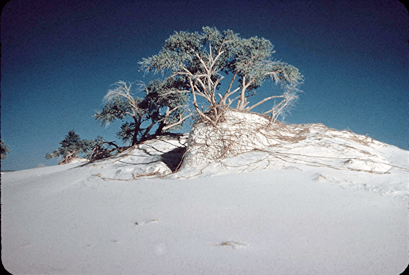
 

Purchased slide – Battle for vegetation
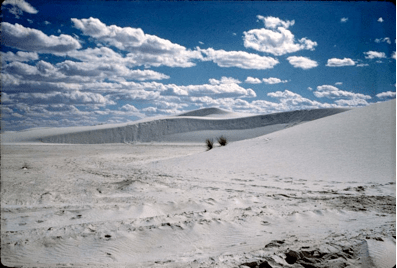
Purchased slide

Purchased slide
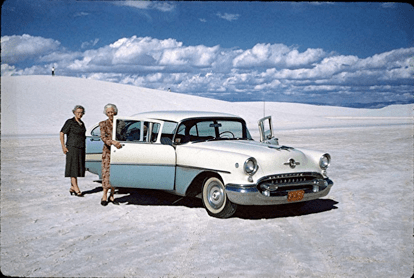
My Granny and her sister – 1959

My Granny holding their dog, Trixie,

Granny’s sister and her husband,

a friend of the family

Granny and Trixie, inspecting the sand


This picture on the website caught my attention. The write-up stated:  Moonlight hikes and sunset tours are available throughout the year from the visitor center, so visitors can get a whole new perspective as the light changes.
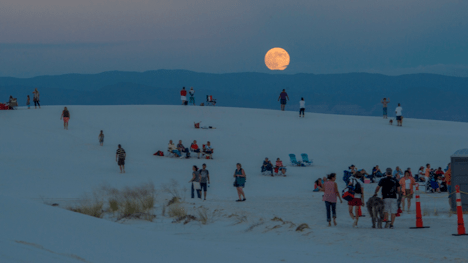
 

Credit Google Search and White Sands website


If you are ever in that area, be sure and give the White Sands National Monument a visit.  It is well worth the time to get THAT sand in your shoes!!


JUDYJudy is living in Central Florida with her retired U.S. Air Force husband of 50+ years. Born in Dallas, Texas, she grew up in the Southwestern United States.She met her husband at their church, where he was attending the university in her town. After college and seminary, he entered the Air Force, and their adventures began.They lived in eight of our United States, and spent six years in Europe, where their oldest daughter was born. She was a stay-at-home mom for many years
Judy has always been involved with music, both playing the piano and singing.
Always interested in exercise, she was an aerobic dancing instructor, as well as a piano teacher for many years, and continues to faithfully exercise at home.
After moving to Central Florida, she served as a church secretary for nearly nine years.Her main hobby at this point in time is scanning pictures and 35mm slides into the computer. She also enjoys scrapbooking.
She and her husband have two married daughters and four grandchildren, including grandtwins.
She and her husband enjoy the Disney parks as often as possible.

What to do when life becomes too much.

23 Feb

Walking by Faith, Not by Sight

Janet Perez Eckles


Reblogged February 23, 2019


Did you ever wonder why the shower is the place where ideas filter through, insights pop up, and solutions appear?

That happened to me the other day. I turned off the faucet and my mind took off in a strange direction.

How lovely it would be…

… if we could shut off the shower of problems when life becomes too much. What if we could stop the downpour of demands? And what if we pushed the knob and turned off the hard stuff that keeps coming down on us?

But as a woman once told me: “Life isn’t like that, honey.”

She’s right. Life is certainly not that easy. But the living God is easy on us when we are wet with worry and anxiety. I found a powerful message, tucked in a verse in the book of Psalms: “Be still and know that I am God” (Psalm 46:10) Like me, you might have read it hundreds of times. But when I heard it recently, two words leaped out and made me smile.

The words are: “I am.”

What a delicious notion of the present, the now, the moment. What a powerful promise that He is the God who is indeed present in our current situation. He is active in this moment of insecurity. He is in control of this minute’s pain and right now, He’s watching our tears fall.

And when we’re dripping with stress, He offers the soft towel of reassurance. The comfort that being still in His presence brings. And the confidence that He is God of all.

“I am God” he says.

In turn, I am, believing. I am trusting and delighting in His promise. I am counting on the guarantee that at this moment He’s delivering us from all suffering. Right now, He’s speaking to us in our affliction, reassuring us when all falls apart, and whispering, “Be still and know that I am God.”

It’s in the “still” of the moment, when stress leaves, faith increases and expectations come alive. They do because if we listen, He’s speaking:  “…those who suffer he delivers in their suffering; he speaks to them in their affliction” (Job 36:15).

When today, life becomes too much, He’s speaking. Tomorrow isn’t here yet. That’s why today we can receive the shower of reassurance. The promise He’s got tomorrow in His hands. And the confidence He’s bigger than any dark moment. So, “be still” He instructs.

Let’s pray.

Father, you observed my anxious heart and saw me tossing during my sleepless night. Though the situation I face is so devastating, it’s not bigger than You. It won’t defeat me because each moment I shall be still in Your presence, wrapped in the reassurance of Your love. In Jesus name.

What keeps you from being still these days?

Janet

______________________________________

Did you know I wrote a book filled with words of encouragement, uplifting thoughts and illustrations of real-life triumph to empower you? Its title, Trials of Today, Treasures for Tomorrow: Overcoming Adversities in Life. You can get it HERE.

CLICK HERE for a one-minute inspirational video.

Looking for a speaker for your upcoming event? A great speaker makes the difference between a so-so event and one that shines with impact. I invite you to view one of my two-minute videos HERE.

Please share: Feel free to share Janet’s posts with your friends.


Source: https://janetperezeckles.com/blog/what-to-do-when-life-becomes-too-much.html


Janet Eckles Perez

Some say she should be the last person to be dancing. Her life is summarized in this 3-minute video: http://bit.ly/1a8wGJR

Janet Perez Eckles’ story of triumph is marked by her work as an international speaker, #1 best-selling author, radio host, personal success coach and master interpreter. Although blind since 31, her passion is to help you see the best of life.

www.janetperezeckles.com

Are Free Rangers Happier?

21 Feb

On the Porch

Onisha Ellis


Our home in North Carolina is in a rural setting. We may have leash laws for dogs, but if so, they are not enforced. I have spoken several times about our porch dog, Gus. He belongs to a neighbor and is a “free ranger.” He roams our small subdivision making sure that his territory is secure from invaders. He misses his family while they are away at work so he spends the day visiting with us on our porch or waiting by the door of my husband’s workshop. I took the picture through the screen of Gus waiting on my husband to climb the steps from the workshop.


There is also a pack of dogs that roam the main road. They don’t cause any problems for us but they aren’t friendly either. Then there is the very annoying small dog that lives less than a quarter of a mile away. It is a car chaser. It takes all my will power to not stop when it takes off after me. I really don’t like the idea of hitting an animal. I drive on, hoping I won’t hear a clunk. For a time it stopped chasing cars while it nursed an injured leg. I was hoping the animal learned a lesson but alas, it is back to chasing again.

In Florida there are strict leash laws and I haven’t seen a “free ranger” in years. I see neighbors briskly waking their pets and we have a nice dog park so that the animals can socialize.

I wonder sometimes if we are being kind to our animal friends by keeping them locked inside. Yes, they are safe and will most likely live a longer life, but at what cost? The free rangers appear happier.

Now before you become outraged, I know that having free ranger dogs roaming our streets would be a safety issue. I do see a parallel here between those who want to live as free rangers versus those who feel it is better to allow an entity such as government to protect them and provide for their needs. For me, I would choose to live as a well-loved free ranger who has the freedom to come and go, yet has a soft bed to come home to at night.


Our pastor shared a very good message on Sunday, titled Something to be Thankful For.  I like the music in the highlights video.


I'm a winnerAfter my retirement, I decided to re-learn the canning and preserving skills I learned from my mother but hadn’t practiced for twenty years. I titled the blog Old Things R New to chronicle my experience.  Since then I have been blessed to have six other bloggers join me, DiVoran Lites, Bill Lites,  Judy Wills, Louise Gibson, Janet Perez Eckles and Melody Hendrix
In addition to blogging, I work as the publicist/marketer/ amateur editor and general  “mom Friday” for my author daughter, Rebekah Lyn. I also manage her website, Rebekah Lyn Books  where we frequently host the best in up and coming authors.

My 2019 goal is to use my love of photographs and words to be an encourager on social media. You can visit Real Life Books and Media You Tube Channel if you would like to view some of the mini-videos I have created for our church, Gateway Community in Titusville, Fl.

2018 Florida Road Trip Part 10 (Continued)

20 Feb

A Slice of Life

Bill Lites


Day 10 Sunday 10/28/2018


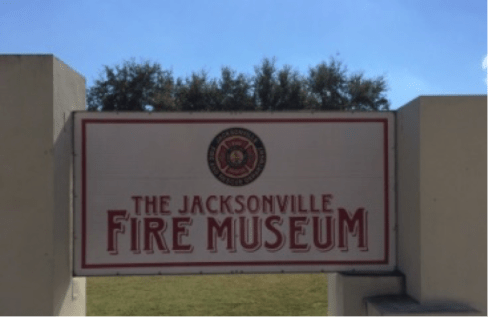
Now I worked my way back to I-95 and headed south to visit the Jacksonville Fire Museum, located in the Midtown area of Jacksonville.   This museum is located in the restored 1886 Fire Station #3, and displays artifacts and memorabilia related the evolution of the Jacksonville Fire Department from the 1850s.  This includes various hand operated, horse drawn, and motorized firefighting and rescue equipment, that have been used by Jacksonville firefighters over the years.


The Museum of Southern History located in the Fairfax area of Jacksonville was my next stop.  The museum was closed today; however, their website informs me that this museum depicts the lifestyles and cultures of the antebellum South.  The museum also covers the cultures of the early Florida Native Americans and those who settled Florida, with respect to the Civil War and more recent times.  As it happens, the Civil War Governor of Florida, John Milton, whose plantation site I had visited, near Marianna the other day, is also mentioned in this museum’s website write-up.


Now I headed a few miles west to visit the Norman Silent Film Studios Museum located in the Arlington area of Jacksonville.  This studio complex (museum) began as the “Eagle Film Studios” in 1906.  This was a typical example of the northern U.S. film studios wanting to be able to continue filming throughout the winter months. Between the years of 1908 & 1922, as many as 30+ northern film studios moved their operations here, where the area soon became known as the “Winter Film Capital of the World.” Richard E. Norman purchased the Eagle Film Studios in 1908, and moved his Midwest film operations to the Jacksonville area, where he renamed it the Norman Silent Film Studios.  Over the years the Norman Film Studios gradually declined as the Jacksonville film industry moved its operations to southern California in the 1930s.  Finally, after many years of very little activity, in about 2008, as part of an overall restoration project, one of the existing buildings was opened as the museum (Google Norman Silent Film Studios to see how the film studio has progressed over the years).


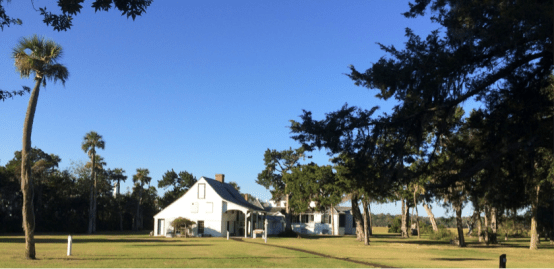
Next on the list, I travelled across town to visit the Kingsley Plantation, located in the Timucuan Ecological & Historic Preserve on Fort George Island.  This 1797 plantation house, and out buildings, are situated conveniently on the Fort George River, where the owner’s docks gave him access to all types of river traffic, and for his own needed supplies and crop transport. Zephaniah Kingsley was a slave trader and shipping magnate, and owned several plantations along the St. Johns River, by the time he became the third known owner of this plantation in 1814 (Google “Kingsley Plantation” for more interesting details about Zephaniah Kingsley and the Kingsley Plantation).


By now I was ready to head for the motel, and gave Greta (my Garmin) the address.  After leaving the Timucuan Ecological & Historic Preserve and St. George Island, I spotted the Sandollar Restaurant and decided to stop in for a seafood dinner with them.  That was a very good choice.  Their Fish Tacos were out-of-this-world good, and the view of Mayport across the St. Johns River, from my outdoor patio table, was beautiful and restful, with the soothing river sounds and the whole scene being painted golden by the setting sun.


—–To Be Continued—–


Bill is a retired Mechanical engineer living with his wonderful artist/writer wife, DiVoran, of 61 years in Titusville, Florida. He was born and raised in the Southwest, did a tour of duty with the U.S. Navy, attended Northrop University in Southern California and ended up working on America’s Manned Space Program for 35 years. He currently is retired and spends most of his time building and flying R/C model airplanes, traveling, writing blogs about his travels for Word Press and supporting his wife’s hobbies with framing, editing and marketing.  He also volunteers with a local church Car Care Ministry and as a tour guide at the Valiant Air Command Warbird Museum there in Titusville.  Bill has two wonderful children, two outstanding grandchildren, and a loving sister and her husband, all of whom also live in Central Florida, so he and DiVoran are rewarded by having family close to spend lots of quality time with.


Bill


One of Bill’s favorite Scriptures is:  John 10:10

Tying Flies

19 Feb

On the Porch

Onisha Ellis


i spent Monday, thinking about my Tuesday post. I was hoping to share something humorous, but it’s hard to find humor these days without a political spin. Monday evening I came across a posting by my North Carolina neighbor giving instructions on how to tie the CDC Carrot Nymph. My first thought was is he working for the CDC? (Centers for Disease Control) On second thought, I decided that carrots and nymphs probably weren’t disease related.

I knew my North Carolina neighbor, Gordon, was a fishing guide in the Smoky Mountains, but I had no idea he had a YouTube channel!

 What could be more fitting for a blog that celebrates the past and future than a post about the timeless art of tying fishing flies? According to  Fishing Museum  http:

“The first mention of fly fishing is in The Treatyse of Fishing with an Angle, published in 1496… . If you want to read more about The Treatyse visit the “origins” page“.


So, if any of our readers like fly fishing, here is one of my neighbor Gordon’s videos.


Should you be interested in a fly fishing trip in our beautiful Smoky Mountains, visit Gordon on his website for information.


TURNING STONES FLY FISHING

My Name Is: DiVoran

18 Feb

My Take

DiVoran Lites


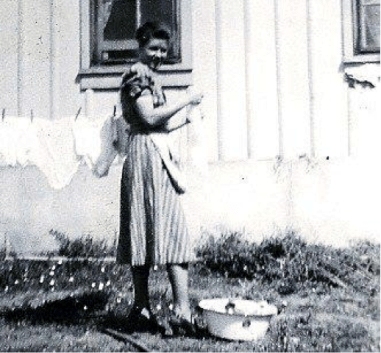
For most of my life, I’ve been explaining how I got my name. This is how it happened: My mother, Dora, and my father, Ivan, lived in Lovelock, Nevada where Daddy worked as a meat cutter for Safeway, and Mother worked at a laundry mostly patronized by miners.


One morning toward the end of her pregnancy she got up with so much energy, she thought she’d clean the coal-burning cook stove in the kitchen before she went to work.

While she cleaned she was thinking about her friend Walkama, who worked there too. Walkama had had a baby earlier. Her labor started while she was at work. I don’t know how her husband knew to come and get her, but he took her home, then she had the baby. Maybe some of the tribe’s women were with her, and in the same day, her husband brought her back. Dora had never heard of anything like that, and she knew she was going to have a very different experience with her child’s birth.

About the time Dora was ready to put the stove back together, her labor started. Ivan came home for lunch and walked Dora to the hospital a short distance away. Her labor commenced in earnest and by 4:00 P. M. I had arrived. She always said, “Just in time for tea.”

In those days white women were held at the hospital for two weeks to recuperate from the ordeal of having a baby. Given Dora’s enjoyment of work of all kinds, she had a long and probably boring time there. One startling thing happened though: on Halloween night three days after I was born, the radio program, “The War of the Worlds,” scared people half to death all over America.

The radio program was presented as a newscast about something that was happening right then. People all over America were scared out of their wits, including Dora. It was one of my birth stories.

The War of the Worlds https://www.youtube.com/watch?v=Xs0K4ApWl4g

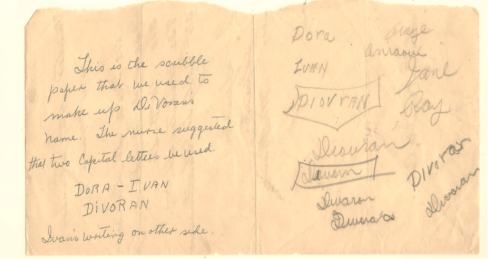
The story about my name went like this: toward the end of the two weeks, the nurse came into our room and told Mother and Daddy that they had to name me or they couldn’t have a birth certificate nor could Mother and baby go home. Now,this is what I think had happened. Daddy really wanted that boy and they must have had boy names picked out, but no names for girls. When the nurse saw that they were flummoxed, she suggested they put their two names together. They worked on it on a scrap of paper and finally came up with DiVoran, with two capitals, one from each of their names.


We left the hospital the day the birth certificate was issued. When we got home, Daddy had the stove all put together clean and shiny. The next day, Mother took me to work in a light-weight baby cot and Walkama, perhaps, carried her baby in a cradle-board on her back as they worked.

I was surprised and pleased to learn in later years that I was born on the Lovelock Paiute Indian Reservation where the town was located.

Author, Poet and Artist

DiVoran has been writing for most of her life. Her first attempt at a story was when she was seven years old and her mother got a new typewriter. DiVoran got to use it and when her dad saw her writing he asked what she was writing about. DiVoran answered that she was writing the story of her life. Her dad’s only comment was, “Well, it’s going to be a very short story.” After most of a lifetime of writing and helping other writers, DiVoran finally launched her own dream which was to write a novel of her own. She now has her Florida Springs trilogy and her novel, a Christian Western Romance, Go West available on Amazon. When speaking about her road to publication, she gives thanks to the Lord for all the people who helped her grow and learn.  She says, “I could never have done it by myself, but when I got going everything fell beautifully into place, and I was glad I had started on my dream.”