A Slice of Life
Bill LItes
The most challenging thing about boat duty on the Hector, was that when not in use, the boat crews had to keep all the boats tied off to the Boat 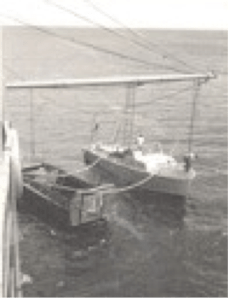 Boom, which was permanently attached to, and located, toward the aft portion of the ship. When a boat was required for any reason, the boat crew had to walk out on the Boat Boom to where their boat was tied-off, and go down the Jacob’s ladder to the boat. Then when they were done with the boat, they had to tie it off to the Painter Line, and climb up the Jacob’s ladder to the Boat Boom, and back to the ship. The first few times I had to do that, I had to walk very slow and it was very scary, since the 1”x 8” catwalk attached to the top of the beam, we had to walk on, was highly varnished, to protect it from the salty environment. This made it very slippery when wet, and I felt like I was “Walking the Plank” every time I went to or from the ship to a boat.
It didn’t take long for the routine to become quite boring, and with duty only every 4th day, we ended up spending a lot of time on liberty at the 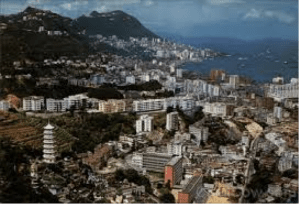 Enlisted Men’s Club or in Sasebo itself. Finally, after months of this routine, the ship made a trip to Hong Kong, to give the crew an opportunity to be exposed to other cultures of the world, and for a chance at some different scenery.
The city that I knew as Hong  Kong in 1957, was built into the hills surrounding it, and reminded me of the Mexican border cities of Juarez or Tijuana (except a lot cleaner & more beautiful), where a person could buy anything very reasonably. I bought a tailor-made Navy blue uniform and a beautiful Chinese Cheongsam silk dress for DiVoran for next to nothing, compared to what they would have cost in the states.
Tours of the island were very interesting and informative. At the time, one area I remember was the ancient Aberdeen Floating Village, sometimes called the “Sea of Dead Ships,” where many of Hong  Kong’s 60,000 boat dwellers lived. Here the boats had been tied so closely together, over so many years, that a person could step from one boat to the next, all the way across a portion of Aberdeen Harbor. The only boats that could get out of that mass, were the ones on the outer edge.
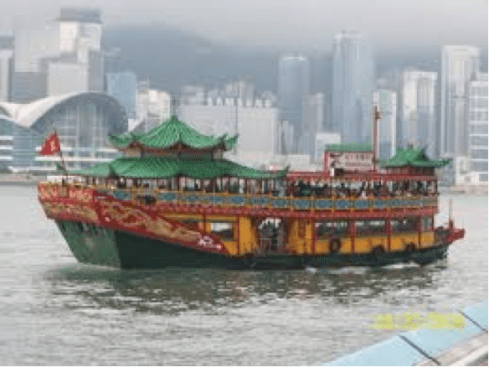
Located in Victoria harbor, were several large multi-deck floating restaurants, which served some of the most delicious authentic Chinese food I ever tasted. From the deck of the restaurant, it looked like one whole hillside was completely devoid of any vegetation and grey in color. When I asked about it, I was told that it was the “Pauper’s Burial Grounds”, where people with no money were buried, then after several years, their gravesite was dug up and another person would be buried there…and so on. That Chinese tradition must have been going on for centuries, involving an awful lot of people, to leave such a large scar on that hillside.
—–To Be Continued—–


 Base in San Diego, and assignment to the fleet repair ship, USS Hector (AR-7). The Hector was one of three sister ships stationed in the Far East, to service the U.S. Pacific Fleet’s ships. The three ships usually rotated their operations between the U.S. west coast and Japan. The Commodore, who headed the Navy’s Pacific fleet repair organization, maintained his headquarters on board each of the three ships as they rotated through the San Diego Naval Base, about every six months or so. Soon after I reported aboard, I learned, as an Engineman Specialist, I qualified for the vacant position as the Commodore’s driver. What a cushy job that was! I spent most of my duty hours cleaning his Navy staff car, running errands for him, and driving him to and from his many meetings ashore, as well as, to and from his home in town.
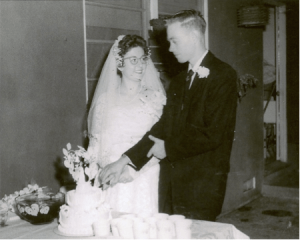 they returned to San Diego area so she could visit me. As she was leaving on that trip, her mother, Dora, had told her, “Now don’t do anything foolish while you are there.” Of course, once she got there, we decided it would be a good time to get married. Our mothers hurried out to California, made all the arrangements, and we did the deed on Labor Day weekend in La Mesa, California. DiVoran and I spent the next four months in marital bliss in our little one-room Balboa Park bungalow, located just five minutes from my work at the naval base.
  1932 Ford five-window coupe hotrod, and was in the process of restoring it in my spare time. The car had been chopped, channeled, and gutted for use as a dragster before I bought it, and had only one wooden bucket seat for the driver, bolted to the frame. Hey, it worked for me! The rear end had been locked, so when you went around a corner, the inside wheel burned rubber. DiVoran couldn’t reach the peddles, and complained, “This was not the kind of car she had expected her new husband to ask her to ride around in.” That was mainly because there was no seat for a passenger, and she had to ride on the plywood floorboard, with no backrest and no seatbelt. Also, she didn’t like having to ride the bus to get to work at the diner where she was waitressing,
  Mercury sedan. DiVoran could drive that car, and life was much more peaceful in our little love nest after that. When it was time for the Hector to leave for its six-month tour of duty in Japan, I took DiVoran and everything we owned, in that Mercury, back to Albuquerque, so she could stay with her parents, and attend beauty school while I was gone.

 Old Things R New