A Slice of Life
Bill Lites

Continuing north again, next we stopped at the tiny village of Hill Top, located close to Ambleside in Near Sawrey, in the English Lake District. Hill Top is the home of Beatrix Potter, who was the English author and illustrator, best known for her imaginative children’s books. Her books featured animals such as those in her first book, “The Tale of Peter Rabbit” written in 1902, and described the English landscape and the country life she knew as a child and loved so much. The small cabin where she wrote many of her books, is arranged with much of her original furniture, and surrounded with beautiful gardens.

DiVoran tells me that as a child, Beatrix was not allowed to play with other children, and spent the summers in the country with her brother. Nature became their favorite subject, and it was there that Beatrix taught herself to draw bunnies, hedgehogs, and the like. Later, when one of Beatrix’s brother’s children was ill, she wanted to send a message of cheer, so she wrote a story and illustrated it. And, that is how her career as a children’s author started. She was one of DiVoran’s favorite children’s story authors, and she read most of the 23 “Peter Rabbit” books to our children when they were young. As you can see from the picture below, DiVoran had to sit in that garden, and just imagine how wonderful it would be to live there and be able to write in such a beautiful and serene place.

When I was finally able to pull DiVoran away from Hill Top, we proceeded on north to our next stop, which was Keswick, England. As it happened, we got there on a Friday, and our hosts at the B & B informed us that the next day was “Market Day” in town. We were not able to partake of the wonderful fruits and vegetables, but we did have a grand time walking the streets with all the people, checking out the variety of shops, and enjoying the street minstrels (known as Buskers) who added to the festivities with their beautiful music.

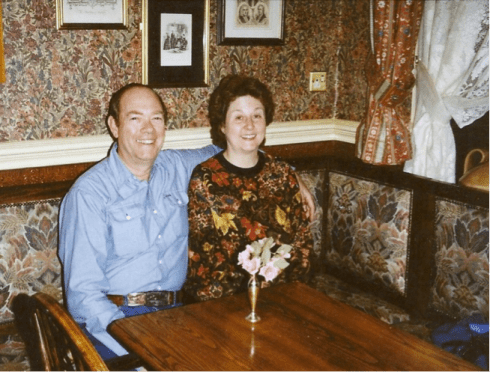
I believe it was in Keswick where we stopped in one of the local pubs for lunch, and they seated us in a small booth for two called a “Snug.” One of the problems we found in English pubs, was their meals were just too much food for us, so we tried to share as often as we could agree on a particular entre. This time we decided we would try one of the house specials, “Lancashire hotpot” which is a dish made traditionally from lamb or mutton, carrots and onions, topped with sliced potatoes, and then left to bake in the oven all day in a heavy pot, on a low heat. Kinda like our “Slow Cooker” or the ever popular “Crock Pot” that is one of the American working gal’s best friends. It was yummy!
As we headed North again, the next point of interest was Hadrian’s Wall, said by many to have stretched all the way across the north of England from Wallsend, on the River Tyne, west along the Cumbria coast to Bowness on-Soliday. Construction was begun by the Romans in 122 AD and, amazingly, was largely completed in six years. Construction was divided into lengths of about 5 miles, with one Roman Legion (4000-5000 men) excavating the foundations, building the milecastles and turrets. Then another legion would follow with the wall construction. There is no mention as to how many legions were required to build this 75-mile long project, but it had to have been several.

—–To Be Continued—–


 Old Things R New