Tag Archives: #Robots

Robots~Part 3

19 Mar

A Slice of Life

Bill Lites

Bill


I just read an article about a new micro engine that says scientists have built the “smallest petrol engine,” tiny enough to power a WATCH.  The mini-motor, which runs for two years on a single squirt of lighter fuel (they say), is set to revolutionize world power/energy technology.  It produces 700 times more energy than a conventional battery, despite being less than a centimeter long.  It is hard for me to imagine a motor small enough to run a laptop, much less a watch, being able to replace a battery, but that is what the article was saying could happen in the not too distant future.  Check it out on the Internet.

Inspired by colonies of insects such as ants and bees, researchers are modeling the behavior of “swarms” of thousands of tiny robots, which together perform a useful task, such as finding something hidden, cleaning, or spying (on who I wonder?).


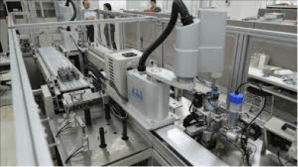
While most robots today are installed in factories or homes, performing labor or life saving jobs, many new types of robots are being developed in laboratories around the world.  Much of the research in robotics now is not focusing on specific industrial tasks, but on investigations into new types of robots, alternative ways to think about or design robots, and new ways to manufacture them.  It is expected that these new types of robots will be able to solve real world problems when they are finally realized. 
1

 Then there are the fears and concerns about robots that have been repeatedly expressed in a wide range of books and films.  A common theme in this genre is the development of a master race of conscious and highly intelligent robots, motivated to take over or destroy the human race.  Does any of that kind of paranoia sound familiar? 

2


Now, you know, I just started out to go on the Internet to check out a few things about “Robots” for my friend Leon, and now I have written a three-part (1250 word) blog about just some of what I found.  Who says the Internet is not a distraction?  Well, it sure can be one for me, as you can see.

3


—–The End—–

Robots~Part 2

12 Mar

A Slice of Life

Bill Lites
Bill


The military is developing unmanned combat air vehicles (UCAVs), which are an upgraded form of unmanned aerial vehicles (UAVs), that can perform a wide variety of missions, including combat.  UCAVs are now being designed which will have the ability to fly themselves, pick their own course and target, and to make most decisions on their own.  How scary is that?


Almost every unmanned space probe ever launched could be considered a robot of one type or another.   Those launched in the early 1960s were very limited in their abilities, but more recently their ability to fly, land, survey and take samples on foreign planets is an indication of the advancement of robotic technology.


Another example of the use of robotics is in the dairy industry.  I just received an email about the dairy farm in Fair Oaks, Indiana that uses computer assisted robotics to process (feed &  milk) their approximately 32,000 cows per day, to produce enough milk for 8 million people.  As part of the daily processing, a transponder that is attached to each cow, reads and records the amount and quality of the milk from that cow, as it is automatically milked.  Also, a pedometer is attached to each cow that records the distance the cow travels in each 24-hour period.


Due to the hazardous nature of mining operations, in particular underground mining, the prevalence of autonomous, semi-autonomous, and tele-operated robots has greatly increased in recent years.  A number of vehicle manufacturers provide autonomous trains, trucks and loaders that will load material, transport it from the mine site to its destination, and unload it without requiring human intervention.


Robots in healthcare have two main functions. Those which assist an individual, such as a person with a disability or a sufferer of a disease, and those which aid in the overall operation  and processing of such industries as pharmaceutical companies and many hospitals systems.


                                                                        —–To Be Continued—–   

Robots Part 1

5 Mar

A Slice of Life

Bill Lites

Bill

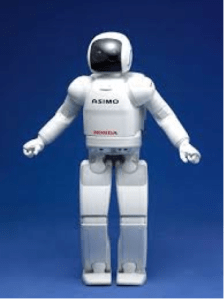
In a letter I received from my friend Leon the other day, he mentioned that he had gotten interested in “Robots & Droids.”  I had no idea where he was getting his information, since I knew he didn’t have a computer.  So, I decided to check out the internet to see what I might find there that might interest him.  WOW, was I surprised!   We are surrounded by robots, whether you realize it or not.  Wikipedia started off by saying, “A robot is a mechanical or virtual agent, usually an electro-mechanical  machine that is guided by a computer program or electronic circuitry.”  Then it went on for pages to describe all kinds of Robotics, Soft Robotics and Virtual Software Agents (otherwise known as Bots).

1


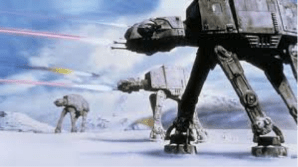
This immediately brought to mind the “Star Wars” movie series with all its robotics in action and living color.  Of course, there were the “Good” robots that were always there to help Luke Skywalker and his friends with whatever had to be done.  These robots were even lifesavers at times, giving up their vital parts for their owners.

2

 Then there were the “Bad” robots, coming (as it seemed) out of the woodwork, lead by the evil Darth Vader.  This guy was determined to get rid of the good guys and take over everything they had, not to mention the whole Galactic Empire.  Boy, did we enjoy watching the good guys defeat the bad guys for a change, even when they were bigger and badder that anyone could imagine.

3


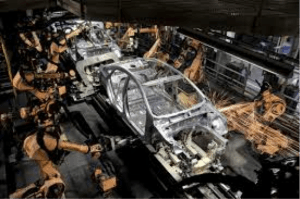
Then I thought about the trip to Alabama I made last year to see another friend.  On the way back I stopped in Montgomery, at the Hyundai plant, for a tour and, saw how the automobile industry is using computer assisted processing and robotics.  It was amazing to see how most of the heavy and dangerous jobs have been replaced by robots. 

4


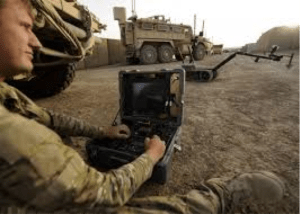
Of course there is the military use of  Teleoperated robots, or telerobots,  which are  devices remotely operated from a distance by a human operator rather than following a predetermined sequence of movements.  These units are being used for such dangerous jobs as bomb locating and disposal.

5


                                                                 —– To Be Continued—–