I am retired and enjoying life. My hobbies are my 5 grandchildren, son and daughter, and my loving husband. I am a photographer and extreme nature lover. I love spending time in my garden or in the wilderness connected to God my Creator.
In this post I hope to help you see and photograph abstracts. Since this is new for me too, many of the images are from the Internet for demonstration. Abstract photography is a challenge but there are some basic tips to get you started off in the right direction.
Believe it or not, your smart phone is the easiest way to take abstracts.
You can just hold up the screen and go on a search for cool close ups, walls, floors, architecture, nature, etc.. Most abstracts are seen by looking at a scene and getting closer and closer to it until you start seeing elements such as patterns, lines, shapes, colors and textures that photographed in a certain way (good composition) can make an appealing image.
Some of the best places to go to look for abstract opportunities are recreational places for kids. It’s always colorful with lines and boldness everywhere. Malls, tourist entertainment areas, gardens, etc are all places that surround you with possibilities.
You could just go around the house and use your phone as a frame and zero in on things that make it’s own little picture. We tend to see the entirety and the big picture of life. But looking at the world only through a tiny frame, gives you an entirely different perspective. If you imagine this grid inside your frame. This is an overlay grid in your camera that will appear on your screen. It will be in your menu. Or you can just imagine it over what you are photographing.
The idea is to place the most important features in your picture on one of the lines. Better yet, on one of the intersctions of the lines. You can hold this frame up to things letting your eyes only see within that frame. Turn your frame vertically, horizonally, diagonally. The idea is to see little miniture pictures within your frame.
There are no rules, but it is helpful if it has at least one of the items listed below.
The most important thing to remember is that after you find your point of interest, adjust your view of it by turning your frame in many directions until you find a good composition.
Composition takes some time to learn and feel, but basically it can be easy using a rule of thirds overlay from your camera or just imagine it over your scene.
Composition is one of the most important elements in any art form.
As well as being visually interesting, abstract photography can create a sense of mystery, making the viewer wonder what it is and whether there’s more to it than first meets the eye. But why you would want to create an image of something that the viewer won’t be able to immediately recognize?
The main purpose of abstract photography and art is to evoke some kind of emotional response from the viewer.
The viewer can create their own story about the image, based on their own reality, experiences and feelings.
Below are some other things to look for.
Look for Lines and Curves
Line and curves are going to give your viewer something to base their new meaning on and add visual interest. Without these shapes, your eye wouldn’t travel through and across the image. Lines have other uses too, like in visual design.
Go Macro.
As we get increasingly close to some subjects, the detail that was not apparent at regular viewing distance may emerge as an abstract photograph separate from the object photographed. Fill the entire frame with the subject, eliminating unwanted backgrounds which is essential for abstract photography.
Shoot Through Another Object
Abstract photography often makes use of objects and turn them into filters. Shooting through a glass bottle, a rain splattered window, or even water might give you just the distortion or light refraction you need to create a really interesting and truly abstract image.
Seek out Texture and Patterns
Emphasizing patterns is one way to take a picture of a normal object that is composed abstractly.
Abstraction by Movement
One way to reduce information, thus creating an abstract photograph is by using motion. This may be subject motion, photographer motion, camera motion, or a combination of any of the above. The easiest way to do this is to put your settings on scene mode landscape and take a picture moving the camera up and down, twirling around, back and forth, diagonally or wiggly is low light.
Choose Strong Shapes
Look for pleasing, interesting or dynamic shapes. They will add structure to your photograph and attract the viewer’s attention. Strong geometrical shapes with straight edges and angled corners will give your photo the most powerful visual impact. For a more subtle impact, choose softer organic shapes such as pebbles and flowers. Think about how to best capture the shape in the image and what angle to shoot it from.
Use Color To Grab Attention
Color is one of the first things that attracts the attention of the viewer, especially from a distance. It also serves to hold their attention for a longer period of time. Using highly saturated or intense colors is another way of grabbing the viewers attention. Contrasting colors will create dynamic photographs.
Look For Repeating Patterns
Emphasizing patterns is a great way of creating an abstract image out of an ordinary object. Using patterns can help to draw your eye around or into the image.
Photograph Reflections
Reflections in water or other shiny surfaces provide a fantastic source of abstract scenes to photograph. The distorted effects you get from rippled water or uneven reflective surfaces create an abstract alternative reality.
Most of all, have fun with your photography. It’s a rewarding hobby.
Next week will be a new adventure.
I am retired and enjoying life. My hobbies are my 5 grandchildren, son and daughter, and my loving husband. I am a photographer and extreme nature lover. I love spending time in my garden or in the wilderness connected to God my Creator.
I wasn’t sure what I was going to blog about next. I thought and thought about it. The next morning I was to go on a morning shoot to Lake Eola in downtown Orlando.
My friend and I set out to do some abstract photography of the buildings and water reflections. This is a new thing for us and an exciting one. So I decided that I would share this new interest with you. I have always loved abstract photography, but it is something that you have to be focused to see and do. You have to re-program your eyes to see differently. And we were ready.
Buildings
All photography works on an instinctive and subconscious level, but more-so with abstracts. When we look at these types of images we don’t necessarily have a rational response. The images are suggestive, sometimes shunning the logical and expected. They are mystifying rather than explanatory, unusual, quirky, idiosyncratic. Their uniqueness makes them very powerful and can engage our imagination very quickly.
The ocean/beach horizon at twilight.
Abstract photography is based on the photographers eye. We’re looking to capture something in a way that it would not usually be seen. Looking for the details, the patterns, the lines, the form, shape and colors that complete a subject and utilizing those key features to make an engaging image.
Sun lit palmetto leaf.
To capture an image in nature as an abstract, you don’t need any special equipment – just a camera, and the most importantly, your own imagination. What matters most is that your photograph reveals an eye-pleasing image, whether you can identify the actual subject or not. In fact it usually doesn’t have a subject. Only pleasing aspects that both calm and stimulate your mind.
Reflection in the water of a building.
If you want to try something different – the challenge of making something new out of something familiar couldn’t be better. Take an ordinary, everyday object in your home or yard and turn it into something of wonder and beauty.
Flower
You’ll never run out of subject matter. Imagine the possibilities – everything around you is potential material. You’ll uncover a whole new world. I love taking everyday objects and transforming them into something completely different and unrecognisable. It’s a great challenge to go beyond what we see and create an alternative view of the world.
Surface texture and color of an outdoor pottery flower pot.
There are no clear rules to abstract photography. The object of the photo may or may not be recognizable. Abstract images may contain a small portion of an object or multiple objects. An abstract will often concentrate on a limited area of a subject that reveals a shape, pattern, form, color or texture. Movement can also create abstract images, such as rushing water or the wind blowing a flower.
Tree landscape – the camera was moved up and down while the shutter was open.
Beach waves at twilight. the camera was moved back and forth horizontally while the shutter was open.
In the next weeks to come I will talk about abstracts in detail. I will try to help you see. This is a rewarding type of photography because you can simply use your phone or any camera. There are no rules and once you get the hang of it, it can be come an obsession. Next week “How to look at things differently and zero in on another world.
The bow of a boat and it’s reflection.
I am retired and enjoying life. My hobbies are my 5 grandchildren, son and daughter, and my loving husband. I am a photographer and extreme nature lover. I love spending time in my garden or in the wilderness connected to God my Creator.
Since people who love butterflies and would like to photograph them, are all at different skill levels, I am going to talk about two shooting methods. One for those who like to just point and shoot or use a cell phone and one for those who are advanced and like to shoot with manual controls.
First there are a few basic things that can greatly improve your butterfly pictures either way you shoot.
Take lots of pictures. When you find a butterfly, keep shooting until it flies away. This gives you the best odds of having at least one good one.
Start shooting from far away. Each step closer is a better and better shot.
Move in slowly as not to alarm the butterfly. You can crop later. Cropping is the finishing touch. There are a lot of simple software programs to use to crop, straighten, adjust exposure, sharpen and enhance. You can do this right in your camera in some models.
Getting a good sharp focus is one of the most difficult of achievements. Here are some tips to help with that:
The cameras now truly have artificial intelligence and usually do a great job. Most of the time, auto is a good choice, especially if you are doing a video clip. One thing I want to mention about videos is that no matter how good the video looks, if the camera is moving around, the video cannot be enjoyed. So be as steady as possible. Use a mono pod if you don’t have steady hands.
If you are taking still pictures, try using your macro mode (flower icon) if you can get close to a feeding butterfly on a flower. Some cameras can give you great closeups. You can even get a macro lens kit for your cell phone. They are not expensive and work pretty well.
If you are shooting a very active butterfly try using your scene mode – Action/Sports (or something similar)
Zoom in. Zooming in will help you get closer and also blur the background (shallow depth of field). It will also help the flash to be at a distance so it doesn’t wash out your subject. Zooming will also help you cut out distracting things surrounding your subject.
Use your flash. The more light the faster your shutter speed will be to stop motion. Check your shot and make sure the flash doesn’t white out your subject.
You can tape a little piece of white paper over your flash as a diffuser. This takes away the harshness of the flash and gives you soft light.
Using the flash in bright sunlight seems odd, but it helps to even out the light.
If a butterfly is in the sun and a shadow is next to it, position yourself so the shadow is behind the butterfly. Having a dark background will make the butterfly pop. Having a flower, nice greenery, distance (blurry background) or even the sky is also a nice background.
Sometimes instead of waiting for the perfect picture to just happen, you can create one.
Buy a nectar juicy potted plant (Milkweed, Penta, etc). After buying one, hose it down to remove pesticides and hydrate the plant. The more moisture, the more nectar. Find a nice background or shadow and place the plant there. The direction of the sun can help or hinder your shot.
Check out how the light looks.
It’s best to position the plant so light is coming from behind you. Have your camera on a tripod, bean bag or a secure place to set the camera. Have everything lined up and ready, and wait for your subject to land. Have a drink, a snack and some patience handy.
Here is my little secret.
Put a drop of red Gatorade on the flower. Once your subject discovers it, it should stay a while as most butterflies love it, giving you a perfect photo op. Keep shooting until it flies away.
Handholding the camera is probably the easiest way to shoot, but harder to get sharp pictures unless you have a steady hand. Just before you push the shutter button, watch the screen to detect any movement, hold your breath and gently, without moving the camera, press down on the shutter button. Try not to let the camera move downward as you press. Re-focus (press shutter button half way down) and shoot again. Keep camera as still as possible. Repeat, repeat, repeat.
Butterflies are cold blooded and need the warmth of the sun to allow it’s body to move freely. It will sit and wait to not only warm up, but to dry out from the morning dew. This may be a good opportunity to check the bushes for one. They will be sleepy and sluggish. You may even get one with some dew drops.
Shoot butterflies at different angles. Shoot them at eye level or slightly below. This reveals it’s face and body. It is more personal and shows more detail of it’s eyes and personality. Or shoot straight down and wait for it to open it’s wings to see color and patterns. Shoot a wide scene showing flowers and landscape as part of the picture.
There are many butterfly conservatories around Florida. This is such a fun opportunity to get many kinds, colors and shapes of butterflies. The light inside is usually diffused and butterfly subjects are everywhere. Look online for the one nearest you.
Truly the very best pictures you will ever get is when the butterfly first emerges from it’s chrysalis and sit’s pretty, waiting for it’s wings to dry. You can have your way with them and get stunning pictures.
Advanced shooting with DSLR (Digital Single Lens Reflex) camera with interchangeable lenses
Control your shutter speed: Your shutter speed are exposure settings that determines how quickly a photograph is taken. There are different ways of doing that. I prefer these camera settings that have worked out the best for me.
ISO – at least ISO 400. If your camera can handle noise well, you can use ISO 640-800. If the exposure is too bright go back to ISO 400.
Aperture – f6.3 – f8
focus – single point focus
Metering – SPOT meter is very important. This will allow you to pinpoint exposure of just the butterfly. You can even shoot into the sun with the spot meter on the butterfly. It makes a unique back lit image. Use your diffused flash to brighten it’s body, or no flash to create a silhouette image with a silver lining.
Light – Use a diffuser over the flash. Try setting your flash to high, but adjust your exposure compensation to -3. This will lessen the brightness on the butterfly and darken the background. Zooming in will also help soften the harshness of the flash. Try using a light ring. This works best with a captured butterfly. You can buy a light box. Set up your scene and put your butterflies in. This is for crazy must get a perfect shot people like me. haha
Photographing butterflies can be addictive. You must have patience and though you don’t have to have special equipment to get good butterfly pics, having the right equipment can greatly improve your pictures if you have a passion for butterflies and you are going to be taking a lot of them.
Below is an educational video I made to ID many Florida butterflies photographed in my yard and Oviedo Lucas Butterfly Conservatory.
I am retired and enjoying life. My hobbies are my 5 grandchildren, son and daughter, and my loving husband. I am a photographer and extreme nature lover. I love spending time in my garden or in the wilderness connected to God my Creator.
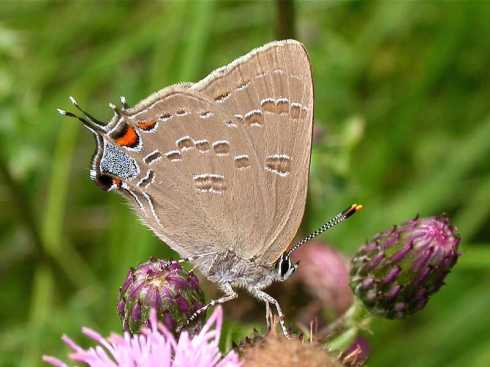
The Gray hairstreak (Strymon melinus) is one of the most common lycaenids in North America. Its larvae feed on the fruits and flowers of a variety of host plants including several species. Gray hairstreaks do not prefer one specific habitat. They are widespread in tropical forests and open, temperate woodland areas. They can also be found in meadows, crop fields, neglected roadsides, and residential parks and yards are often homes of this fascinating and rare butterfly. Its larvae feed on the fruits and flowers of a variety of host plants including several species mallows, members of the pea family, buckwheats, clovers, and many other plants.
In Florida, the most common hairstreaks are the “Gray Hairstreak”
The adults are quick fliers and are seen most often between the months of May and September. The larvae of gray hairstreaks, when abundant, can become pests to commercial crops, including cotton, beans, corn, and hops.
Habits such as these have earned the caterpillar the common name of “cotton square borer” and “bean lycaenid”. However, I love spotting Hairstreaks in the garden.
The are small and fly fast, but once you focus your eyes on them you’ll see their delightful display of confusing preditors, by rubbing their hind wings together in the typical fashion of most hairstreaks.
This back-and-forth movement makes the tail like extensions on the hindwings look like anntennae, apparently to fool predators into attacking a less vital part of their body. They like to bask in the sun with their head down and hindwings up with it’s false antenae in motion. Below are two videos showing the motion of the wings.
Another very different looking hairstreak is the “Atala” butterfly (Coontie Hairstreak) Scientific name: Satyrium pruni
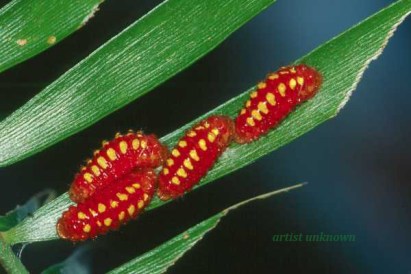
Some hairstreaks don’t have tails like the gray hairstreak butterfly. The Atala butterfly is also called the Coontie butterfly because the Coontie plant is it’s host plant.
Sunshine State gardeners have rediscovered the Florida coontie as a native plant well adapted to Florida yards. Its increased use in landscapes has encouraged the presence of the rare atala butterfly. This is such a beautiful and unusual looking butterfly. Even the caterpillars are unusual looking. To me they look like pretty gummy candy.
There are many many different hairstreak butterflies in Florida, some common, some rare and many endangered.
Next week we will look at a few more butterflies and a few more ways to photograph them , then off to another adventure. I’m not sure what yet, but it will be a surprise to even me.
I am retired and enjoying life. My hobbies are my 5 grandchildren, son and daughter, and my loving husband. I am a photographer and extreme nature lover. I love spending time in my garden or in the wilderness connected to God my Creator.
I have moved the Hairstreak butterflies to next week. I thought it would be a good idea to show you some dangerous moth caterpillars before we move on, since we talked about harmless Florida moths last week. Most are harmless, but there are some Florida moths that can cause severe pain and possible reactions. Many caterpillars have hairs or spines. Some contain poison glands. In contact with human skin, they can cause pain, rashes, itching, burning, swelling, and blistering like this puss moth caterpillar.
Avoiding caterpillars with hairs or spines is best.
To treat a caterpillar exposure:
1. If the caterpillar is on the skin, remove it without using your hands!Gently put tape over the exposed area, sticky side down. (Any kind of tape will do.)
2. Pull up the tape, removing the hairs or spines.
3. Repeat with fresh pieces of tape as often as needed to treat the area involved.
4. Wash the area gently with soap and water.
5. If the area itches, put on a paste of baking soda and water.
Use ice pack to reduce swelling.
6. If that doesn’t help, try Zanfel Benadryl or a hydrocortisone cream.
7. If that doesn’t help, try an antihistamine cream. That shouldn’t be the first choice, as it doesn’t always help. Also, some people have skin reactions to these creams.
8. If the area is badly blistered, contact your health provider.
9. Call your health provider about a tetanus booster if your shots are not up to date.
The southern flannel moth, Megalopyge opercularis is an attractive small moth that is best-known because of its larva, the puss caterpillar, which is one of the most venomous caterpillars in the United States. The southern flannel moth (puss caterpillar) is found from New Jersey to Florida and west to Arkansas and Texas. It is common in Florida but reaches its greatest abundance in Texas from Dallas southward in the western central part of the state. Found on Oaks and citrus.
Buck Moth found on Oak and Willow.
The adult buck moths have a flight period that occurs between October and November. as late as December in Florida. The adults are active during the day and are very quick fliers, and can be found flying most commonly between noon and 2:00 pm in oak forests during sunny weather
Lo Moth
Lo Moth found on Ixora and rose. Adult moths are strictly nocturnal, flying generally only during the first few hours of the night.
Saddleback
Saddleback caterpillar and moth. Host plants are many plants, vegetables, flowers, citrus, maples, oaks, and blueberries.
Spines can become airborne and consequently be inhaled or contact sensitive tissues like the eyes and nose.
Spiny Oak Slug
Spiny Oak-Slug Host plants – Oak and willow, apple, blueberry, sycamore and more. caterpillars seen from late June to October.
Tussock
A large caterpillar 1-3/4 to 2-1/4 inches. Stinging hairs are intermixed with soft hairs in diffuse tufts. Host plants – Oak, willow and deciduous plants.
I love spotting Hairstreaks in the garden. They are small and fly fast, but once you focus your eyes on them you’ll see their delightful display of rubbing their hindwings together in the typical fashion of most hairstreaks. It’s mesmerizing. This back-and-forth movement makes the moving appendages on the hind wings look like anntennae, apparently to fool predators into attacking a less vital part of their body. They like to bask in the sun with their head down and hindwings up with it’s false antenae in motion.
Please join me next week. We will look at the Hairstreak butterflies.
I am retired and enjoying life. My hobbies are my 5 grandchildren, son and daughter, and my loving husband. I am a photographer and extreme nature lover. I love spending time in my garden or in the wilderness connected to God my Creator.
Moths are insects that belong to the order Lepidoptera. They are less-colorful cousins of butterflies. There are more than 150.000 species of moths that can be found around the world. Moths inhabit forests, fields, meadows, agricultural fields and human settlements. In most parts of the world, moths are classified as pests because they destroy commercially important types of fruit and crops.
Interesting Moths Facts:
Moths can be small as pinhead or large as the hand of adult man. Their wingspan ranges from 0.11 to 12 inches.
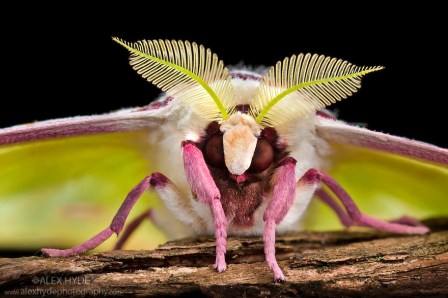
Moths are active during the night and their bodies are usually dark colored (they blend with darkness of the night). Moths have feathery or filament-like antennas on the head. Antennas are equipped with scent receptors that facilitate finding of food and partners. Moths are able to detect females that are 7 miles away thanks to exceptional sense of smell.
Indian Moon Moth / Indian Luna Moth {Actias selen} head-on view showing feather-like antennae. Captive insect.
Moths have long, curled tongue designed for diet based on nectar, fruits and berries.
Moths are important pollinators of various plant species. They use moon, stars and geomagnetic field to navigate during the flight. Moths are important source of food for the birds, mammals, amphibians, reptiles and numerous invertebrates. Even people in some parts of the world consume moths as valuable source of proteins and minerals.
Moths use several strategies to distract predators. Some secrete repelling fluids like this Leopard moth below. It’s larvae is also equipped with spines for protection.
Moths produce from 40 to 1.000 eggs in a lifetime. Eggs hatch after few days or couple of months (eggs of some species remain dormant during the winter and hatch at the beginning of the spring). Females reproduce only once in a lifetime, while males can mate a couple of times.
Larva (caterpillar) lives from few weeks to couple of months. It usually eats plant material, wool, silk or even other insects. Fully grown larva encapsulates itself in the cocoon and transforms into adult moth. They are usually found in dirt or plant debris in the ground.
Adult moths live from 1 to 4 weeks. Males have longer lifespan than females.
The Sphingidae are a family of moths (Lepidoptera), commonly known as hawk moths, sphinx moths, and hornworms; it includes about 1,450 species. These moth species are found in every region. They are moderate to large in size and are distinguished among moths for their rapid, sustained flying ability. Their narrow wings and streamlined abdomens are adaptations for rapid flight.
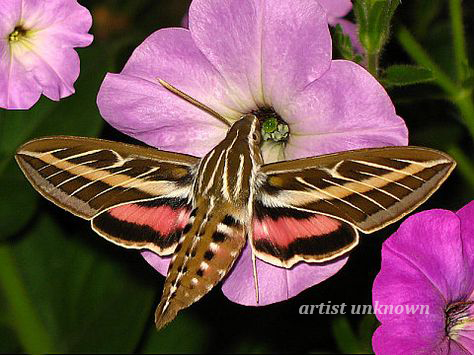
Some hawk moths, such as the hummingbird hawk-moth or the white-lined sphinx, hover in midair while they feed on nectar from flowers, so are sometimes mistaken for hummingbirds. The hummingbird moths are among the fastest flying insects on earth. These moths can fly at over 12 miles per hour.
A hummingbird moth! Yes, you read that right―a moth that resembles a hummingbird to the minutest detail, yet does not even fall into the same species.
❖ Like hummingbirds, these moths can sustain flight for as long as they need to feed and can move sideways and backwards.
❖ It is also interesting to note that the hovering of some like this Sphinx Moth cause a humming sound like a hummingbird.
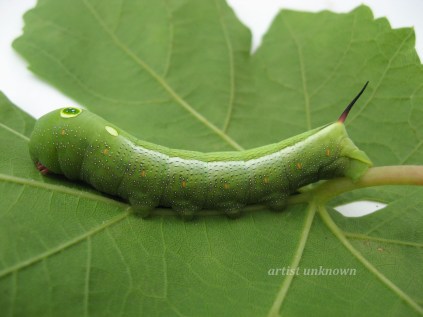
Some hummingbird moth larvae are large with stout bodies, and called tomato worms or horn worms. . They have five pairs of prolegs and most species have a “horn” at the posterior end. They are seldom welcomed, but adult moths are very beneficial.
Some caterpillars fall prey to the braconid wasp that lay their eggs on the moth larvae and feeds the wasp hatchlings with it’s life.
Moths primarily hide during the day and emerge at dusk or during the early morning hours. This is when I see them in the garden. Luna, Atlas and Prometheus are species of moth that do not have a mouth.
They have short lifespans and their only purpose is to reproduce and lay eggs. Moths are important pollinators of various plant species. Below is a surprising moth. The polka dot wasp moth.
The species is also called the Oleander Moth after the Oleander plant, from which its young feed. Like most wasp moths, these moths are day fliers. It looks like a very dangerous wasp, but in fact is a harmless moth.
The caterpillars are orange or dark orange with long black hairs. The caterpillars look dangerous too, but the setae do not inflict any harm.
Next week we’ll return to butterflies. We will start with a delightful species of little butterflies called Hair Streaks.
I am retired and enjoying life. My hobbies are my 5 grandchildren, son and daughter, and my loving husband. I am a photographer and extreme nature lover. I love spending time in my garden or in the wilderness connected to God my Creator.
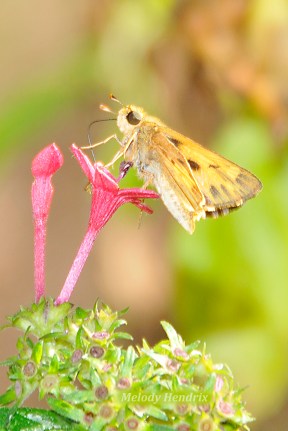
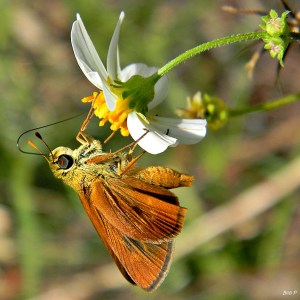
Skippers are a family, Hesperiidae, of the Lepidoptera (moths and butterflies). “Are Skippers butterflies or a moths?”
They fly during the day like butterflies, but have some characteristics that seem to set them apart from other butterflies. Scientists have generally compromised by declaring skippers to be a third category, somewhere between butterflies and moths.
Being diurnal, they are generally called butterflies. Their host plants are those in the legume family, so a vegetable gardener may occasionally find these caterpillars on their green beans or peas. You will find them on Beggar ticks (Bidens). A very common and important wildflowers. Also known as Spanish needles and tickseed.
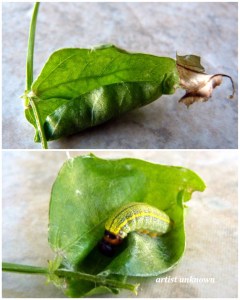
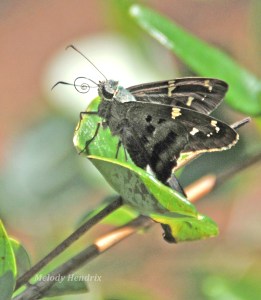
Long-tailed skipper caterpillars are “leaf-rollers” – they take shelter inside leaves by using silk to draw the leaf around them. Caterpillars make a nest out of a leaf or leaves and spend their time in the nest when they are not eating.
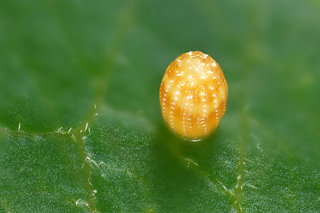
When they lay eggs,
they sometimes make stacks of their eggs when laying on their host plants!
Worldwide in distribution, skippers are richest in the tropics. More than 3,500 species are described, with approximately 275 in North America, many of which are found only in Arizona and Texas. Most skippers are small to medium, usually orange, brown, black, white, or gray. A few have iridescent colors.
Skippers have large eyes, short antennae (often with hooked clubs), stout bodies, and three pairs of walking legs. Their flight is often rapid, making wing movement appear blurred. Adults of most species have long probicscises and feed on floral nectar, but some also take up nutrients from bird droppings. Males have scent scales found in modified forewing patches.
Butterflies, moths, skippers; really… what is the difference?
The answer would primarily be the antennae. Butterfly antennae are thin with knobs on the tips most of the time while skippers have hooked ends instead of knobs.
The order Lepidoptera consists of approximately 265,000 species of butterflies and moths worldwide and only about 7.5% of them are butterflies. Moths are much more abundant than butterflies, but, why is it that we notice more butterflies? This is easy to answer. Many moths are nocturnal, they are active at night. We notice butterflies more often because they are usually more colorful and active during the day as they visit our flowers and gardens on a regular basis. But, there are actually more day flying moths than there are butterflies.
The colors displayed on butterfly wings can be any color imaginable. But when you think of a moth, you think browns, tans, and dull colors.There are many moths that have beautiful bright colors and butterflies that are dull brown for camouflaging.
Next week we’ll look at some strange and lovely moths you may have seen in your garden.
I am retired and enjoying life. My hobbies are my 5 grandchildren, son and daughter, and my loving husband. I am a photographer and extreme nature lover. I love spending time in my garden or in the wilderness connected to God my Creator.
The Heliconinae are “longwing butterflies”, which have long, narrow wings compared to other butterflies.
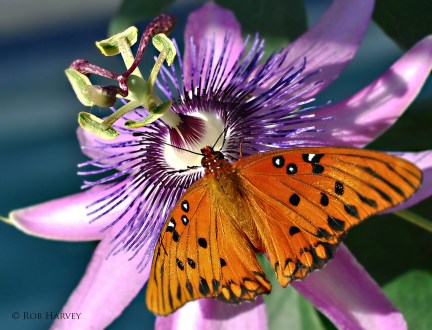
Gulf Fritillary butterflies are orange with black spots. The underside of their wings are covered with orange scales with large patches of silver scales. In its adult form, the gulf fritillary is a medium-sized butterfly that has extended forewings and a wingspan range of 2.5 to 3.7 inches. Gulf Fritillary butterflies are found in the lower half of the United States.
Adult butterflies use Lantana and passionvine blossoms (Maypop) as their main nectar and food source whereas the Passiflora plants (passionvine) serve as the main resource for egg laying and foodplants for the larvae.
Eggs are laid singly on or off the plant. Eggs are yellow when freshly laid and turn a rusty color before they hatch.
Caterpillars are orange with black spikes. Sometimes they will have gray stripes down their sides. The spikes cannot harm anything.
Caterpillars molt (crawl out of their old cuticle/skin) four times before they to pupate. Because a caterpillars’ cuticle doesn’t grow, it can only stretch to a certain point before it is essential for the caterpillar to shed/molt its old cuticle.
After molting, its new spikes are blond until they dry black. It is not unusual for a caterpillar to crawl off its host plant to molt. Adult butterflies emerge from the chrysalis, in the middle of the summer, about nine days after pupating.
Male and female only have slight differences in appearance. Females are larger than the males. Males have brighter orange colored wings than females. Females are usually darker in color and are more marked with black streak.
The general process for a typical courtship interaction begins when a male flies and lands near a perching female, who is most likely perched on a host plant. Once the male has landed, the male assumes a position next to the female with their heads together and with their bodies aligned at a 45-degree angle. At this time, the male engages in a specific action called the wing clap display in which the male continuously claps its wings open and closed. During this time, the antennae of the female are placed between the opening and closing wings. After the male ceases wing movement, the male butterfly will move into a mating position. Butterflies and moths belong to the order Lepidoptera and all members have scales covering their bodies and wings. Color results from an interaction between light and matter.
Hey, thanks for visiting us butterflies. There are lot’s more butterflies I want you to enjoy, but next week I want to show you something a little different. Something you may have never noticed. SKIPPERS They are little half butterfly, half moth cuties. They are small and fly so fast they are a blur and hardly get noticed. But they are so adorable, I know you will like them. See ya next week.
I am retired and enjoying life. My hobbies are my 5 grandchildren, son and daughter, and my loving husband. I am a photographer and extreme nature lover. I love spending time in my garden or in the wilderness connected to God my Creator.
The giant swallowtail, Papilio cresphontes Cramer, is a striking, wonderfully “exotic”-looking butterfly that is abundant in Florida.
It is the largest butterfly species in the United States and Canada with a wingspan within the ranges of 4 to 6 inches. The wings are colored black or blackish brown and feature yellow banding on both the fore and hind wing dorsally. Each hind wing tail features a yellow-orange colored eye, the eye can also appear reddish yellow. Another single blue band can be distinguished above the eye. Distinction between males and females is very difficult as both sexes are similar, however, females feature longer wing spans than males as adults. The larval or caterpillar stage is very large and can be considered a pest due to its habit of feeding on the foliage of most Citrus species. They are refered to as “orangedogs” A few can quickly defoliate small or young plants. However, larvae can be tolerated on large dooryard citrus trees in order to enjoy the soon-to-develop magnificent adult butterfly stage
The giant swallowtail is widely distributed throughout the American continent. Its range extends from southern New England across the northern Great Lakes states, into Ontario, through the southern portions of the Central Plains to the Rocky Mountains. The species ranges southward to Florida and the Caribbean, into the southwestern United States, and on through Mexico to Central and South America.
The giant swallowtail is very common throughout the entire state of Florida. It is active throughout the year in southern Florida, and is common in northern Florida, except in January and February. The giant swallowtail is very distinct from all other swallowtails found in Florida.
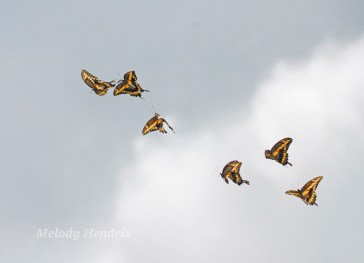
Adult butterflies sip nectar from many flowers and are common, but spectacular, visitors to butterfly gardens. Identified nectar sources include azalea, bougainvillea, Japanese honeysuckle, goldenrod, dame’s rocket, bouncing Bet, and swamp milkweed. They may also sip liquid from manure. A collective name for a group of butterflies is called a ‘Kaleidoscope.
Adult males patrol flyways through pine woods or citrus groves searching for females. Flight is very strong and leisurely, and the butterflies may glide long distances between wing beats.
Courtship and copulation occur in the afternoon.
The five larval instars stages differ in appearance but they all share a resemblance to bird droppings. Younger instars are more realistic bird-dropping mimics due to their smaller size. Mature larvae usually rest on stems or leaf petioles, but younger larvae often rest in plain view on the upper surfaces of leaves where bird droppings would be expected. Below is a newly hatched larva of the giant swallowtail, Papilio cresphontes Cramer. They are refured to as “CATS”in this fuzzy instar stage.
Larvae defend themselves against predators (both insects and vertebrates) and parasitic insects by being less visible through cryptic coloration and pattern like resembling bird droppings.
The larvae possess an osmeterium, an orange or reddish Y-shaped eversible gland that is located mid-dorsally behind the head. When attacked by small predators, the larva extrudes the gland and attempts to wipe it against the attacker. The osmeterium of fourth and fifth instars contains a highly noxious, pungent mixture of chemicals.
The top photo, the caterpillar just shed it’s last skin and attached itself to a stick with silk and sling.
Below it has become a hardened chrysalis and will go through metamorphasis for about 10 days before emerging into a beautiful butterfly.
Below is a newly emerged Giant Swallowtail. Wings inflated but not dry. Before the wings totally dry, this is a perfect opportunity to effortlessly take beautiful butterfly photos.
Take your photos when there is plenty of light. Shoot many different angles. Use a flash when the sun is behind the butterfly. Otherwise, best with natural light. I will talk more about photographing butterflies later.
Next week we will explore the Gulf Frittilary butterfly.
I am retired and enjoying life. My hobbies are my 5 grandchildren, son and daughter, and my loving husband. I am a photographer and extreme nature lover. I love spending time in my garden or in the wilderness connected to God my Creator.
(C) Copyright 2012-2024 Old Things R New All rights reserved. This website is an Amazon affiliate and the income from sales helps to defray the cost of running the site.









 The adult buck moths have a flight period that occurs between October and November. as late as December in Florida. The adults are active during the day and are very quick fliers, and can be found flying most commonly between noon and 2:00 pm in oak forests during sunny weather
 Lo Moth found on Ixora and rose. Adult moths are strictly nocturnal, flying generally only during the first few hours of the night.
 Saddleback caterpillar and moth. Host plants are many plants, vegetables, flowers, citrus, maples, oaks, and blueberries.



















 Old Things R New