A Slice of Life
Bill LItes

Back on the Hector, the ship headed west, and after an uneventful week at sea, our first stop on the way to Japan was Honolulu, Hawaii, to refuel the ship and to spend a few days enjoying that beautiful tropical paradise.  Honolulu was everything the travel brochures advertise it to be. That was a marvelous time, with swimming, snorkeling, surfing, touring, and an occasional wonderful and delicious evening luau, with lots of pretty hula dancers.
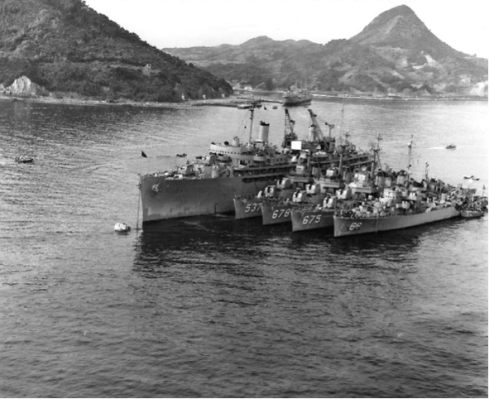
Then it was another week at sea before we arrived at our destination, Sasebo, Japan, where, for the next six months, we were scheduled to swing around a buoy in the harbor, servicing any Pacific fleet Navy ship needing the type of repairs not extensive enough to require a shipyard. The USS Jason (AR-8), the sister ship we were relieving, had her steam up and was ready to head back to California when we arrived. There was a brief “Changing of the Guard” ceremony, then the Jason was gone, and we began the work for which the ship had been designed.
My duty on the Hector, while it was on station in Japan, was as a diesel engine mechanic. This task kept me busy repairing and overhauling the  many boat engines used by the ship, as well as boat duty. Since we were tied up to a buoy in Sasebo harbor, anyone needing to leave the ship to go anywhere (ship to ship, or ship to shore) had to go by boat. There was the Captain’s Gig, used by the Captain and the other ship’s officers, and the Liberty Launches, used to transport the ship’s enlisted personnel and for every other task know to man. The three-man crew for each boat consisted of a Boatswain’s mate, a Quartermaster and an Engineman. This meant the ship had to supply enough three-man crews to man all the boats the ship might have in the water at any one time, and still maintain adequate shipboard operations.
When ships would tie up alongside the Hector for repairs, our ship’s boats would normally provide transportation for their personnel, as well as our own. Since the four-ship destroyer squadrons usually traveled together, we could sometimes have as many as eight ships tied up alongside at one time. As might be expected, this kept us very busy with boat runs, transporting people, equipment and supplies to and from the ship and the base, 24/7. One big surprise at Sasebo, during our stay there, was the day the Fleet Tug USS Tawasa (ATF-92) came along side the Hector, and there was my high school friend, Jim, from Albuquerque. We had a great visit and both remarked what a small world it was, that we should run into each other on the other side of the world from where we had first become friends.
—–To Be Continued—–


 Old Things R New